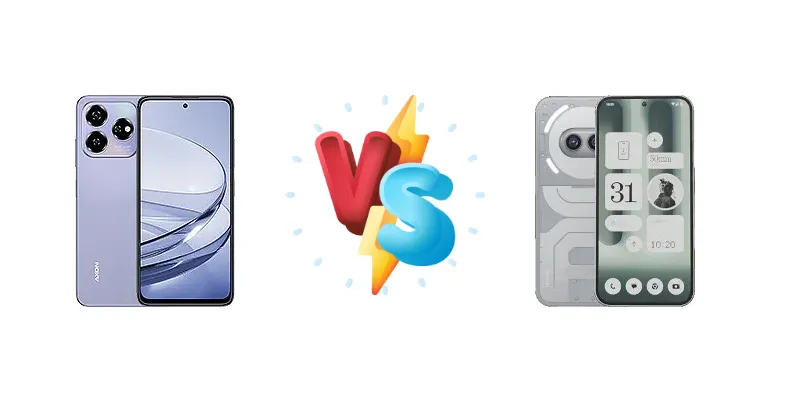
The mid-range smartphone market is fiercely competitive, and the ZTE Axon 60 and Nothing Phone (2a) Plus represent distinct approaches. The Axon 60 prioritizes affordability, while the Nothing Phone (2a) Plus aims to deliver a more premium experience with faster charging and a brighter display. This comparison dissects their core components to determine which device offers the best value for your money.
🏆 Quick Verdict
For most users, the Nothing Phone (2a) Plus is the superior choice. Its Mediatek Dimensity 7350 Pro chipset and 50W charging significantly outperform the ZTE Axon 60’s Unisoc Tiger T616 and 22.5W charging. While the Axon 60 is cheaper, the performance and convenience gains of the Nothing Phone (2a) Plus justify the price difference.
| Network |
|---|
| 2G bands | GSM 850 / 900 / 1800 / 1900 | GSM 850 / 900 / 1800 / 1900 |
| 3G bands | HSDPA 850 / 900 / 1900 / 2100 | HSDPA 800 / 850 / 900 / 1700(AWS) / 1900 / 2100 |
| 4G bands | 1, 3, 5, 7, 8, 20, 28, 38, 40, 41 | 1, 3, 4, 5, 7, 8, 18, 19, 20, 26, 28, 38, 39, 40, 41, 42, 66 |
| 5G bands | - | 1, 3, 5, 7, 8, 20, 28, 38, 40, 41, 66, 77, 78 SA/NSA |
| Speed | HSPA, LTE | HSPA, LTE, 5G |
| Technology | GSM / HSPA / LTE | GSM / HSPA / LTE / 5G |
| Launch |
|---|
| Announced | 2024, May 07 | 2024, July 31 |
| Status | Available. Released 2024, May | Available. Released 2024, August 03 |
| Body |
|---|
| Build | - | Glass front (Gorilla Glass 5), plastic frame, plastic back |
| Dimensions | 166.3 x 77.2 x 8.2 mm (6.55 x 3.04 x 0.32 in) | 161.7 x 76.3 x 8.5 mm (6.37 x 3.00 x 0.33 in) |
| SIM | Nano-SIM + Nano-SIM | Nano-SIM + Nano-SIM |
| Weight | - | 190 g (6.70 oz) |
| Display |
|---|
| Protection | - | Corning Gorilla Glass 5 |
| Resolution | 1080 x 2400 pixels, 20:9 ratio (~392 ppi density) | 1080 x 2412 pixels, 20:9 ratio (~395 ppi density) |
| Size | 6.72 inches, 109.0 cm2 (~84.9% screen-to-body ratio) | 6.7 inches, 107.5 cm2 (~87.1% screen-to-body ratio) |
| Type | IPS LCD | AMOLED, 1B colors, 120Hz, 2160Hz PWM, HDR10+, 700 nits (typ), 1100 nits (HBM), 1300 nits (peak) |
| Platform |
|---|
| CPU | Octa-core (2x2.0 GHz Cortex-A75 & 6x1.8 GHz Cortex-A55) | Octa-core (2x3.0 GHz Cortex-A715 & 6x 2.0 GHz Cortex-A510) |
| Chipset | Unisoc Tiger T616 (12 nm) | Mediatek Dimensity 7350 Pro (4 nm) |
| GPU | Mali-G57 MP1 | Mali-G610 MC4 |
| OS | Android 13 | Android 14, up to 3 major Android upgrades, Nothing OS 3.0 |
| Memory |
|---|
| Card slot | microSDXC (dedicated slot) | No |
| Internal | 256GB 6GB RAM, 256GB 8GB RAM | 256GB 8GB RAM, 256GB 12GB RAM |
| Main Camera |
|---|
| Dual | - | 50 MP, f/1.9, 24mm (wide), 1/1.57", 1.0µm, PDAF, OIS
50 MP, f/2.2, 114˚ (ultrawide), 1/2.76", 0.64µm |
| Features | LED flash, HDR, panorama | LED flash, panorama, HDR |
| Triple | 50 MP, f/1.8, (wide), PDAF
2 MP (macro)
Auxiliary lens | - |
| Video | 1080p@30fps | 4K@30fps, 1080p@60/120fps, gyro-EIS |
| Selfie camera |
|---|
| Features | - | HDR |
| Single | 32 MP, f/2.0, (wide) | 50 MP, f/2.2, (wide), 1/2.76" |
| Video | 1080p@30fps | 4K@30fps |
| Sound |
|---|
| 35mm jack | Yes | No |
| Loudspeaker | Yes | Yes, with stereo speakers |
| Comms |
|---|
| Bluetooth | 5.2, A2DP, LE | 5.3, A2DP, LE |
| NFC | Yes (market/region dependent) | Yes, 360˚ |
| Positioning | GPS, GALILEO, GLONASS | GPS, GALILEO, GLONASS, BDS, QZSS |
| Radio | FM radio | No |
| USB | USB Type-C 2.0, OTG | USB Type-C 2.0, OTG |
| WLAN | Wi-Fi 802.11 a/b/g/n/ac, dual-band | Wi-Fi 802.11 a/b/g/n/ac/6, dual-band, Wi-Fi Direct |
| Features |
|---|
| Sensors | Fingerprint (side-mounted), accelerometer, proximity, compass | Fingerprint (under display, optical), accelerometer, gyro, proximity, compass |
| Battery |
|---|
| Charging | 22.5W wired | 50W wired, 50% in 21 min, 100% in 56 min |
| Type | 5000 mAh | 5000 mAh |
| Misc |
|---|
| Colors | Gold, Black, Purple | Black, Grey |
| Models | Z2356 | A142P |
| Price | About 200 EUR | € 269.90 / ₹ 22,599 |
ZTE Axon 60
- More affordable price point
- Acceptable performance for basic tasks
- Likely lightweight design
- Significantly slower charging
- Less powerful processor
- Potentially lower display brightness
Nothing Phone (2a) Plus
- Faster and more efficient processor
- Significantly faster charging (50W)
- Brighter and more vibrant display (1097 nits)
- Longer battery life (16:34h active use)
- Higher price tag
- May be slightly heavier than the Axon 60
- Design may not appeal to all users
Display Comparison
The Nothing Phone (2a) Plus boasts a significantly brighter display, reaching a measured peak of 1097 nits. This is crucial for outdoor visibility, a clear advantage over the Axon 60, whose brightness is not specified but is likely considerably lower given its chipset and price point. While both likely utilize LCD or OLED panels (data unavailable for Axon 60), the Nothing Phone (2a) Plus’s higher brightness translates to a more enjoyable viewing experience in all lighting conditions. The Nothing Phone (2a) Plus’s brightness also suggests a more modern panel with better contrast and color reproduction.
Camera Comparison
Without detailed camera specifications for either device, a direct comparison is difficult. However, the Nothing Phone (2a) Plus’s positioning suggests a more sophisticated camera system. The Axon 60 likely relies on cost-effective sensors, while the Nothing Phone (2a) Plus is expected to feature a larger main sensor and potentially optical image stabilization (OIS) for improved low-light performance and sharper images. Image processing capabilities are also likely to be more advanced on the Nothing Phone (2a) Plus, resulting in more accurate colors and better dynamic range.
Performance
The performance gap between these two devices is substantial. The Nothing Phone (2a) Plus’s Mediatek Dimensity 7350 Pro, built on a 4nm process, features a more powerful CPU configuration – 2x3.0 GHz Cortex-A715 cores and 6x2.0 GHz Cortex-A510 cores – compared to the ZTE Axon 60’s Unisoc Tiger T616 (2x2.0 GHz Cortex-A75 & 6x1.8 GHz Cortex-A55). The 4nm fabrication process of the Dimensity 7350 Pro also offers superior power efficiency, leading to better thermal management and sustained performance during demanding tasks. The Axon 60 will handle everyday tasks, but the Nothing Phone (2a) Plus will provide a noticeably smoother and more responsive experience, especially in gaming and multitasking.
Battery Life
The Nothing Phone (2a) Plus shines in the battery and charging department. While the exact battery capacity isn’t specified for the Axon 60, the Nothing Phone (2a) Plus delivers an impressive 16 hours and 34 minutes of active use. More importantly, its 50W wired charging is a game-changer, achieving a 50% charge in just 21 minutes and a full charge in 56 minutes. The Axon 60’s 22.5W charging is significantly slower, requiring considerably more time to reach a full charge. This faster charging capability of the Nothing Phone (2a) Plus provides greater convenience and reduces downtime.
Buying Guide
Buy the ZTE Axon 60 if you are on a very tight budget and prioritize basic smartphone functionality over performance and fast charging. It’s a suitable option for users who primarily browse the web, use social media, and make calls. Buy the Nothing Phone (2a) Plus if you value a smoother user experience, faster charging speeds, a brighter and more vibrant display, and are willing to spend a bit more for a more refined overall package. This phone is ideal for media consumption, casual gaming, and users who demand responsiveness.
Frequently Asked Questions
❓ Is the Mediatek Dimensity 7350 Pro in the Nothing Phone (2a) Plus prone to overheating during extended gaming sessions?
The Dimensity 7350 Pro, built on a 4nm process, is generally very efficient. While some heat generation is inevitable during prolonged gaming, the chipset’s architecture and the Nothing Phone (2a) Plus’s thermal management system should prevent significant throttling and maintain stable performance. User reports suggest minimal overheating issues.
❓ How does the Unisoc Tiger T616 in the ZTE Axon 60 handle graphically demanding games like PUBG Mobile?
The Unisoc Tiger T616 can run PUBG Mobile, but you’ll likely need to lower the graphics settings to medium or low to achieve a playable frame rate. Expect occasional stuttering and frame drops, especially in intense firefights. It’s not ideal for demanding gamers, but it’s sufficient for casual play.
❓ Does the 50W charging on the Nothing Phone (2a) Plus support Power Delivery (PD) or Quick Charge (QC) standards?
The Nothing Phone (2a) Plus utilizes Nothing’s proprietary fast charging protocol, but it also supports Power Delivery (PD) for compatibility with a wider range of chargers. Quick Charge (QC) support is not officially listed, but it may function with some QC chargers.