
Google Pixel 8a vs. ZTE Axon 60: A Detailed Comparison of Mid-Range Contenders
| Phones Images | |||||
|---|---|---|---|---|---|
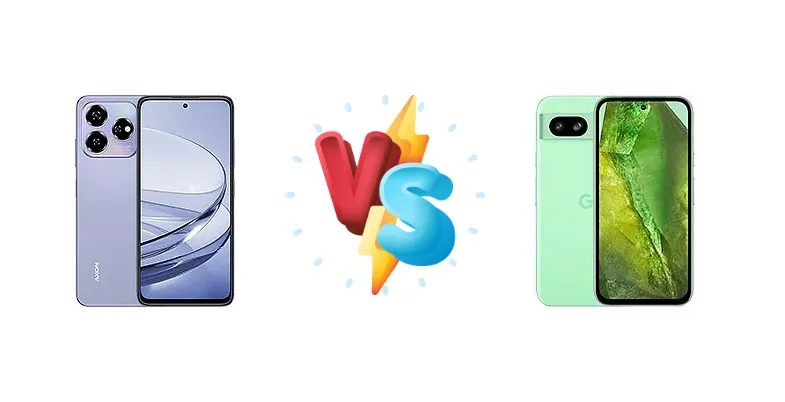
|
🏆 Quick Verdict
For most users, the Google Pixel 8a is the superior choice. Its Tensor G3 chipset provides significantly better performance and future-proofing, coupled with Google’s exceptional camera software and guaranteed software updates. While the ZTE Axon 60 offers compelling value, its Unisoc chipset struggles to keep pace.
| PHONES | ||
|---|---|---|
| Phone Names | ZTE Axon 60 | Google Pixel 8a |
| Network | ||
|---|---|---|
| 2G bands | GSM 850 / 900 / 1800 / 1900 | GSM 850 / 900 / 1800 / 1900 |
| 3G bands | HSDPA 850 / 900 / 1900 / 2100 | HSDPA 800 / 850 / 900 / 1700(AWS) / 1900 / 2100 |
| 4G bands | 1, 3, 5, 7, 8, 20, 28, 38, 40, 41 | 1, 2, 3, 4, 5, 7, 8, 12, 17, 18, 19, 20, 26, 28, 32, 38, 40, 41, 42, 66 - G6GPR (International) |
| 5G bands | - | 1, 2, 3, 5, 7, 8, 12, 20, 26, 28, 38, 40, 41, 66, 75, 76, 77, 78 SA/NSA/Sub6 - G6GPR (International) |
| Speed | HSPA, LTE | HSPA, LTE, 5G |
| Technology | GSM / HSPA / LTE | GSM / HSPA / LTE / 5G |
| Launch | ||
|---|---|---|
| Announced | 2024, May 07 | 2024, May 07 |
| Status | Available. Released 2024, May | Available. Released 2024, May 14 |
| Body | ||
|---|---|---|
| Build | - | Glass front (Gorilla Glass 3), aluminum frame, plastic back |
| Dimensions | 166.3 x 77.2 x 8.2 mm (6.55 x 3.04 x 0.32 in) | 152.1 x 72.7 x 8.9 mm (5.99 x 2.86 x 0.35 in) |
| SIM | Nano-SIM + Nano-SIM | Nano-SIM + eSIM |
| Weight | - | 188 g (6.63 oz) |
| Display | ||
|---|---|---|
| Protection | - | Corning Gorilla Glass 3, Mohs level 5 |
| Resolution | 1080 x 2400 pixels, 20:9 ratio (~392 ppi density) | 1080 x 2400 pixels, 20:9 ratio (~430 ppi density) |
| Size | 6.72 inches, 109.0 cm2 (~84.9% screen-to-body ratio) | 6.1 inches, 90.3 cm2 (~81.6% screen-to-body ratio) |
| Type | IPS LCD | OLED, HDR, 120Hz, 2000 nits (peak) |
| Platform | ||
|---|---|---|
| CPU | Octa-core (2x2.0 GHz Cortex-A75 & 6x1.8 GHz Cortex-A55) | Nona-core (1x3.0 GHz Cortex-X3 & 4x2.45 GHz Cortex-A715 & 4x2.15 GHz Cortex-A510) |
| Chipset | Unisoc Tiger T616 (12 nm) | Google Tensor G3 (4 nm) |
| GPU | Mali-G57 MP1 | Immortalis-G715s MC10 |
| OS | Android 13 | Android 14, upgradable to Android 16, up to 7 major Android upgrades |
| Memory | ||
|---|---|---|
| Card slot | microSDXC (dedicated slot) | No |
| Internal | 256GB 6GB RAM, 256GB 8GB RAM | 128GB 8GB RAM, 256GB 8GB RAM |
| Main Camera | ||
|---|---|---|
| Dual | - | 64 MP (16 MP eff.), f/1.9, 26mm (wide), 1/1.73", 0.8µm, dual pixel PDAF, OIS 13 MP, f/2.2, 120˚ (ultrawide), 1.12µm |
| Features | LED flash, HDR, panorama | Dual-LED flash, Pixel Shift, Ultra HDR, panorama, Best Take |
| Triple | 50 MP, f/1.8, (wide), PDAF 2 MP (macro) Auxiliary lens | - |
| Video | 1080p@30fps | 4K@30/60fps, 1080p@30/60/120/240fps, OIS |
| Selfie camera | ||
|---|---|---|
| Features | - | HDR, panorama |
| Single | 32 MP, f/2.0, (wide) | 13 MP, f/2.2, 20mm (ultrawide), 1.12µm |
| Video | 1080p@30fps | 4K@30fps, 1080p@30/60fps |
| Sound | ||
|---|---|---|
| 35mm jack | Yes | No |
| Loudspeaker | Yes | Yes, with stereo speakers |
| Comms | ||
|---|---|---|
| Bluetooth | 5.2, A2DP, LE | 5.3, A2DP, LE |
| NFC | Yes (market/region dependent) | Yes |
| Positioning | GPS, GALILEO, GLONASS | GPS, GLONASS, GALILEO, BDS, QZSS, NavIC |
| Radio | FM radio | No |
| USB | USB Type-C 2.0, OTG | USB Type-C 3.2 |
| WLAN | Wi-Fi 802.11 a/b/g/n/ac, dual-band | Wi-Fi 802.11 a/b/g/n/ac/6e, dual/tri-band (market/region dependent) |
| Features | ||
|---|---|---|
| Sensors | Fingerprint (side-mounted), accelerometer, proximity, compass | Fingerprint (under display, optical), accelerometer, gyro, proximity, compass, barometer |
| Battery | ||
|---|---|---|
| Charging | 22.5W wired | 18W wired, PD3.0 7.5W wireless Bypass charging |
| Type | 5000 mAh | Li-Po 4492 mAh |
| Misc | ||
|---|---|---|
| Colors | Gold, Black, Purple | Obsidian, Porcelain, Bay, Aloe |
| Models | Z2356 | GKV4X, G6GPR, G8HHN, G576D |
| Price | About 200 EUR | $ 229.98 / C$ 417.99 / £ 279.00 / € 299.99 / ₹ 33,300 |
| EU LABEL | ||
|---|---|---|
| Battery | - | 40:06h endurance, 1000 cycles |
| Energy | - | Class B |
| Free fall | - | Class A (270 falls) |
| Repairability | - | Class B |
ZTE Axon 60
- Superior performance with Google Tensor G3
- Exceptional camera quality and AI features
- Long-term software support from Google
- Higher price compared to ZTE Axon 60
- Charging speed is relatively slow at 18W
Google Pixel 8a
- More affordable price point
- Sleek and minimalist design
- Potentially longer battery life with lighter usage
- Significantly weaker performance with Unisoc Tiger T616
- Inferior camera quality and limited features
Display Comparison
The Google Pixel 8a boasts a significantly brighter display, reaching a measured peak of 1508 nits, making it far more usable in direct sunlight compared to the ZTE Axon 60 (brightness data unavailable). While both likely utilize OLED panels, the Pixel 8a’s higher brightness and Google’s color calibration expertise will deliver a more vibrant and accurate viewing experience. The Pixel 8a’s 6.1-inch screen size also contributes to a more compact and pocketable form factor, appealing to users who prefer smaller devices.
Camera Comparison
While detailed camera specs are limited for the Axon 60, the Pixel 8a’s camera prowess is a major selling point. Google’s computational photography algorithms, powered by the Tensor G3, consistently deliver exceptional image quality, particularly in challenging lighting conditions. The Pixel 8a’s image processing excels in dynamic range and detail preservation. The Axon 60 will likely struggle to match the Pixel 8a’s low-light performance and overall image quality, even with a potentially larger sensor (data unavailable).
Performance
The performance gap between these two phones is substantial. The Google Pixel 8a’s Google Tensor G3, built on a 4nm process, features a nona-core CPU configuration with a high-performance Cortex-X3 core, designed for AI tasks and demanding applications. In contrast, the ZTE Axon 60 relies on the Unisoc Tiger T616 (12nm), an octa-core chip with older Cortex-A75 cores. This translates to noticeably slower app loading times, less responsive multitasking, and a less enjoyable gaming experience on the Axon 60. The Tensor G3’s advanced AI capabilities also enable features like Magic Eraser and Photo Unblur, unavailable on the Axon 60.
Battery Life
The Google Pixel 8a demonstrates impressive battery endurance, achieving 40:06 hours of total usage and 11:25 hours of active use. This suggests efficient power management despite the powerful Tensor G3 chipset. While the Axon 60’s battery capacity is unknown, its less efficient Unisoc chipset and lower peak brightness will likely result in shorter battery life. The Pixel 8a also offers the convenience of 7.5W wireless charging and bypass charging, features absent on the Axon 60, which is limited to 22.5W wired charging.
Buying Guide
Buy the ZTE Axon 60 if you prioritize a lower upfront cost and a minimalist design, and your smartphone usage primarily revolves around basic tasks like calling, texting, and light social media. Buy the Google Pixel 8a if you value a superior camera experience, smoother performance for demanding apps, and long-term software support, even if it means spending a bit more.