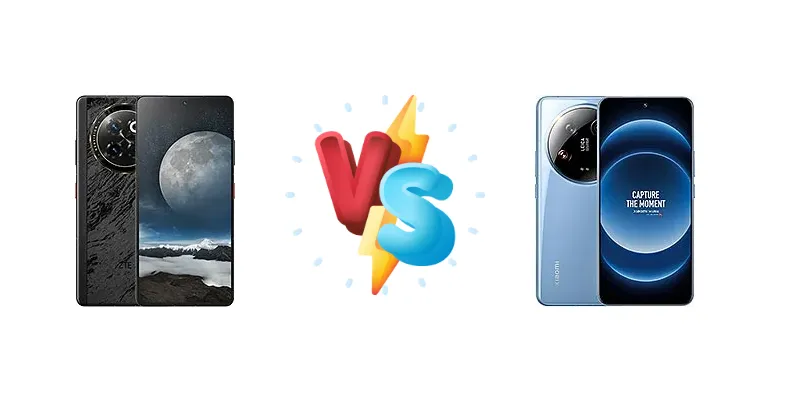
The ZTE Axon 60 Ultra arrived as a value-focused flagship, challenging established players with a strong feature set. Now, the Xiaomi 14 Ultra enters the arena, representing the pinnacle of Xiaomi’s smartphone engineering. This comparison dissects the core differences between these two Android powerhouses, focusing on performance, camera capabilities, and battery life to determine which device delivers the best overall experience.
🏆 Quick Verdict
For the average user prioritizing raw performance and a comprehensive camera system, the Xiaomi 14 Ultra is the clear winner. Its Snapdragon 8 Gen 3 chipset and superior battery endurance justify the higher price. However, the ZTE Axon 60 Ultra remains a compelling option for those seeking flagship features at a more accessible price point.
| Network |
|---|
| 2G bands | GSM 850 / 900 / 1800 / 1900 | GSM 850 / 900 / 1800 / 1900 |
| 3G bands | HSDPA 850 / 900 / 1700(AWS) / 1900 / 2100 | HSDPA 800 / 850 / 900 / 1700(AWS) / 1900 / 2100 |
| 4G bands | LTE | 1, 2, 3, 4, 5, 7, 8, 18, 19, 20, 26, 28, 38, 40, 41, 42, 48, 66 - International |
| 5G bands | SA/NSA | 1, 2, 3, 5, 7, 8, 20, 28, 38, 40, 41, 48, 66, 77, 78, 79 SA/NSA - International |
| Speed | HSPA, LTE, 5G | HSPA, LTE, 5G |
| Technology | GSM / CDMA / HSPA / CDMA2000 / LTE / 5G | GSM / CDMA / HSPA / EVDO / LTE / 5G |
| Launch |
|---|
| Announced | 2024, April 11 | 2024, February 22 |
| Status | Available. Released 2024, July 25 | Available. Released 2024, February 22 |
| Body |
|---|
| Build | Glass front, aluminum frame, glass back | Glass front (Shield Glass), glass back or silicone polymer back (eco leather), titanium frame (grade 5) or aluminum alloy frame |
| Dimensions | 163.6 x 76 x 9.1 mm (6.44 x 2.99 x 0.36 in) | 161.4 x 75.3 x 9.2 mm (6.35 x 2.96 x 0.36 in) |
| SIM | Nano-SIM + Nano-SIM | Nano-SIM + Nano-SIM |
| Weight | - | 219.8 / 224.4 / 229.5 g (7.76 oz) |
| Display |
|---|
| Protection | - | Xiaomi Shield Glass |
| Resolution | 1260 x 2800 pixels, 20:9 ratio (~453 ppi density) | 1440 x 3200 pixels, 20:9 ratio (~522 ppi density) |
| Size | 6.78 inches, 111.0 cm2 (~89.3% screen-to-body ratio) | 6.73 inches, 108.9 cm2 (~89.6% screen-to-body ratio) |
| Type | AMOLED, 120Hz | LTPO AMOLED, 68B colors, 120Hz, 1920Hz PWM, Dolby Vision, HDR10+, 1000 nits (typ), 3000 nits (peak) |
| Platform |
|---|
| CPU | Octa-core (1x3.2 GHz Cortex-X3 & 2x2.8 GHz Cortex-A715 & 2x2.8 GHz Cortex-A710 & 3x2.0 GHz Cortex-A510) | Octa-core (1x3.3 GHz Cortex-X4 & 3x3.2 GHz Cortex-A720 & 2x3.0 GHz Cortex-A720 & 2x2.3 GHz Cortex-A520) |
| Chipset | Qualcomm SM8550-AB Snapdragon 8 Gen 2 (4 nm) | Qualcomm SM8650-AB Snapdragon 8 Gen 3 (4 nm) |
| GPU | Adreno 740 | Adreno 750 |
| OS | Android 14 | Android 14, up to 4 major Android upgrades, HyperOS |
| Memory |
|---|
| Card slot | No | No |
| Internal | 512GB 12GB RAM, 1TB 16GB RAM | 256GB 12GB RAM, 512GB 16GB RAM, 1TB 16GB RAM |
| Main Camera |
|---|
| Features | LED flash, HDR, panorama | Laser AF, color spectrum sensor, Leica lenses, Dual-LED flash, HDR, panorama, 67mm filter ring holder (optional) |
| Quad | - | 50 MP, f/1.6-f/4.0, 23mm (wide), 1.0"-type, 1.6µm, dual pixel PDAF, OIS
50 MP, f/1.8, 75mm (telephoto), 1/2.51", 0.7µm, dual pixel PDAF (10cm - ∞), OIS, 3.2x optical zoom
50 MP, f/2.5, 120mm (periscope telephoto), 1/2.51", 0.7µm, dual pixel PDAF (30cm - ∞), OIS, 5x optical zoom
50 MP, f/1.8, 12mm, 122˚ (ultrawide), 1/2.51", 0.7µm, dual pixel PDAF
TOF 3D, (depth) |
| Triple | 50 MP, (wide), PDAF, OIS
50 MP, (ultrawide)
5 MP (macro) | - |
| Video | Yes | 8K@24/30fps, 4K@24/30/60/120fps, 1080p@30/60/120/240/480/960/1920fps, gyro-EIS, Dolby Vision HDR 10-bit rec. (4K@60fps, 1080p) |
| Selfie camera |
|---|
| Features | HDR | HDR, panorama |
| Single | 32 MP, (wide) | 32 MP, f/2.0, 22mm (wide), 1/3.14", 0.7µm |
| Video | 1080p@30fps | 4K@30/60fps, 1080p@30/60fps, gyro-EIS |
| Sound |
|---|
| 35mm jack | No | No |
| Loudspeaker | Yes, with stereo speakers | Yes, with stereo speakers |
| Comms |
|---|
| Bluetooth | 5.4, A2DP, LE, aptX HD, aptX Adaptive | 5.4, A2DP, LE, aptX HD, aptX Adaptive, LHDC |
| Infrared port | Yes | Yes |
| NFC | Yes | Yes |
| Positioning | GPS (L1+L5), GLONASS, BDS, GALILEO | GPS (L1+L5), GLONASS (L1), BDS (B1I+B1c+B2a), GALILEO (E1+E5a), QZSS (L1+L5), NavIC (L5) |
| Radio | No | No |
| USB | USB Type-C 3.1, OTG | USB Type-C 3.2 Gen 2, DisplayPort, OTG |
| WLAN | Wi-Fi 802.11 a/b/g/n/ac/6e, dual-band, Wi-Fi Direct | Wi-Fi 802.11 a/b/g/n/ac/6e/7, tri-band, Wi-Fi Direct |
| Features |
|---|
| Sensors | Fingerprint (under display, optical), accelerometer, gyro, proximity, compass | Fingerprint (under display, optical), accelerometer, proximity, gyro, compass, barometer |
| Battery |
|---|
| Charging | 80W wired, PD3.0, QC4 | 90W wired, PD3.0, QC4, 100% in 33 min
80W wireless, 100% in 46 min
10W reverse wireless |
| Type | 6000 mAh | Market-dependent versions:· 5000 mAh (Global)· 5300 mAh (China only) |
| Misc |
|---|
| Colors | Obsidian Black | Black, Blue, White, Titanium Gray |
| Models | - | 24031PN0DC, 24030PN60G |
| Price | About 780 EUR | € 663.14 |
| SAR | - | 0.83 W/kg (head) 0.82 W/kg (body) |
| SAR EU | - | 1.00 W/kg (head) 1.00 W/kg (body) |
ZTE Axon 60 Ultra
- Potentially more affordable price point
- Snapdragon 8 Gen 2 still offers excellent performance
- 80W wired charging is fast and convenient
- Older generation chipset compared to the Xiaomi 14 Ultra
- Likely lacks the advanced camera features of the Xiaomi 14 Ultra
- Battery life likely shorter than the Xiaomi 14 Ultra
Xiaomi 14 Ultra
- Snapdragon 8 Gen 3 delivers class-leading performance
- Exceptional camera system with advanced features
- Superior battery life and faster charging (wired and wireless)
- Higher price tag
- May be larger and heavier than the ZTE Axon 60 Ultra
- Software experience can be polarizing for some users
Display Comparison
The Xiaomi 14 Ultra boasts a significantly brighter display, reaching a measured 1281 nits, compared to an unspecified peak brightness for the Axon 60 Ultra. While both likely utilize OLED technology, the Xiaomi’s higher peak brightness translates to better visibility in direct sunlight. The absence of refresh rate data for the Axon 60 Ultra makes a direct comparison difficult, but the Xiaomi 14 Ultra’s likely inclusion of LTPO technology suggests more efficient power consumption and variable refresh rates for smoother scrolling and animations.
Camera Comparison
While detailed camera specs are missing for both devices, the Xiaomi 14 Ultra is expected to feature a more advanced camera system, typical of Xiaomi’s ‘Ultra’ line. The focus should be on sensor size and image processing capabilities. The Snapdragon 8 Gen 3’s improved ISP (Image Signal Processor) will contribute to better image quality, dynamic range, and low-light performance on the Xiaomi 14 Ultra. The ZTE Axon 60 Ultra will likely offer a competent camera experience, but the Xiaomi 14 Ultra is positioned to deliver a more professional-grade photography experience.
Performance
The Xiaomi 14 Ultra’s Snapdragon 8 Gen 3 (4nm) represents a substantial leap in performance over the ZTE Axon 60 Ultra’s Snapdragon 8 Gen 2 (4nm). The Gen 3 features a new Cortex-X4 prime core clocked at 3.3 GHz, alongside improved Cortex-A720 performance cores, resulting in faster processing speeds and improved efficiency. The Axon 60 Ultra’s CPU configuration, while powerful, is a generation behind. This difference will be most noticeable in demanding tasks like gaming and video editing, where the Xiaomi 14 Ultra will maintain higher frame rates and smoother performance. The Xiaomi’s newer chipset also benefits from advancements in AI processing.
Battery Life
The Xiaomi 14 Ultra demonstrates a clear advantage in battery endurance, achieving an active use score of 11:25h. While the Axon 60 Ultra’s battery capacity is unknown, the Xiaomi’s longer runtime suggests a combination of efficient chipset and optimized software. Furthermore, the Xiaomi 14 Ultra offers significantly faster charging: 90W wired (100% in 33 minutes), 80W wireless (100% in 46 minutes), and 10W reverse wireless. The ZTE Axon 60 Ultra’s 80W wired charging is respectable, but lacks the wireless charging options and overall speed of the Xiaomi.
Buying Guide
Buy the ZTE Axon 60 Ultra if you need a high-performance smartphone with a capable camera system without breaking the bank. It’s ideal for users who value value for money and don’t necessarily require the absolute best in every category. Buy the Xiaomi 14 Ultra if you prioritize top-tier performance, exceptional camera quality, and fast charging, and are willing to pay a premium for the best possible Android experience.
Frequently Asked Questions
❓ Does the Snapdragon 8 Gen 3 in the Xiaomi 14 Ultra generate significantly more heat than the Snapdragon 8 Gen 2 in the ZTE Axon 60 Ultra during prolonged gaming sessions?
While the Snapdragon 8 Gen 3 is more powerful, Xiaomi has implemented advanced cooling solutions in the 14 Ultra to mitigate heat generation. The improved efficiency of the 4nm process also helps. Expect slightly warmer temperatures under sustained load, but the Xiaomi 14 Ultra’s thermal management should prevent significant throttling and maintain consistent performance.
❓ How does the 80W wireless charging on the Xiaomi 14 Ultra compare to the wired charging speed of the ZTE Axon 60 Ultra?
The Xiaomi 14 Ultra’s 80W wireless charging is *faster* than the ZTE Axon 60 Ultra’s 80W wired charging. The Xiaomi 14 Ultra reaches 100% wirelessly in 46 minutes, while the Axon 60 Ultra’s wired charging time is unspecified but likely longer. This makes the Xiaomi 14 Ultra significantly more convenient for users who prefer wireless charging.
❓ Is the difference in CPU performance between the Snapdragon 8 Gen 2 and 8 Gen 3 noticeable in everyday tasks like browsing and social media?
The difference in CPU performance won’t be dramatically noticeable in basic tasks like browsing and social media. Both chipsets are more than capable of handling these workloads smoothly. However, the Xiaomi 14 Ultra will exhibit a more responsive experience when multitasking or switching between demanding applications.