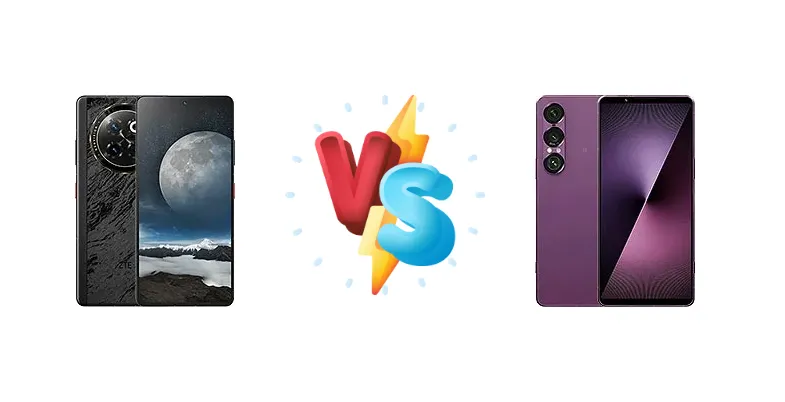
The ZTE Axon 60 Ultra arrives as a value-focused flagship, challenging established players with its Snapdragon 8 Gen 2 platform. Conversely, the Sony Xperia 1 VII represents Sony’s continued commitment to a premium, creator-focused experience, powered by the cutting-edge Snapdragon 8 Elite. This comparison dissects the core differences between these two Android titans, focusing on where each excels and who will benefit most from their respective strengths.
🏆 Quick Verdict
For the average user prioritizing raw performance and value, the ZTE Axon 60 Ultra offers a compelling package. However, the Sony Xperia 1 VII wins for those who demand exceptional battery life, a brighter display, and a more refined, long-lasting user experience, justifying its higher price point.
| Network |
|---|
| 2G bands | GSM 850 / 900 / 1800 / 1900 | GSM 850 / 900 / 1800 / 1900 |
| 3G bands | HSDPA 850 / 900 / 1700(AWS) / 1900 / 2100 | HSDPA 800 / 850 / 900 / 1700(AWS) / 1900 / 2100 |
| 4G bands | LTE | 1, 2, 3, 4, 5, 7, 8, 12, 13, 17, 19, 20, 25, 26, 28, 32, 34, 38, 39, 40, 41, 66 - Europe |
| 5G bands | SA/NSA | 1, 3, 5, 7, 8, 20, 28, 38, 40, 41, 75, 77, 78 SA/NSA/Sub6 - Europe |
| Speed | HSPA, LTE, 5G | HSPA, LTE, 5G |
| Technology | GSM / CDMA / HSPA / CDMA2000 / LTE / 5G | GSM / HSPA / LTE / 5G |
| Launch |
|---|
| Announced | 2024, April 11 | 2025, May 13 |
| Status | Available. Released 2024, July 25 | Available. Released 2025, June 04 |
| Body |
|---|
| Build | Glass front, aluminum frame, glass back | Glass front (Gorilla Glass Victus 2), glass back (Gorilla Glass Victus), aluminum frame |
| Dimensions | 163.6 x 76 x 9.1 mm (6.44 x 2.99 x 0.36 in) | 162 x 74 x 8.2 mm (6.38 x 2.91 x 0.32 in) |
| SIM | Nano-SIM + Nano-SIM | · Nano-SIM + eSIM· Nano-SIM + Nano-SIM |
| Weight | - | 197 g (6.95 oz) |
| Display |
|---|
| Protection | - | Corning Gorilla Glass Victus 2, Mohs level 5 |
| Resolution | 1260 x 2800 pixels, 20:9 ratio (~453 ppi density) | 1080 x 2340 pixels, 19.5:9 ratio (~396 ppi density) |
| Size | 6.78 inches, 111.0 cm2 (~89.3% screen-to-body ratio) | 6.5 inches, 103.7 cm2 (~86.5% screen-to-body ratio) |
| Type | AMOLED, 120Hz | LTPO OLED, 1B colors, 120Hz, HDR BT.2020 |
| Platform |
|---|
| CPU | Octa-core (1x3.2 GHz Cortex-X3 & 2x2.8 GHz Cortex-A715 & 2x2.8 GHz Cortex-A710 & 3x2.0 GHz Cortex-A510) | Octa-core (2x4.32 GHz Oryon V2 Phoenix L + 6x3.53 GHz Oryon V2 Phoenix M) |
| Chipset | Qualcomm SM8550-AB Snapdragon 8 Gen 2 (4 nm) | Qualcomm SM8750-AB Snapdragon 8 Elite (3 nm) |
| GPU | Adreno 740 | Adreno 830 |
| OS | Android 14 | Android 15, up to 4 major Android upgrades |
| Memory |
|---|
| Card slot | No | microSDXC (uses shared SIM slot) |
| Internal | 512GB 12GB RAM, 1TB 16GB RAM | 256GB 12GB RAM, 512GB 12GB RAM |
| Main Camera |
|---|
| Features | LED flash, HDR, panorama | Zeiss optics, Zeiss T* lens coating, color spectrum sensor, LED flash, panorama, HDR, eye tracking |
| Triple | 50 MP, (wide), PDAF, OIS
50 MP, (ultrawide)
5 MP (macro) | 48 MP, f/1.9, 24mm (wide), 1/1.35", 1.12µm, dual pixel PDAF, OIS
12 MP, f/2.3, 85mm (telephoto), f/3.5, 170mm (telephoto), 1/3.5", 1.0µm, dual pixel PDAF, 3.5x-7.1x continuous optical zoom, OIS, 4cm macro @ 120mm, no AF
48 MP, f/2.0, 16mm (ultrawide), 1/1.56", 1.0µm, PDAF |
| Video | Yes | 4K@24/30/60/120fps HDR, 1080p@30/60/120fps; 5-axis gyro-EIS, OIS |
| Selfie camera |
|---|
| Features | HDR | HDR |
| Single | 32 MP, (wide) | 12 MP, f/2.0, 24mm (wide), 1/2.9", 1.22µm |
| Video | 1080p@30fps | 4K@30/60fps, 1080p@30/60fps, 5-axis gyro-EIS |
| Sound |
|---|
| 35mm jack | No | Yes |
| Loudspeaker | Yes, with stereo speakers | Yes, with stereo speakers |
| Comms |
|---|
| Bluetooth | 5.4, A2DP, LE, aptX HD, aptX Adaptive | 6.0, A2DP, LE Audio, aptX HD, aptX Adaptive, aptX Lossless |
| Infrared port | Yes | - |
| NFC | Yes | Yes |
| Positioning | GPS (L1+L5), GLONASS, BDS, GALILEO | GPS, GLONASS, BDS, GALILEO, QZSS |
| Radio | No | No |
| USB | USB Type-C 3.1, OTG | USB Type-C 3.2, OTG, video output |
| WLAN | Wi-Fi 802.11 a/b/g/n/ac/6e, dual-band, Wi-Fi Direct | Wi-Fi 802.11 a/b/g/n/ac/6e/7, tri-band, Wi-Fi Direct, DLNA |
| Features |
|---|
| Sensors | Fingerprint (under display, optical), accelerometer, gyro, proximity, compass | Fingerprint (side-mounted), accelerometer, gyro, proximity, barometer, compass |
| Battery |
|---|
| Charging | 80W wired, PD3.0, QC4 | 30W wired, PD3.0, PPS, 50% in 30 min
15W wireless
Reverse wireless |
| Type | 6000 mAh | 5000 mAh |
| Misc |
|---|
| Colors | Obsidian Black | Moss Green, Orchid Purple, Slate Black |
| Models | - | XQ-FS54, XQFS54EUKCG.GC, XQFS54EUKCV.GC, XQFS54EUKCB.GC, PDX256 |
| Price | About 780 EUR | € 1,338.99 / $ 1,394.99 / £ 1,149.94 |
| EU LABEL |
|---|
| Battery | - | 43:30h endurance, 1400 cycles |
| Energy | - | Class B |
| Free fall | - | Class B (181 falls) |
| Repairability | - | Class D |
ZTE Axon 60 Ultra
- Faster 80W wired charging
- Potentially lower price point
- Excellent Snapdragon 8 Gen 2 performance
- Battery life likely inferior to Xperia 1 VII
- Display brightness likely lower than Xperia 1 VII
- Camera system details currently unknown
Sony Xperia 1 VII
- Exceptional battery life (43:30h endurance)
- Brighter display (1475 nits)
- Snapdragon 8 Elite with Oryon CPU architecture
- Slower 30W wired charging
- Higher price point
- May lack some of the Axon 60 Ultra's value-added features
Display Comparison
The Sony Xperia 1 VII boasts a significantly brighter display, reaching a measured 1475 nits, making it ideal for outdoor visibility. While the Axon 60 Ultra’s display specs are not provided, Sony’s panel technology is known for its color accuracy and natural tones. The Xperia 1 VII’s endurance rating of 43:30h suggests a power-efficient display, potentially utilizing LTPO technology for variable refresh rates, further conserving battery. The lack of detailed display information for the Axon 60 Ultra makes a direct comparison challenging, but Sony clearly holds an advantage in peak brightness and likely efficiency.
Camera Comparison
Without detailed camera specifications for the Axon 60 Ultra, a direct comparison is limited. However, Sony’s Xperia line is renowned for its image processing and optical quality. The Xperia 1 VII likely features a sophisticated camera system optimized for natural colors and dynamic range. The focus should be on the main sensor size and aperture, as these are key determinants of low-light performance. The Axon 60 Ultra will likely rely on software enhancements to compete, but Sony’s expertise in optics and image signal processing gives the Xperia 1 VII a potential edge. We'll need to see detailed camera specs for the Axon 60 Ultra to make a definitive judgement.
Performance
The Xperia 1 VII’s Snapdragon 8 Elite, built on a 3nm process, represents a substantial leap in efficiency and performance over the Axon 60 Ultra’s 4nm Snapdragon 8 Gen 2. The Elite’s Oryon V2 Phoenix CPU architecture (2x4.32 GHz + 6x3.53 GHz) is designed for sustained performance, potentially offering a noticeable advantage in demanding tasks like video editing and high-end gaming. While the Gen 2’s Cortex-X3 core (3.2 GHz) is powerful, the 3nm node and Oryon architecture of the Elite should translate to less thermal throttling and more consistent frame rates under prolonged load. The Axon 60 Ultra will still deliver excellent performance, but the Xperia 1 VII has a clear architectural advantage.
Battery Life
The Sony Xperia 1 VII’s battery life is a standout feature, achieving an impressive 43:30h endurance and 15:32h of active use. This is significantly higher than what is typically seen in flagship devices. While the Axon 60 Ultra offers faster 80W wired charging, the Xperia 1 VII’s 30W charging (with 50% in 30 minutes) and 15W wireless charging, combined with its exceptional battery endurance, provides a more practical and convenient charging experience. The Xperia 1 VII also boasts 1400 battery cycles, indicating a longer lifespan than typical smartphones.
Buying Guide
Buy the ZTE Axon 60 Ultra if you need a powerful phone for gaming and everyday tasks without breaking the bank, and appreciate fast 80W charging. Buy the Sony Xperia 1 VII if you prioritize all-day battery life, a stunningly bright display for outdoor use, and a premium build quality with a focus on media consumption and longevity.
Frequently Asked Questions
❓ Does the Snapdragon 8 Elite in the Xperia 1 VII actually get noticeably hotter than the Snapdragon 8 Gen 2 during extended gaming sessions?
The Snapdragon 8 Elite's 3nm process and Oryon CPU architecture are specifically designed to improve thermal efficiency. While both chips are powerful, the Xperia 1 VII should exhibit less thermal throttling and maintain higher sustained performance during prolonged gaming compared to the Axon 60 Ultra.
❓ How does the 30W charging on the Xperia 1 VII compare to the 80W charging on the Axon 60 Ultra in real-world usage?
While 80W is faster on paper, the Xperia 1 VII’s exceptional battery life means you’ll likely need to charge it less frequently. The 30W charging still reaches 50% in 30 minutes, and the combination of slower charging with significantly longer battery life provides a more convenient overall experience for many users.
❓ Is the 1400 battery cycle rating of the Xperia 1 VII a significant advantage over other smartphones?
Yes, 1400 cycles is considerably higher than the typical 500-800 cycles found in most smartphones. This indicates that the Xperia 1 VII’s battery will retain a higher percentage of its original capacity after years of use, extending the device’s overall lifespan.