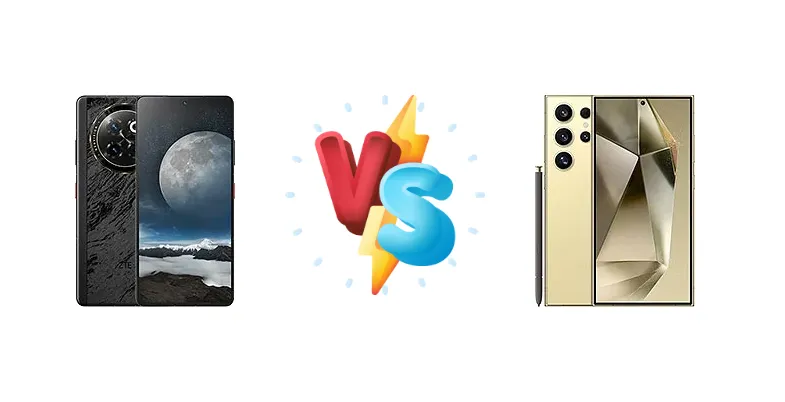
The smartphone landscape is currently defined by incremental upgrades and premium pricing. The ZTE Axon 60 Ultra, offering last year’s flagship silicon at a competitive price, challenges the dominance of the newly released Samsung Galaxy S24 Ultra. This comparison dissects the key differences between these two Android powerhouses, focusing on performance, camera capabilities, battery life, and overall value.
🏆 Quick Verdict
For the average user prioritizing raw power and a refined ecosystem, the Samsung Galaxy S24 Ultra is the superior choice, thanks to its Snapdragon 8 Gen 3 and exceptional battery life. However, the ZTE Axon 60 Ultra presents a compelling value proposition, delivering near-flagship performance at a significantly lower cost.
| Network |
|---|
| 2G bands | GSM 850 / 900 / 1800 / 1900 | GSM 850 / 900 / 1800 / 1900 |
| 3G bands | HSDPA 850 / 900 / 1700(AWS) / 1900 / 2100 | HSDPA 850 / 900 / 1700(AWS) / 1900 / 2100 |
| 4G bands | LTE | 1, 2, 3, 4, 5, 7, 8, 12, 13, 17, 18, 19, 20, 25, 26, 28, 32, 38, 39, 40, 41, 66 - International |
| 5G bands | SA/NSA | 1, 2, 3, 5, 7, 8, 12, 20, 25, 26, 28, 38, 40, 41, 66, 75, 77, 78 SA/NSA/Sub6 - International |
| Speed | HSPA, LTE, 5G | HSPA, LTE (up to 7CA), 5G |
| Technology | GSM / CDMA / HSPA / CDMA2000 / LTE / 5G | GSM / CDMA / HSPA / EVDO / LTE / 5G |
| Launch |
|---|
| Announced | 2024, April 11 | 2024, January 17 |
| Status | Available. Released 2024, July 25 | Available. Released 2024, January 24 |
| Body |
|---|
| Build | Glass front, aluminum frame, glass back | Glass front (Corning Gorilla Armor), glass back (Corning Gorilla Armor), titanium frame (grade 2) |
| Dimensions | 163.6 x 76 x 9.1 mm (6.44 x 2.99 x 0.36 in) | 162.3 x 79 x 8.6 mm (6.39 x 3.11 x 0.34 in) |
| SIM | Nano-SIM + Nano-SIM | · Nano-SIM + Nano-SIM + eSIM + eSIM (max 2 at a time) - INT· Nano-SIM + eSIM + eSIM (max 2 at a time) - USA· Nano-SIM + Nano-SIM - CN |
| Weight | - | 232 g or 233 g (8.18 oz) |
| Display |
|---|
| Protection | - | Corning Gorilla Armor |
| Resolution | 1260 x 2800 pixels, 20:9 ratio (~453 ppi density) | 1440 x 3120 pixels, 19.5:9 ratio (~505 ppi density) |
| Size | 6.78 inches, 111.0 cm2 (~89.3% screen-to-body ratio) | 6.8 inches, 113.5 cm2 (~88.5% screen-to-body ratio) |
| Type | AMOLED, 120Hz | Dynamic LTPO AMOLED 2X, 120Hz, HDR10+, 2600 nits (peak) |
| Platform |
|---|
| CPU | Octa-core (1x3.2 GHz Cortex-X3 & 2x2.8 GHz Cortex-A715 & 2x2.8 GHz Cortex-A710 & 3x2.0 GHz Cortex-A510) | 8-core (1x3.39GHz Cortex-X4 & 3x3.1GHz Cortex-A720 & 2x2.9GHz Cortex-A720 & 2x2.2GHz Cortex-A520) |
| Chipset | Qualcomm SM8550-AB Snapdragon 8 Gen 2 (4 nm) | Qualcomm SM8650-AC Snapdragon 8 Gen 3 (4 nm) |
| GPU | Adreno 740 | Adreno 750 (1 GHz) |
| OS | Android 14 | Android 14, up to 7 major Android upgrades, One UI 8.0 |
| Memory |
|---|
| Card slot | No | No |
| Internal | 512GB 12GB RAM, 1TB 16GB RAM | 256GB 12GB RAM, 512GB 12GB RAM, 1TB 12GB RAM |
| Main Camera |
|---|
| Features | LED flash, HDR, panorama | Laser AF, LED flash, auto-HDR, panorama |
| Quad | - | 200 MP, f/1.7, 24mm (wide), 1/1.3", 0.6µm, multi-directional PDAF, OIS
10 MP, f/2.4, 67mm (telephoto), 1/3.52", 1.12µm, PDAF, OIS, 3x optical zoom
50 MP, f/3.4, 111mm (periscope telephoto), 1/2.52", 0.7µm, PDAF, OIS, 5x optical zoom
12 MP, f/2.2, 13mm, 120˚ (ultrawide), 1/2.55", 1.4µm, dual pixel PDAF, Super Steady video |
| Triple | 50 MP, (wide), PDAF, OIS
50 MP, (ultrawide)
5 MP (macro) | - |
| Video | Yes | 8K@24/30fps, 4K@30/60/120fps, 1080p@30/60/120/240fps, HDR10+, stereo sound rec., gyro-EIS |
| Selfie camera |
|---|
| Features | HDR | HDR, HDR10+ |
| Single | 32 MP, (wide) | 12 MP, f/2.2, 26mm (wide), 1/3.2", 1.12µm, dual pixel PDAF |
| Video | 1080p@30fps | 4K@30/60fps, 1080p@30fps |
| Sound |
|---|
| 35mm jack | No | No |
| Loudspeaker | Yes, with stereo speakers | Yes, with stereo speakers |
| Comms |
|---|
| Bluetooth | 5.4, A2DP, LE, aptX HD, aptX Adaptive | 5.3, A2DP, LE |
| Infrared port | Yes | - |
| NFC | Yes | Yes |
| Positioning | GPS (L1+L5), GLONASS, BDS, GALILEO | GPS, GLONASS, BDS, GALILEO, QZSS |
| Radio | No | No |
| USB | USB Type-C 3.1, OTG | USB Type-C 3.2, DisplayPort 1.2, OTG |
| WLAN | Wi-Fi 802.11 a/b/g/n/ac/6e, dual-band, Wi-Fi Direct | Wi-Fi 802.11 a/b/g/n/ac/6e/7, tri-band, Wi-Fi Direct |
| Features |
|---|
| Sensors | Fingerprint (under display, optical), accelerometer, gyro, proximity, compass | Fingerprint (under display, ultrasonic), accelerometer, gyro, proximity, compass, barometer |
| Battery |
|---|
| Charging | 80W wired, PD3.0, QC4 | 45W wired, PD3.0, 65% in 30 min
15W wireless (Qi)
4.5W reverse wireless |
| Type | 6000 mAh | Li-Ion 5000 mAh |
| Misc |
|---|
| Colors | Obsidian Black | Titanium Black, Titanium Gray, Titanium Violet, Titanium Yellow, Titanium Blue, Titanium Green, Titanium Orange |
| Models | - | SM-S928B, SM-S928B/DS, SM-S928U, SM-S928U1, SM-S928W, SM-S928N, SM-S9280, SM-S928E, SM-S928E/DS |
| Price | About 780 EUR | $ 514.94 / C$ 929.99 / £ 630.00 / € 658.53 / ₹ 84,999 |
| SAR | - | 1.26 W/kg (head) 0.62 W/kg (body) |
| SAR EU | - | 1.06 W/kg (head) 1.30 W/kg (body) |
ZTE Axon 60 Ultra
- More affordable price point
- Faster wired charging (80W)
- Potentially better thermal efficiency due to older chipset
- Older Snapdragon 8 Gen 2 chipset
- Likely less refined software experience
- Battery life likely inferior to S24 Ultra
Samsung Galaxy S24 Ultra
- Latest Snapdragon 8 Gen 3 chipset
- Exceptional battery life (13:49h active use)
- Brighter and more accurate display
- Significantly higher price
- Slower wired charging (45W)
- Potential for software bloat
Display Comparison
The Samsung Galaxy S24 Ultra boasts a significantly brighter display, reaching a measured peak of 1447 nits, ensuring excellent visibility even in direct sunlight. While the Axon 60 Ultra’s display specs aren’t provided, Samsung’s panel technology and brightness advantage are substantial. Both devices likely utilize adaptive refresh rate technology, but the S24 Ultra’s superior brightness and color accuracy, typical of Samsung’s flagship displays, provide a more immersive viewing experience. The S24 Ultra’s LTPO panel also contributes to better power efficiency.
Camera Comparison
While both phones are expected to offer versatile camera systems, the specifics are crucial. The S24 Ultra’s camera system is renowned for its image processing and low-light performance. Without detailed sensor information for the Axon 60 Ultra, it’s difficult to make a direct comparison. However, Samsung’s expertise in computational photography and its larger sensor sizes typically result in superior image quality, particularly in challenging conditions. The S24 Ultra’s video capabilities are also likely to be more advanced, offering features like 8K recording and enhanced stabilization. The Axon 60 Ultra will likely offer a competitive camera experience, but may fall short of the S24 Ultra’s overall refinement.
Performance
The core difference lies in the chipsets: the ZTE Axon 60 Ultra utilizes the Qualcomm Snapdragon 8 Gen 2 (4nm), while the Samsung Galaxy S24 Ultra features the newer Snapdragon 8 Gen 3 (4nm). The Gen 3’s Cortex-X4 prime core, clocked at 3.39GHz, represents a significant architectural improvement over the Gen 2’s Cortex-X3 (3.2GHz). This, coupled with the Gen 3’s enhanced GPU, translates to faster application loading, smoother multitasking, and improved gaming performance. The S24 Ultra’s CPU configuration (1x3.39GHz + 3x3.1GHz + 2x2.9GHz + 2x2.2GHz) also demonstrates a more balanced approach to core clock speeds compared to the Axon 60 Ultra’s (1x3.2GHz + 2x2.8GHz + 2x2.8GHz + 3x2.0GHz). Both devices likely utilize LPDDR5x RAM, but the S24 Ultra’s optimized thermal management will allow it to sustain peak performance for longer durations.
Battery Life
The Samsung Galaxy S24 Ultra demonstrates a clear advantage in battery endurance, achieving an active use score of 13:49h. The Axon 60 Ultra’s battery capacity is not specified, but the S24 Ultra’s longer runtime suggests a larger battery or more efficient power management. While the Axon 60 Ultra supports faster 80W wired charging, the S24 Ultra’s 45W charging, reaching 65% in 30 minutes, is still respectable. The S24 Ultra also offers 15W wireless charging and 4.5W reverse wireless charging, features absent from the Axon 60 Ultra’s charging specifications.
Buying Guide
Buy the ZTE Axon 60 Ultra if you need a high-performance Android phone without the exorbitant price tag, and are comfortable with a less polished software experience. You'll benefit from excellent gaming capabilities and a capable camera system. Buy the Samsung Galaxy S24 Ultra if you prioritize the best possible performance, a long-lasting battery, a mature software ecosystem, and a top-tier camera experience, and are willing to pay a premium for it.
Frequently Asked Questions
❓ Does the Snapdragon 8 Gen 2 in the Axon 60 Ultra throttle under sustained load, like during extended gaming sessions?
While the Snapdragon 8 Gen 2 is a powerful chip, throttling can occur in any smartphone under heavy load. However, the 4nm process node generally offers better thermal efficiency than older nodes, potentially mitigating throttling in the Axon 60 Ultra. Real-world testing would be needed to determine the extent of throttling compared to the S24 Ultra.
❓ How does the charging speed difference (80W vs 45W) translate to real-world usage scenarios for the Axon 60 Ultra and S24 Ultra?
The Axon 60 Ultra’s 80W charging will provide a faster initial charge, getting you from 0% to a usable level quicker. However, the S24 Ultra’s 45W charging, reaching 65% in 30 minutes, is still quite fast. The difference becomes less significant as the battery approaches full capacity. The S24 Ultra’s longer overall battery life also reduces the frequency of needing to charge.
❓ Is the lack of wireless charging on the Axon 60 Ultra a significant drawback for users accustomed to this feature?
For users heavily reliant on wireless charging, the absence of this feature on the Axon 60 Ultra is a notable omission. The convenience of simply placing the phone on a charging pad is lost. However, the faster wired charging speed partially compensates for this, allowing for quick top-ups when needed.