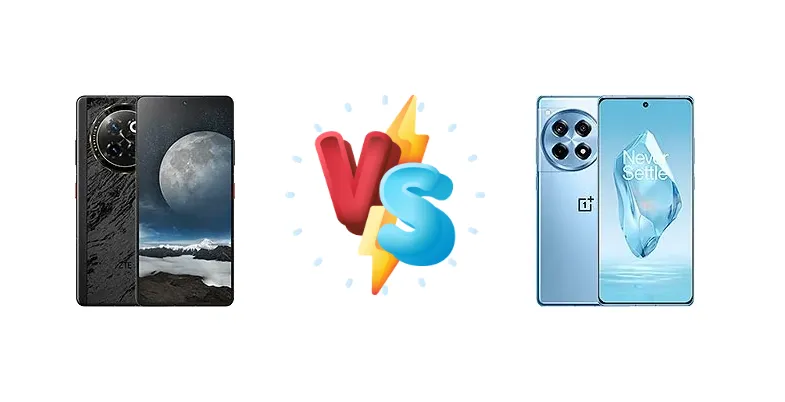
The ZTE Axon 60 Ultra and OnePlus 12R represent compelling options in a crowded flagship market, both powered by Qualcomm’s Snapdragon 8 Gen 2. However, they approach the high-end segment with different philosophies: the Axon 60 Ultra aims for a premium experience with a focus on design, while the OnePlus 12R prioritizes performance and battery life at a more accessible price point. This comparison dissects their key differences to help you choose the right device.
🏆 Quick Verdict
For the average user prioritizing sustained performance and rapid charging, the OnePlus 12R emerges as the winner. Its 100W charging and impressive 14:32h active use battery life provide a tangible advantage over the Axon 60 Ultra’s 80W charging, despite both sharing the same Snapdragon 8 Gen 2 chipset.
| Network |
|---|
| 2G bands | GSM 850 / 900 / 1800 / 1900 | GSM 850 / 900 / 1800 / 1900 |
| 3G bands | HSDPA 850 / 900 / 1700(AWS) / 1900 / 2100 | HSDPA 850 / 900 / 1700(AWS) / 1900 / 2100 |
| 4G bands | LTE | 1, 2, 3, 4, 5, 7, 8, 12, 17, 18, 19, 20, 26, 28, 32, 38, 39, 40, 41, 66 |
| 5G bands | SA/NSA | 1, 2, 3, 5, 7, 8, 12, 20, 28, 38, 40, 41, 66, 77, 78 SA/NSA |
| Speed | HSPA, LTE, 5G | HSPA, LTE, 5G |
| Technology | GSM / CDMA / HSPA / CDMA2000 / LTE / 5G | GSM / CDMA / HSPA / LTE / 5G |
| Launch |
|---|
| Announced | 2024, April 11 | 2024, January 23 |
| Status | Available. Released 2024, July 25 | Available. Released 2024, February 06 |
| Body |
|---|
| Build | Glass front, aluminum frame, glass back | Glass front (Gorilla Glass Victus 2), aluminum frame, glass back |
| Dimensions | 163.6 x 76 x 9.1 mm (6.44 x 2.99 x 0.36 in) | 163.3 x 75.3 x 8.8 mm (6.43 x 2.96 x 0.35 in) |
| SIM | Nano-SIM + Nano-SIM | · Nano-SIM + Nano-SIM + eSIM (max 2 at a time)· Nano-SIM + Nano-SIM |
| Weight | - | 207 g (7.30 oz) |
| Display |
|---|
| Protection | - | Corning Gorilla Glass Victus 2 |
| Resolution | 1260 x 2800 pixels, 20:9 ratio (~453 ppi density) | 1264 x 2780 pixels (~450 ppi density) |
| Size | 6.78 inches, 111.0 cm2 (~89.3% screen-to-body ratio) | 6.78 inches, 111.7 cm2 (~90.9% screen-to-body ratio) |
| Type | AMOLED, 120Hz | LTPO4 AMOLED, 1B colors, 120Hz, HDR10+, Dolby Vision, 1600 nits (HBM), 4500 nits (peak) |
| Platform |
|---|
| CPU | Octa-core (1x3.2 GHz Cortex-X3 & 2x2.8 GHz Cortex-A715 & 2x2.8 GHz Cortex-A710 & 3x2.0 GHz Cortex-A510) | Octa-core (1x3.2 GHz Cortex-X3 & 2x2.8 GHz Cortex-A715 & 2x2.8 GHz Cortex-A710 & 3x2.0 GHz Cortex-A510) |
| Chipset | Qualcomm SM8550-AB Snapdragon 8 Gen 2 (4 nm) | Qualcomm SM8550-AB Snapdragon 8 Gen 2 (4 nm) |
| GPU | Adreno 740 | Adreno 740 |
| OS | Android 14 | Android 14, up to 3 major Android upgrades, OxygenOS 15 |
| Memory |
|---|
| Card slot | No | No |
| Internal | 512GB 12GB RAM, 1TB 16GB RAM | 128GB 8GB RAM, 256GB 8GB RAM, 256GB 12GB RAM, 256GB 16GB RAM |
| Main Camera |
|---|
| Features | LED flash, HDR, panorama | Laser AF, color spectrum sensor, LED flash, HDR, panorama |
| Triple | 50 MP, (wide), PDAF, OIS
50 MP, (ultrawide)
5 MP (macro) | 50 MP, f/1.8, 24mm (wide), 1/1.56", 1.0µm, multi-directional PDAF, OIS
8 MP, f/2.2, 16mm, 112˚ (ultrawide), 1/4.0", 1.12µm
2 MP (macro) |
| Video | Yes | 4K@30/60fps, 1080p@30/60/120/240fps, gyro-EIS, OIS |
| Selfie camera |
|---|
| Features | HDR | HDR, panorama |
| Single | 32 MP, (wide) | 16 MP, f/2.4, 26mm (wide), 1/3", 1.0µm |
| Video | 1080p@30fps | 1080p@30fps, gyro-EIS |
| Sound |
|---|
| 35mm jack | No | No |
| Loudspeaker | Yes, with stereo speakers | Yes, with stereo speakers |
| Comms |
|---|
| Bluetooth | 5.4, A2DP, LE, aptX HD, aptX Adaptive | 5.3, A2DP, LE, aptX HD |
| Infrared port | Yes | Yes |
| NFC | Yes | Yes |
| Positioning | GPS (L1+L5), GLONASS, BDS, GALILEO | GPS, GALILEO, GLONASS, BDS, QZSS |
| Radio | No | No |
| USB | USB Type-C 3.1, OTG | USB Type-C 2.0 |
| WLAN | Wi-Fi 802.11 a/b/g/n/ac/6e, dual-band, Wi-Fi Direct | Wi-Fi 802.11 a/b/g/n/ac/6/7, dual-band |
| Features |
|---|
| Sensors | Fingerprint (under display, optical), accelerometer, gyro, proximity, compass | Fingerprint (under display, optical), accelerometer, gyro, proximity, compass |
| Battery |
|---|
| Charging | 80W wired, PD3.0, QC4 | 100W wired, 100% in 26 min |
| Type | 6000 mAh | Li-Ion 5500 mAh |
| Misc |
|---|
| Colors | Obsidian Black | Iron Gray, Cool Blue, Electric Violet, Sunset Dune |
| Models | - | CPH2609, CPH2585, CPH2611 |
| Price | About 780 EUR | € 410.84 / $ 399.95 / £ 649.00 |
| SAR | - | 1.19 W/kg (head) 0.82 W/kg (body) |
ZTE Axon 60 Ultra
- Potential for a more premium design and build quality.
- Snapdragon 8 Gen 2 offers flagship-level performance.
- 80W charging is still relatively fast.
- Battery life likely inferior to the OnePlus 12R.
- Charging speed is slower than the OnePlus 12R.
- Limited information available on key specs like display brightness and camera details.
OnePlus 12R
- Exceptional 14:32h active use battery life.
- Ultra-fast 100W charging (0-100% in 26 minutes).
- High peak brightness of 1181 nits.
- May lack the premium design elements of the Axon 60 Ultra.
- Camera system details are limited.
- Software experience may be less refined than some competitors.
Display Comparison
While both phones utilize high-quality panels, the OnePlus 12R boasts a measured peak brightness of 1181 nits, suggesting a more visible display in direct sunlight compared to the Axon 60 Ultra (brightness data unavailable). Both devices likely employ AMOLED technology, but the absence of LTPO information for the Axon 60 Ultra means the 12R may offer more adaptive refresh rate control, potentially saving battery. Bezels and color accuracy are not specified, making it difficult to definitively declare a winner in this category beyond the brightness advantage of the 12R.
Camera Comparison
Camera details for the Axon 60 Ultra are absent, making a direct comparison challenging. However, the OnePlus 12R’s camera system is likely to focus on delivering consistent, reliable image quality. Without sensor size or aperture information for either device, it’s difficult to assess low-light performance. The inclusion of Optical Image Stabilization (OIS) on the OnePlus 12R would be a significant advantage for capturing sharp photos and stable videos. We can assume both phones will offer a range of shooting modes, but the Axon 60 Ultra’s potential for a more advanced camera system remains unknown without further details.
Performance
Both the ZTE Axon 60 Ultra and OnePlus 12R are equipped with the Qualcomm SM8550-AB Snapdragon 8 Gen 2 (4nm), featuring the same Octa-core CPU configuration (1x3.2 GHz Cortex-X3, 2x2.8 GHz Cortex-A715, 2x2.8 GHz Cortex-A710, 3x2.0 GHz Cortex-A510). This means raw processing power will be nearly identical. However, the OnePlus 12R’s larger battery and potentially more robust cooling solution (specifications unavailable) could lead to less thermal throttling during extended gaming sessions, maintaining peak performance for longer. RAM specifications are missing for both, but LPDDR5x is expected in this price bracket, further minimizing performance bottlenecks.
Battery Life
The OnePlus 12R clearly excels in battery and charging. Its active use score of 14:32h demonstrates impressive endurance, while the 100W wired charging allows for a full charge in just 26 minutes. The ZTE Axon 60 Ultra’s 80W charging, while still fast, is noticeably slower. The battery capacity of the Axon 60 Ultra is unknown, but the 12R’s combination of capacity and charging speed provides a significant convenience advantage for users who frequently need to top up their devices.
Buying Guide
Buy the ZTE Axon 60 Ultra if you value a potentially more refined software experience and are willing to trade some charging speed and battery endurance for it. Buy the OnePlus 12R if you prioritize all-day battery life, incredibly fast 100W charging, and maximizing performance for gaming and demanding tasks without breaking the bank.
Frequently Asked Questions
❓ Will the Snapdragon 8 Gen 2 in the OnePlus 12R experience significant throttling during prolonged gaming sessions?
While the Snapdragon 8 Gen 2 is a powerful chip, sustained performance can be affected by thermal throttling. The OnePlus 12R’s larger battery and potentially improved cooling system (details unavailable) may help mitigate throttling compared to the Axon 60 Ultra, allowing for longer periods of peak performance during gaming.
❓ Is the 80W charging on the ZTE Axon 60 Ultra slow compared to the 100W on the OnePlus 12R?
80W charging is still considered fast, but the OnePlus 12R’s 100W charging is demonstrably quicker, achieving a full charge in just 26 minutes. This difference is significant for users who prioritize minimizing downtime and quickly topping up their battery.
❓ How does the software experience differ between the ZTE Axon 60 Ultra and the OnePlus 12R?
OnePlus’ OxygenOS is generally known for its clean interface and useful customization options. ZTE’s MyOS is less widely known and may offer a different software experience. User preference will play a large role in determining which software is preferred.