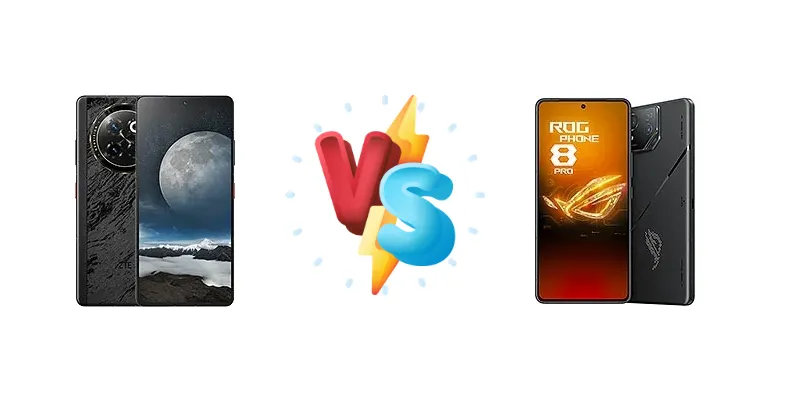
The ZTE Axon 60 Ultra arrives as a compelling value proposition, offering flagship specs at a competitive price. However, it faces stiff competition from the Asus ROG Phone 8 Pro, a dedicated gaming device packing the latest Snapdragon silicon and a host of gamer-centric features. This comparison dissects both phones to determine which reigns supreme for different user needs.
🏆 Quick Verdict
For the average user prioritizing value and a well-rounded experience, the ZTE Axon 60 Ultra is a strong contender. However, the Asus ROG Phone 8 Pro emerges as the clear winner for mobile gamers and power users, thanks to its superior chipset, optimized thermal management, and gaming-specific features.
| Network |
|---|
| 2G bands | GSM 850 / 900 / 1800 / 1900 | GSM 850 / 900 / 1800 / 1900 |
| 3G bands | HSDPA 850 / 900 / 1700(AWS) / 1900 / 2100 | HSDPA 850 / 900 / 1700(AWS) / 1800 / 1900 / 2100 - International |
| 4G bands | LTE | 1, 2, 3, 4, 5, 7, 8, 12, 17, 18, 19, 20, 25, 26, 28, 32, 34, 38, 39, 40, 41, 42, 43, 48, 66 - International |
| 5G bands | SA/NSA | 1, 2, 3, 5, 7, 8, 12, 18, 20, 25, 26, 28, 38, 40, 41, 48, 66, 77, 78, 79 SA/NSA/Sub6 - International |
| Speed | HSPA, LTE, 5G | HSPA, LTE (Up to 7CA), 5G |
| Technology | GSM / CDMA / HSPA / CDMA2000 / LTE / 5G | GSM / CDMA / HSPA / LTE / 5G |
| Launch |
|---|
| Announced | 2024, April 11 | 2024, January 08 |
| Status | Available. Released 2024, July 25 | Available. Released 2024, January 18 |
| Body |
|---|
| Build | Glass front, aluminum frame, glass back | Glass front (Gorilla Glass Victus 2), glass back (Gorilla Glass), aluminum frame |
| Dimensions | 163.6 x 76 x 9.1 mm (6.44 x 2.99 x 0.36 in) | 163.8 x 76.8 x 8.9 mm (6.45 x 3.02 x 0.35 in) |
| SIM | Nano-SIM + Nano-SIM | Nano-SIM + Nano-SIM |
| Weight | - | 225 g (7.94 oz) |
| Display |
|---|
| Protection | - | Corning Gorilla Glass Victus 2 |
| Resolution | 1260 x 2800 pixels, 20:9 ratio (~453 ppi density) | 1080 x 2400 pixels, 20:9 ratio (~388 ppi density) |
| Size | 6.78 inches, 111.0 cm2 (~89.3% screen-to-body ratio) | 6.78 inches, 111.0 cm2 (~88.2% screen-to-body ratio) |
| Type | AMOLED, 120Hz | LTPO AMOLED, 1B colors, 165Hz, HDR10, 1600 nits (HBM), 2500 nits (peak) |
| Platform |
|---|
| CPU | Octa-core (1x3.2 GHz Cortex-X3 & 2x2.8 GHz Cortex-A715 & 2x2.8 GHz Cortex-A710 & 3x2.0 GHz Cortex-A510) | Octa-core (1x3.3 GHz Cortex-X4 & 3x3.2 GHz Cortex-A720 & 2x3.0 GHz Cortex-A720 & 2x2.3 GHz Cortex-A520) |
| Chipset | Qualcomm SM8550-AB Snapdragon 8 Gen 2 (4 nm) | Qualcomm SM8650-AB Snapdragon 8 Gen 3 (4 nm) |
| GPU | Adreno 740 | Adreno 750 |
| OS | Android 14 | Android 14, up to 2 major Android upgrades |
| Memory |
|---|
| Card slot | No | No |
| Internal | 512GB 12GB RAM, 1TB 16GB RAM | 512GB 16GB RAM, 1TB 24GB RAM |
| Main Camera |
|---|
| Features | LED flash, HDR, panorama | LED flash, HDR, panorama |
| Triple | 50 MP, (wide), PDAF, OIS
50 MP, (ultrawide)
5 MP (macro) | 50 MP, f/1.9, 24mm (wide), 1/1.56", 1.0µm, PDAF, gimbal OIS
32 MP, f/2.4, (telephoto), 1/3.2", 0.7µm, PDAF, OIS, 3x optical zoom
13 MP, f/2.2, 13mm, 120˚ (ultrawide) |
| Video | Yes | 8K@24fps, 4K@30/60fps, 1080p@30/60/120/240fps, 720p@480fps; gyro-EIS, HDR10+ |
| Selfie camera |
|---|
| Features | HDR | Panorama, HDR |
| Single | 32 MP, (wide) | 32 MP, f/2.5, 22mm (wide), 1/3.2", 0.7µm |
| Video | 1080p@30fps | 1080p@30fps |
| Sound |
|---|
| 35mm jack | No | Yes |
| Loudspeaker | Yes, with stereo speakers | Yes, with stereo speakers |
| Comms |
|---|
| Bluetooth | 5.4, A2DP, LE, aptX HD, aptX Adaptive | 5.4, A2DP, LE, aptX HD, aptX Adaptive, aptX Lossless |
| Infrared port | Yes | - |
| NFC | Yes | Yes |
| Positioning | GPS (L1+L5), GLONASS, BDS, GALILEO | GPS (L1+L5), BDS (B1I+B1c+B2a), GALILEO (E1+E5a), QZSS (L1+L5), NavIC (L5), GLONASS |
| Radio | No | No |
| USB | USB Type-C 3.1, OTG | USB Type-C (side), DisplayPort 1.4; USB Type-C (bottom), OTG |
| WLAN | Wi-Fi 802.11 a/b/g/n/ac/6e, dual-band, Wi-Fi Direct | Wi-Fi 802.11 a/b/g/n/ac/6e/7, tri-band, Wi-Fi Direct |
| Features |
|---|
| Sensors | Fingerprint (under display, optical), accelerometer, gyro, proximity, compass | Fingerprint (under display, optical), accelerometer, gyro, proximity, compass |
| Battery |
|---|
| Charging | 80W wired, PD3.0, QC4 | 65W wired, PD3.0, PPS, QC5, 100% in 39 min - International
30W wired, PD3.0, PPS - India
15W wireless (Qi)
10W reverse wired |
| Type | 6000 mAh | 5500 mAh |
| Misc |
|---|
| Colors | Obsidian Black | Phantom Black |
| Models | - | AI2401, AI2401_A, AI2401_D |
| Price | About 780 EUR | $ 1,157.98 / £ 1,693.75 / € 632.66 |
ZTE Axon 60 Ultra
- Potentially better value for money
- Faster wired charging (80W)
- Likely strong camera performance based on ZTE's history
- Older Snapdragon 8 Gen 2 chipset
- Battery life likely shorter than ROG Phone 8 Pro
Asus ROG Phone 8 Pro
- Latest Snapdragon 8 Gen 3 chipset
- Exceptional battery life (14:43h active use)
- Gaming-focused features and optimized thermal design
- Higher price point
- Slower wired charging than Axon 60 Ultra (65W/30W)
Display Comparison
The Asus ROG Phone 8 Pro boasts a significantly brighter display, reaching a measured 1765 nits, ensuring excellent visibility even in direct sunlight. While the Axon 60 Ultra’s display specs are not provided, the ROG Phone’s brightness advantage is substantial. The ROG Phone 8 Pro likely utilizes an LTPO panel for adaptive refresh rates, contributing to power efficiency. The ROG Phone’s focus on gaming also suggests a higher touch sampling rate, crucial for responsiveness. Bezels are expected to be minimal on both, but the ROG Phone’s design prioritizes screen real estate for immersive gaming.
Camera Comparison
The context data for the Axon 60 Ultra lacks specific camera details, but ZTE has historically focused on high-resolution sensors. The ROG Phone 8 Pro’s camera capabilities are described as 'Photo / Video,' lacking specifics. However, the ROG Phone’s camera system is likely tuned for versatility rather than outright image quality. The ROG Phone’s video capabilities are likely enhanced for streaming and content creation. Without detailed sensor information for the Axon 60 Ultra, it’s difficult to definitively declare a winner, but the ROG Phone’s image processing is likely optimized for fast capture and real-time effects.
Performance
The Asus ROG Phone 8 Pro’s Snapdragon 8 Gen 3 (4nm) represents a generational leap over the ZTE Axon 60 Ultra’s Snapdragon 8 Gen 2 (4nm). The Gen 3 features a new Cortex-X4 prime core clocked at 3.3 GHz, compared to the Gen 2’s 3.2 GHz Cortex-X3, resulting in noticeable CPU performance gains. The ROG Phone also benefits from newer Cortex-A720 cores, offering improved efficiency and performance. The ROG Phone’s thermal design is crucial; its advanced cooling system will allow the Gen 3 to sustain peak performance for longer durations, minimizing throttling during demanding games. The Axon 60 Ultra will provide excellent performance, but the ROG Phone 8 Pro has a clear edge in sustained, peak performance.
Battery Life
The Asus ROG Phone 8 Pro demonstrates superior battery endurance with an active use score of 14:43h, indicating excellent power efficiency. While the Axon 60 Ultra’s battery capacity is unknown, the ROG Phone’s longer runtime suggests a combination of efficient chipset and optimized software. The ROG Phone 8 Pro offers 65W wired charging (international) and 30W (India), reaching 100% in 39 minutes (international). It also includes 15W wireless and 10W reverse wired charging. The Axon 60 Ultra’s 80W wired charging is faster, but the ROG Phone’s broader charging options and longer runtime provide greater flexibility.
Buying Guide
Buy the ZTE Axon 60 Ultra if you need a flagship-level smartphone with a capable camera and strong performance for everyday tasks and moderate gaming, all at a more accessible price point. Buy the Asus ROG Phone 8 Pro if you prioritize uncompromising gaming performance, extended battery life during intense sessions, and a feature set tailored to competitive mobile gaming.
Frequently Asked Questions
❓ Does the ROG Phone 8 Pro's Snapdragon 8 Gen 3 chipset overheat during prolonged gaming sessions?
The ROG Phone 8 Pro incorporates an advanced cooling system designed to mitigate thermal throttling. While the Snapdragon 8 Gen 3 is a powerful chip, the ROG Phone’s cooling solution, including vapor chambers and potentially active cooling accessories, allows it to sustain peak performance for extended periods, minimizing overheating and maintaining stable frame rates.
❓ Is the 30W charging speed in India for the ROG Phone 8 Pro a significant drawback compared to the 65W international version?
The 30W charging speed in India is slower than the 65W offered in other regions. However, the ROG Phone 8 Pro’s excellent battery optimization and large battery capacity partially offset this difference. While it will take longer to fully charge, the phone’s overall battery life remains a strong point.
❓ What kind of gaming triggers does the ROG Phone 8 Pro have, and are they customizable?
The ROG Phone 8 Pro features AirTriggers, ultrasonic buttons located on the side of the device. These can be mapped to on-screen controls for a more console-like gaming experience. They are highly customizable, allowing users to adjust sensitivity, trigger modes (press, swipe, hold), and assign different functions to each trigger.