
ZTE Axon 60 Ultra vs. Apple iPhone 15 Pro Max: A Deep Dive Comparison
| Phones Images | |||||
|---|---|---|---|---|---|
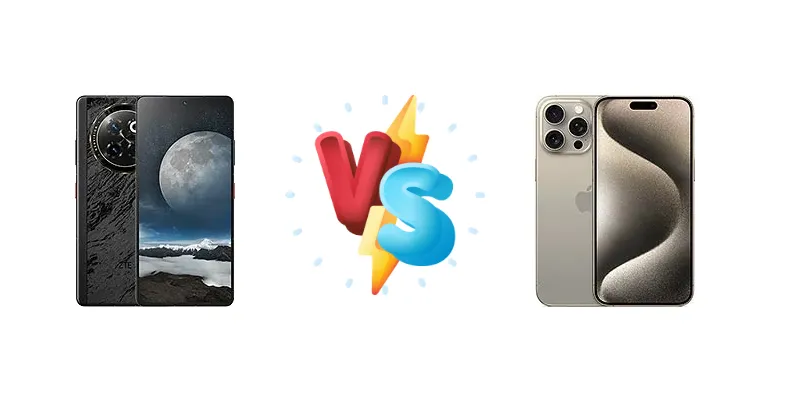
|
🏆 Quick Verdict
For the average user prioritizing a seamless ecosystem and long-term software support, the iPhone 15 Pro Max remains the superior choice. However, the ZTE Axon 60 Ultra delivers comparable performance and a potentially more versatile camera system at a significantly lower price point, making it a strong contender for Android enthusiasts.
| PHONES | ||
|---|---|---|
| Phone Names | ZTE Axon 60 Ultra | Apple iPhone 15 Pro Max |
| Network | ||
|---|---|---|
| 2G bands | GSM 850 / 900 / 1800 / 1900 | GSM 850 / 900 / 1800 / 1900 |
| 3G bands | HSDPA 850 / 900 / 1700(AWS) / 1900 / 2100 | HSDPA 850 / 900 / 1700(AWS) / 1900 / 2100 |
| 4G bands | LTE | 1, 2, 3, 4, 5, 7, 8, 12, 13, 17, 18, 19, 20, 25, 26, 28, 30, 32, 34, 38, 39, 40, 41, 42, 46, 48, 53, 66 - A3106 |
| 5G bands | SA/NSA | 1, 2, 3, 5, 7, 8, 12, 20, 25, 26, 28, 30, 38, 40, 41, 48, 53, 66, 70, 77, 78, 79 SA/NSA/Sub6 - A3106 |
| Speed | HSPA, LTE, 5G | HSPA, LTE, 5G, EV-DO Rev.A 3.1 Mbps |
| Technology | GSM / CDMA / HSPA / CDMA2000 / LTE / 5G | GSM / CDMA / HSPA / EVDO / LTE / 5G |
| Launch | ||
|---|---|---|
| Announced | 2024, April 11 | 2023, September 12 |
| Status | Available. Released 2024, July 25 | Available. Released 2023, September 22 |
| Body | ||
|---|---|---|
| Build | Glass front, aluminum frame, glass back | Glass front, glass back, titanium frame (grade 5) |
| Dimensions | 163.6 x 76 x 9.1 mm (6.44 x 2.99 x 0.36 in) | 159.9 x 76.7 x 8.3 mm (6.30 x 3.02 x 0.33 in) |
| SIM | Nano-SIM + Nano-SIM | · Nano-SIM + eSIM + eSIM (max 2 at a time; International)· eSIM + eSIM (8 or more, max 2 at a time; USA)· Nano-SIM + Nano-SIM (China) |
| Weight | - | 221 g (7.80 oz) |
| Display | ||
|---|---|---|
| Protection | - | Ceramic Shield glass |
| Resolution | 1260 x 2800 pixels, 20:9 ratio (~453 ppi density) | 1290 x 2796 pixels, 19.5:9 ratio (~460 ppi density) |
| Size | 6.78 inches, 111.0 cm2 (~89.3% screen-to-body ratio) | 6.7 inches, 110.2 cm2 (~89.8% screen-to-body ratio) |
| Type | AMOLED, 120Hz | LTPO Super Retina XDR OLED, 120Hz, HDR10, Dolby Vision, 1000 nits (typ), 2000 nits (HBM) |
| Platform | ||
|---|---|---|
| CPU | Octa-core (1x3.2 GHz Cortex-X3 & 2x2.8 GHz Cortex-A715 & 2x2.8 GHz Cortex-A710 & 3x2.0 GHz Cortex-A510) | Hexa-core (2x3.78 GHz + 4x2.11 GHz) |
| Chipset | Qualcomm SM8550-AB Snapdragon 8 Gen 2 (4 nm) | Apple A17 Pro (3 nm) |
| GPU | Adreno 740 | Apple GPU (6-core graphics) |
| OS | Android 14 | iOS 17, upgradable to iOS 26.1 |
| Memory | ||
|---|---|---|
| Card slot | No | No |
| Internal | 512GB 12GB RAM, 1TB 16GB RAM | 256GB 8GB RAM, 512GB 8GB RAM, 1TB 8GB RAM |
| Main Camera | ||
|---|---|---|
| Features | LED flash, HDR, panorama | Dual-LED dual-tone flash, HDR (photo/panorama) |
| Triple | 50 MP, (wide), PDAF, OIS 50 MP, (ultrawide) 5 MP (macro) | 48 MP, f/1.8, 24mm (wide), 1/1.28", 1.22µm, dual pixel PDAF, sensor-shift OIS 12 MP, f/2.8, 120mm (periscope telephoto), 1/3.06", 1.12µm, dual pixel PDAF, 3D sensor‑shift OIS, 5x optical zoom 12 MP, f/2.2, 13mm, 120˚ (ultrawide), 1/2.55", 1.4µm, dual pixel PDAF TOF 3D LiDAR scanner (depth) |
| Video | Yes | 4K@24/25/30/60fps, 1080p@25/30/60/120/240fps, 10-bit HDR, Dolby Vision HDR (up to 60fps), ProRes, 3D (spatial) video, stereo sound rec. |
| Selfie camera | ||
|---|---|---|
| Features | HDR | HDR, Dolby Vision HDR |
| Single | 32 MP, (wide) | 12 MP, f/1.9, 23mm (wide), 1/3.6", 1.0µm, PDAF, OIS SL 3D, (depth/biometrics sensor) |
| Video | 1080p@30fps | 4K@24/25/30/60fps, 1080p@25/30/60/120fps, gyro-EIS |
| Sound | ||
|---|---|---|
| 35mm jack | No | No |
| Loudspeaker | Yes, with stereo speakers | Yes, with stereo speakers |
| Comms | ||
|---|---|---|
| Bluetooth | 5.4, A2DP, LE, aptX HD, aptX Adaptive | 5.3, A2DP, LE |
| Infrared port | Yes | - |
| NFC | Yes | Yes |
| Positioning | GPS (L1+L5), GLONASS, BDS, GALILEO | GPS (L1+L5), GLONASS, GALILEO, BDS, QZSS, NavIC |
| Radio | No | No |
| USB | USB Type-C 3.1, OTG | USB Type-C 3.2 Gen 2, DisplayPort |
| WLAN | Wi-Fi 802.11 a/b/g/n/ac/6e, dual-band, Wi-Fi Direct | Wi-Fi 802.11 a/b/g/n/ac/6e, tri-band, hotspot |
| Features | ||
|---|---|---|
| Sensors | Fingerprint (under display, optical), accelerometer, gyro, proximity, compass | Face ID, accelerometer, gyro, proximity, compass, barometer |
| Battery | ||
|---|---|---|
| Charging | 80W wired, PD3.0, QC4 | Wired, PD2.0, 50% in 30 min 15W wireless (MagSafe) 15W wireless (Qi2) - requires iOS 17.2 update 4.5W reverse wired |
| Type | 6000 mAh | Li-Ion 4441 mAh |
| Misc | ||
|---|---|---|
| Colors | Obsidian Black | Black Titanium, White Titanium, Blue Titanium, Natural Titanium |
| Models | - | A2849, A3105, A3106, A3108, iPhone16,2 |
| Price | About 780 EUR | € 758.79 / $ 579.87 / £ 628.29 |
| SAR | - | 1.07 W/kg (head) 1.11 W/kg (body) |
| SAR EU | - | 0.98 W/kg (head) 0.98 W/kg (body) |
ZTE Axon 60 Ultra
- Significantly faster 80W wired charging
- Potentially more affordable price point
- Android OS offers greater customization
- Software update support may be limited
- Ecosystem integration is less seamless than Apple
Apple iPhone 15 Pro Max
- Exceptional performance with the A17 Pro chip
- Long-term software support and updates
- Superior ecosystem integration with other Apple devices
- Slower charging speeds compared to the Axon 60 Ultra
- Higher price tag
Display Comparison
The iPhone 15 Pro Max boasts a peak brightness of 1787 nits, ensuring excellent visibility even in direct sunlight. While the Axon 60 Ultra’s display specs aren’t provided, it’s likely lower, though still respectable. Apple’s use of a ProMotion display (LTPO) allows for adaptive refresh rates up to 120Hz, optimizing battery life and smoothness. The iPhone’s display technology is a key differentiator, offering a more refined visual experience, while the Axon 60 Ultra likely focuses on maximizing screen real estate and color vibrancy.
Camera Comparison
Without detailed camera specs for the Axon 60 Ultra, a direct comparison is challenging. However, the iPhone 15 Pro Max’s camera system is renowned for its computational photography and video capabilities. Apple’s image processing prioritizes natural-looking images with excellent dynamic range. The Axon 60 Ultra, given ZTE’s history, may lean towards more saturated colors and aggressive sharpening. The iPhone’s ProRes video recording capabilities are a significant advantage for professional videographers. The absence of specific sensor details for the Axon 60 Ultra makes it difficult to assess its low-light performance relative to the iPhone.
Performance
The core of the performance difference lies in the chipsets. Apple’s A17 Pro, fabricated on a 3nm process, offers a hexa-core CPU configuration with two high-performance cores clocked at 3.78 GHz. This contrasts with the ZTE Axon 60 Ultra’s Snapdragon 8 Gen 2 (4nm), an octa-core processor. While the Snapdragon 8 Gen 2 is a powerhouse, the A17 Pro’s architectural advantages and smaller node size likely translate to superior single-core performance and efficiency. The iPhone 15 Pro Max benefits from Apple’s tight control over hardware and software, optimizing performance for real-world tasks. The Axon 60 Ultra, however, offers a competitive experience, particularly in multi-threaded workloads.
Battery Life
The iPhone 15 Pro Max achieves an impressive 16:01h active use score, demonstrating excellent battery life. While the Axon 60 Ultra’s battery capacity is unknown, its 80W wired charging significantly outpaces the iPhone’s slower charging speeds (50% in 30 minutes). The iPhone 15 Pro Max supports 15W wireless charging via MagSafe and Qi2 (requiring iOS 17.2), while the Axon 60 Ultra’s wireless charging capabilities are not specified. The Axon 60 Ultra’s faster charging is a clear advantage for users who frequently need to top up their battery quickly.
Buying Guide
Buy the ZTE Axon 60 Ultra if you need maximum hardware for your dollar, prioritize fast charging speeds (80W), and prefer the flexibility of the Android operating system. Buy the Apple iPhone 15 Pro Max if you value a polished user experience, guaranteed software updates for years to come, and tight integration with other Apple devices, even if it means paying a premium.