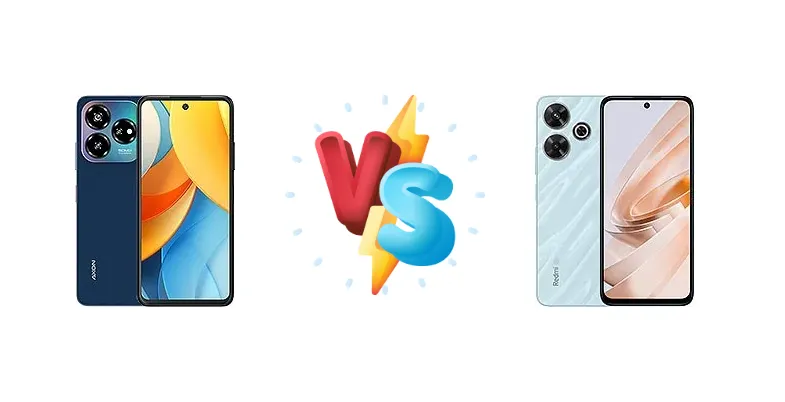
The sub-$200 smartphone market is fiercely competitive. The ZTE Axon 60 Lite and Xiaomi Redmi Note 13R both aim to deliver essential features at an accessible price, but they take drastically different approaches to achieving this. The Axon 60 Lite prioritizes affordability, while the Redmi Note 13R focuses on a more modern chipset for improved performance. This comparison dissects the key differences to help you choose the right phone for your needs.
🏆 Quick Verdict
For most users, the Xiaomi Redmi Note 13R is the better buy. Its Snapdragon 4+ Gen 2 chipset, built on a 4nm process, provides a noticeable performance advantage over the Axon 60 Lite’s Unisoc T606. However, the Axon 60 Lite remains a viable option for those prioritizing a lower upfront cost and aren't demanding users.
| Network |
|---|
| 2G bands | GSM 850 / 900 / 1800 / 1900 | GSM 850 / 900 / 1800 / 1900 |
| 3G bands | HSDPA 850 / 900 / 1900 / 2100 | HSDPA 850 / 900 / 2100 |
| 4G bands | LTE | 1, 3, 5, 8, 34, 38, 39, 40, 41 |
| 5G bands | - | 1, 5, 8, 28, 41, 78 SA/NSA |
| Speed | HSPA, LTE | HSPA, LTE, 5G |
| Technology | GSM / HSPA / LTE | GSM / CDMA / HSPA / EVDO / LTE / 5G |
| Launch |
|---|
| Announced | 2024, May 07 | 2024, May 17 |
| Status | Available. Released 2024, May | Available. Released 2024, May 17 |
| Body |
|---|
| Build | - | Glass front, plastic frame, glass back |
| Dimensions | 164.2 x 75.3 x 8.6 mm (6.46 x 2.96 x 0.34 in) | 168.6 x 76.3 x 8.2 mm (6.64 x 3.00 x 0.32 in) |
| SIM | Nano-SIM + Nano-SIM | Nano-SIM + Nano-SIM |
| Weight | - | 205 g (7.23 oz) |
| Display |
|---|
| Resolution | 720 x 1612 pixels, 20:9 ratio (~267 ppi density) | 1080 x 2460 pixels (~396 ppi density) |
| Size | 6.6 inches, 104.6 cm2 (~84.6% screen-to-body ratio) | 6.79 inches, 109.5 cm2 (~85.1% screen-to-body ratio) |
| Type | IPS LCD | IPS LCD, 120Hz, 550 nits |
| Platform |
|---|
| CPU | Octa-core (2x1.6 GHz Cortex-A75 & 6x1.6 GHz Cortex-A55) | Octa-core (2x2.3 GHz Cortex-A78 & 6x1.95 GHz Cortex-A55) |
| Chipset | Unisoc T606 (12 nm) | Qualcomm SM4450 Snapdragon 4+ Gen 2 (4 nm) |
| GPU | Mali-G57 MP1 | Adreno 613 |
| OS | Android 13 | Android 14, HyperOS |
| Memory |
|---|
| Card slot | Unspecified | No |
| Internal | 256GB 4GB RAM | 128GB 6GB RAM, 128GB 8GB RAM, 256GB 8GB RAM, 256GB 12GB RAM, 512GB 12GB RAM |
| Main Camera |
|---|
| Dual | 50 MP, f/1.8, (wide), PDAF
Auxiliary lens | 50 MP, f/1.8, (wide), 1/2.76", 0.64µm, PDAF
2 MP (macro) |
| Features | LED flash, HDR, panorama | LED flash, HDR |
| Video | 1080p@30fps | 1080p@30fps |
| Selfie camera |
|---|
| Single | 8 MP | 8 MP, (wide), 1/4.0", 1.12µm |
| Video | Yes | 1080p@30fps |
| Sound |
|---|
| 35mm jack | Yes | Yes |
| Loudspeaker | Yes | Yes |
| Comms |
|---|
| Bluetooth | 5.2, A2DP, LE | 5.3, A2DP, LE |
| Infrared port | - | Yes |
| NFC | Unspecified | Yes |
| Positioning | GPS | GPS, GLONASS, GALILEO, BDS |
| Radio | Unspecified | No |
| USB | USB Type-C 2.0 | USB Type-C |
| WLAN | Wi-Fi 802.11 a/b/g/n/ac, dual-band | Wi-Fi 802.11 a/b/g/n/ac, dual-band |
| Features |
|---|
| Sensors | Fingerprint (side-mounted), accelerometer, proximity | Fingerprint (side-mounted), accelerometer, compass |
| Battery |
|---|
| Charging | 22.5W wired | 33W wired |
| Type | 5000 mAh | 5030 mAh |
| Misc |
|---|
| Colors | Gold, Blue, Purple | Black, Blue, Silver |
| Models | - | 2406ERN9CC |
| Price | About 150 EUR | About 180 EUR |
ZTE Axon 60 Lite
- Lower price point makes it highly accessible.
- Adequate for basic smartphone tasks.
- Potentially longer battery life due to less powerful chipset (depending on battery capacity).
- Unisoc T606 chipset is significantly less powerful than the Snapdragon 4+ Gen 2.
- Slower charging speed (22.5W).
- Likely to struggle with demanding apps and games.
Xiaomi Redmi Note 13R
- Snapdragon 4+ Gen 2 offers a substantial performance boost.
- Faster 33W wired charging.
- More efficient chipset for better battery life and thermal management.
- Higher price compared to the ZTE Axon 60 Lite.
- May not offer a dramatically better camera experience without further specs.
- Still a budget device with inherent limitations.
Display Comparison
Neither phone boasts a standout display. While specific panel details (like peak brightness or color gamut coverage) are unavailable, the focus here is on the underlying processors impacting the user interface smoothness. The display quality will likely be similar, leaning towards adequate for the price point. Bezels are expected to be comparable, typical of this segment. The absence of high refresh rates on both devices suggests a focus on power efficiency rather than visual fluidity.
Camera Comparison
Without detailed camera specs, it’s difficult to make a definitive judgment. However, the Redmi Note 13R’s likely inclusion of a more modern image signal processor (ISP) within the Snapdragon 4+ Gen 2 chipset suggests better image processing capabilities. The Axon 60 Lite will likely rely on software optimizations to compensate for its older chipset. Expect both phones to perform adequately in good lighting conditions, but the Redmi Note 13R should offer better low-light performance and dynamic range. The prevalence of 2MP macro lenses on both devices suggests they are largely marketing features and won't significantly impact image quality.
Performance
The core difference lies in the chipsets. The Xiaomi Redmi Note 13R’s Qualcomm Snapdragon 4+ Gen 2 (4nm) is a significant upgrade over the ZTE Axon 60 Lite’s Unisoc T606 (12nm). The 4nm fabrication process inherently offers better power efficiency and thermal performance, translating to less throttling during sustained workloads. The Snapdragon’s CPU configuration – 2x2.3 GHz Cortex-A78 & 6x1.95 GHz Cortex-A55 – also represents a generational leap in architecture compared to the Axon 60 Lite’s 2x1.6 GHz Cortex-A75 & 6x1.6 GHz Cortex-A55. This means faster app launches, smoother multitasking, and a more responsive overall experience on the Redmi Note 13R. While RAM details are missing, the chipset advantage will be the dominant factor.
Battery Life
The Redmi Note 13R’s 33W wired charging is a clear advantage over the Axon 60 Lite’s 22.5W charging. This translates to significantly faster charging times, reducing downtime. While battery capacity isn’t specified, the Snapdragon 4+ Gen 2’s superior power efficiency means the Redmi Note 13R will likely offer comparable or even better battery life despite potentially having a similar capacity to the Axon 60 Lite. Expect the Redmi Note 13R to reach a full charge in under 90 minutes, while the Axon 60 Lite will likely take over two hours.
Buying Guide
Buy the ZTE Axon 60 Lite if you need a functional smartphone for basic tasks like calling, texting, and light social media browsing, and your budget is extremely tight. Buy the Xiaomi Redmi Note 13R if you prefer a smoother user experience, better app loading times, and the ability to handle more demanding applications and occasional gaming, even if it means spending a bit more.
Frequently Asked Questions
❓ Will the Redmi Note 13R handle popular games like PUBG Mobile or Call of Duty?
The Snapdragon 4+ Gen 2 in the Redmi Note 13R is capable of running PUBG Mobile and Call of Duty, but likely at medium settings to maintain a stable frame rate. Don't expect flagship-level performance, but it will provide a playable experience. The Axon 60 Lite will struggle with these titles, likely requiring very low settings and potentially experiencing significant lag.
❓ How much faster is the charging on the Redmi Note 13R compared to the Axon 60 Lite?
The Redmi Note 13R’s 33W charging is considerably faster than the Axon 60 Lite’s 22.5W. While exact times depend on battery capacity, expect the Redmi Note 13R to charge from 0-100% in approximately 80-90 minutes, while the Axon 60 Lite will likely take over 2 hours.
❓ Is the Unisoc T606 chipset in the Axon 60 Lite sufficient for everyday tasks like browsing and social media?
Yes, the Unisoc T606 is adequate for basic tasks like web browsing, social media, and messaging. However, you may experience slowdowns when multitasking or opening multiple apps. It's best suited for users who primarily need a phone for communication and light use.
❓ Does the Redmi Note 13R support 5G connectivity?
While the context data doesn't explicitly state 5G support, the Snapdragon 4+ Gen 2 chipset *can* support 5G depending on the specific modem configuration used by Xiaomi. It's highly likely the Redmi Note 13R offers 5G connectivity, but it's best to confirm with the official product specifications.