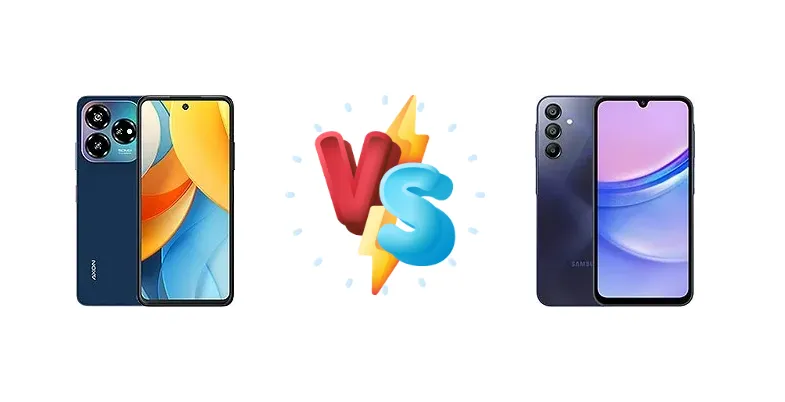
The sub-$200 smartphone market is fiercely competitive. The ZTE Axon 60 Lite and Samsung Galaxy A15 both aim to deliver essential features at an accessible price point, but they take different approaches. The Axon 60 Lite focuses on a streamlined experience, while the Galaxy A15 prioritizes battery life and a brighter display. This comparison dissects their key differences to help you choose the right device.
🏆 Quick Verdict
For most users, the Samsung Galaxy A15 emerges as the stronger choice. Its Mediatek Helio G99 chipset provides a noticeable performance edge over the ZTE Axon 60 Lite’s Unisoc T606, and the significantly longer 15:28h battery life in active use makes it ideal for all-day usage. While the Axon 60 Lite is a capable device, the A15 offers a more refined experience.
| Network |
|---|
| 2G bands | GSM 850 / 900 / 1800 / 1900 | GSM 850 / 900 / 1800 / 1900 |
| 3G bands | HSDPA 850 / 900 / 1900 / 2100 | HSDPA 850 / 900 / 2100 |
| 4G bands | LTE | 1, 3, 5, 7, 8, 20, 28, 38, 40, 41 |
| Speed | HSPA, LTE | HSPA, LTE |
| Technology | GSM / HSPA / LTE | GSM / HSPA / LTE |
| Launch |
|---|
| Announced | 2024, May 07 | 2023, December 11 |
| Status | Available. Released 2024, May | Available. Released 2023, December 16 |
| Body |
|---|
| Build | - | Glass front, plastic back, plastic frame |
| Dimensions | 164.2 x 75.3 x 8.6 mm (6.46 x 2.96 x 0.34 in) | 160.1 x 76.8 x 8.4 mm (6.30 x 3.02 x 0.33 in) |
| SIM | Nano-SIM + Nano-SIM | · Nano-SIM· Nano-SIM + Nano-SIM |
| Weight | - | 200 g (7.05 oz) |
| Display |
|---|
| Resolution | 720 x 1612 pixels, 20:9 ratio (~267 ppi density) | 1080 x 2340 pixels, 19.5:9 ratio (~396 ppi density) |
| Size | 6.6 inches, 104.6 cm2 (~84.6% screen-to-body ratio) | 6.5 inches, 103.7 cm2 (~84.3% screen-to-body ratio) |
| Type | IPS LCD | Super AMOLED, 90Hz, 800 nits (HBM) |
| Platform |
|---|
| CPU | Octa-core (2x1.6 GHz Cortex-A75 & 6x1.6 GHz Cortex-A55) | Octa-core (2x2.2 GHz Cortex-A76 & 6x2.0 GHz Cortex-A55) |
| Chipset | Unisoc T606 (12 nm) | Mediatek Helio G99 (6 nm) |
| GPU | Mali-G57 MP1 | Mali-G57 MC2 |
| OS | Android 13 | Android 14, up to 4 major Android upgrades, One UI 7 |
| Memory |
|---|
| Card slot | Unspecified | microSDXC (uses shared SIM slot) |
| Internal | 256GB 4GB RAM | 128GB 4GB RAM, 128GB 6GB RAM, 128GB 8GB RAM, 256GB 6GB RAM, 256GB 8GB RAM |
| Main Camera |
|---|
| Dual | 50 MP, f/1.8, (wide), PDAF
Auxiliary lens | - |
| Features | LED flash, HDR, panorama | LED flash, panorama, HDR |
| Triple | - | 50 MP, f/1.8, 26mm (wide), 1/2.8", 0.64µm, PDAF
5 MP, f/2.2, 17mm (ultrawide), 1/5.0", 1.12µm
2 MP (macro) |
| Video | 1080p@30fps | 1080p@30fps |
| Selfie camera |
|---|
| Single | 8 MP | 13 MP, f/2.0, 26mm (wide), 1/3.06", 1.12µm |
| Video | Yes | 1080p@30fps |
| Sound |
|---|
| 35mm jack | Yes | Yes |
| Loudspeaker | Yes | Yes |
| Comms |
|---|
| Bluetooth | 5.2, A2DP, LE | 5.3, A2DP, LE |
| NFC | Unspecified | Yes (market/region dependent) |
| Positioning | GPS | GPS, GALILEO, GLONASS, BDS, QZSS |
| Radio | Unspecified | FM radio (market/region dependent) |
| USB | USB Type-C 2.0 | USB Type-C 2.0 |
| WLAN | Wi-Fi 802.11 a/b/g/n/ac, dual-band | Wi-Fi 802.11 a/b/g/n/ac, dual-band, Wi-Fi Direct |
| Features |
|---|
| Sensors | Fingerprint (side-mounted), accelerometer, proximity | Fingerprint (side-mounted), accelerometer, compass |
| Battery |
|---|
| Charging | 22.5W wired | 25W wired |
| Type | 5000 mAh | 5000 mAh |
| Misc |
|---|
| Colors | Gold, Blue, Purple | Brave Black, Optimistic Blue, Magical Blue, Personality Yellow |
| Models | - | SM-A155F, SM-A155F/DSN, SM-A155M, SM-A155M/DS, SM-A155P, SM-A155R |
| Price | About 150 EUR | € 168.99 / $ 125.00 / £ 113.00 |
| SAR EU | - | 0.42 W/kg (head) 1.29 W/kg (body) |
ZTE Axon 60 Lite
- Potentially cleaner software experience (ZTE's MyOS is generally less bloated than Samsung's One UI)
- Competitive price point
- Sleek design (based on marketing materials)
- Less powerful Unisoc T606 chipset
- Likely lower display brightness
- Unknown battery life performance
Samsung Galaxy A15
- Superior performance with the Mediatek Helio G99
- Excellent battery life (15:28h active use)
- Brighter 808 nit display
- Samsung's One UI can be resource-intensive
- Potentially higher price compared to Axon 60 Lite
- May include pre-installed bloatware
Display Comparison
The Samsung Galaxy A15 boasts a significantly brighter display, reaching a measured peak brightness of 808 nits. This is crucial for outdoor visibility, a common pain point in this price segment. While the Axon 60 Lite’s display specifications are not provided, it’s likely to fall considerably short of this figure. The A15’s brightness advantage will be immediately noticeable in direct sunlight. The panel technology is also a factor; Samsung typically employs PLS LCDs which offer wider viewing angles than the TN panels often found in this price bracket, though the Axon 60 Lite’s panel type is unknown.
Camera Comparison
Without detailed camera specifications for the Axon 60 Lite, a direct comparison is limited. However, the Galaxy A15 likely benefits from Samsung’s established image processing algorithms. While both phones likely feature a primary camera and potentially depth/macro sensors, the image quality will hinge on sensor size and software optimization. It’s reasonable to assume the A15’s image processing will deliver more consistent results, particularly in challenging lighting conditions. The prevalence of low-resolution macro lenses on both devices suggests they are primarily for marketing purposes and offer limited practical benefit.
Performance
The Mediatek Helio G99 in the Galaxy A15 represents a substantial upgrade over the Unisoc T606 found in the Axon 60 Lite. The G99, built on a 6nm process, features more powerful Cortex-A76 cores clocked at 2.2 GHz, compared to the A75 cores at 1.6 GHz in the T606. This translates to faster app loading times, smoother multitasking, and improved gaming performance. The 6nm node also contributes to better thermal efficiency, meaning the A15 is less likely to throttle under sustained load. The Axon 60 Lite’s 12nm T606 is adequate for basic tasks, but will struggle with demanding applications.
Battery Life
The Samsung Galaxy A15’s standout feature is its exceptional battery life, achieving 15 hours and 28 minutes of active use. This is a significant advantage over what we’d expect from the Axon 60 Lite, which lacks a published battery life score. While the Axon 60 Lite offers 22.5W charging, the A15 counters with 25W charging. The difference is marginal, but combined with the larger battery capacity (implied by the long active use time), the A15 provides a more worry-free experience, reducing the need for frequent top-ups.
Buying Guide
Buy the ZTE Axon 60 Lite if you prioritize a minimalist software experience and are comfortable with slightly slower performance for basic tasks. Buy the Samsung Galaxy A15 if you need a phone that can reliably last a full day on a single charge, offers a brighter and more visible display, and provides a smoother overall user experience thanks to its more powerful chipset.
Frequently Asked Questions
❓ Does the Mediatek Helio G99 in the Galaxy A15 get hot during extended gaming sessions?
The Helio G99 is relatively efficient thanks to its 6nm process. While it will generate heat during prolonged gaming, the A15’s thermal design should prevent significant throttling, allowing for sustained performance. It won't match a flagship phone, but it's a capable performer for mobile games.
❓ Is the 25W charging on the Galaxy A15 significantly faster than the 22.5W on the Axon 60 Lite?
The difference in charging wattage is relatively small, but combined with the Galaxy A15’s likely larger battery capacity, it should result in a slightly faster overall charge time. Expect a full charge to take around 1.5-2 hours on both devices.
❓ How does the software experience differ between the ZTE Axon 60 Lite and the Samsung Galaxy A15?
ZTE’s MyOS is generally considered a lighter skin than Samsung’s One UI. One UI offers more features and customization options, but can be more resource-intensive. The Axon 60 Lite may offer a smoother experience for users who prefer a minimalist approach.
❓ Will the Unisoc T606 in the Axon 60 Lite struggle with multitasking?
The Unisoc T606 is adequate for basic multitasking, such as switching between messaging apps and web browsing. However, it may exhibit slowdowns when running multiple demanding applications simultaneously. The Galaxy A15’s Helio G99 will handle multitasking more efficiently.