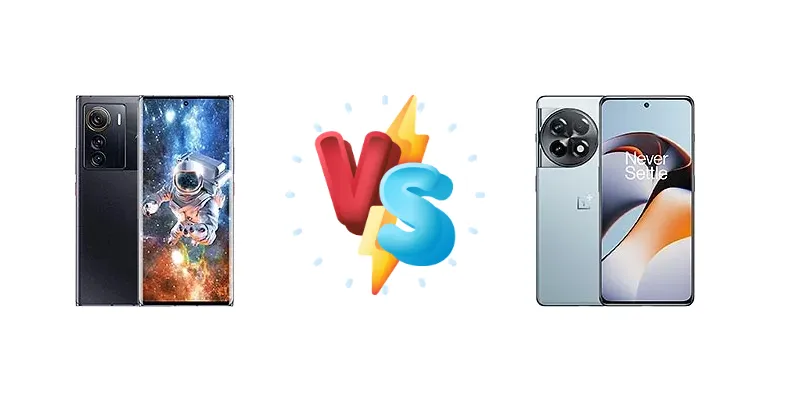
Both the ZTE Axon 50 Ultra and the OnePlus 11R represent compelling value in the flagship space, leveraging the proven Qualcomm Snapdragon 8+ Gen 1 chipset. However, subtle differences in CPU clock speeds and, crucially, charging technology create distinct user experiences. This comparison dissects these nuances to determine which device delivers the best overall package.
🏆 Quick Verdict
For most users, the OnePlus 11R emerges as the slightly better choice. Its 100W charging significantly reduces downtime, and while the CPU clocks are marginally lower, the real-world performance difference is negligible. The Axon 50 Ultra offers a compelling alternative if charging speed isn't a priority.
| Network |
|---|
| 2G bands | GSM 850 / 900 / 1800 / 1900 | GSM 850 / 900 / 1800 / 1900 |
| 3G bands | HSDPA 850 / 900 / 1700(AWS) / 1900 / 2100 | HSDPA 850 / 900 / 1700(AWS) / 2100 |
| 4G bands | LTE | 1, 3, 4, 5, 8, 28, 34, 38, 39, 40, 41 |
| 5G bands | SA/NSA | 1, 3, 5, 8, 28, 40, 41, 77, 78 SA/NSA |
| Speed | HSPA, LTE, 5G | HSPA, LTE (3CA), 5G |
| Technology | GSM / CDMA / HSPA / CDMA2000 / LTE / 5G | GSM / CDMA / HSPA / LTE / 5G |
| | CDMA2000 1x | CDMA 800 |
| Launch |
|---|
| Announced | 2023, April 12 | 2023, February 07 |
| Status | Cancelled | Available. Released 2023, February 21 |
| Body |
|---|
| Build | Glass front, glass back, aluminum frame | Glass front, glass back (Gorilla Glass 5), plastic frame |
| Dimensions | 161.8 x 73.1 x 8.9 mm (6.37 x 2.88 x 0.35 in) | 163.4 x 74.3 x 8.7 mm (6.43 x 2.93 x 0.34 in) |
| SIM | Nano-SIM + Nano-SIM | Nano-SIM + Nano-SIM |
| Weight | 199 g (7.02 oz) | 204 g (7.20 oz) |
| Display |
|---|
| Resolution | 1080 x 2400 pixels, 20:9 ratio (~395 ppi density) | 1240 x 2772 pixels, 20:9 ratio (~451 ppi density) |
| Size | 6.67 inches, 107.4 cm2 (~90.8% screen-to-body ratio) | 6.74 inches, 109.2 cm2 (~90.0% screen-to-body ratio) |
| Type | AMOLED, 1B colors, 144Hz | Fluid AMOLED, 1B colors, 120Hz, HDR10+, 1450 nits (peak) |
| Platform |
|---|
| CPU | Octa-core (1x3.0 GHz Cortex-X2 & 3x2.75 GHz Cortex-A710 & 4x2.0 GHz Cortex-A510) | Octa-core (1x3.0 GHz Cortex-X2 & 3x2.5 GHz Cortex-A710 & 4x1.80 GHz Cortex-A510) |
| Chipset | Qualcomm SM8475 Snapdragon 8+ Gen 1 (4 nm) | Qualcomm SM8475 Snapdragon 8+ Gen 1 (4 nm) |
| GPU | Adreno 730 | Adreno 730 |
| OS | Android 12, MyOS 12 | Android 13, upgradable to Android 15, OxygenOS 15 |
| Memory |
|---|
| Card slot | No | No |
| Internal | 256GB 12GB RAM, 512GB 12GB RAM | 128GB 8GB RAM, 256GB 16GB RAM, 512GB 18GB RAM |
| | UFS 3.1 | UFS 3.1 |
| Main Camera |
|---|
| Features | Laser AF, Dual-LED dual-tone flash, panorama, HDR | Color spectrum sensor, LED flash, HDR, panorama |
| Single | - | 16 MP, f/2.4, 24mm (wide), 1/3.09", 1.0µm |
| Triple | 64 MP, f/1.9, 24mm (wide), 1/1.73", 0.8µm, PDAF, OIS
50 MP, f/2.0, (telephoto), PDAF, 3x optical zoom
50 MP, f/2.2, 116˚ (ultrawide), PDAF | 50 MP, f/1.8, 24mm (wide), 1/1.56", 1.0µm, multi-directional PDAF, OIS
8 MP, f/2.2, 120˚ (ultrawide), 1/4.0", 1.12µm
2 MP (macro) |
| Video | 8K@30fps, 4K@30/60/120fps, 1080p@30/60fps, gyro-EIS, HDR10, 10‑bit video | 4K@30/60fps, 1080p@30/60/240fps, gyro-EIS |
| Selfie camera |
|---|
| Features | HDR | HDR |
| Single | 32 MP, f/2.5, (wide) | 16 MP, f/2.4, 24mm (wide), 1/3.09", 1.0µm |
| Video | 1080p@30fps | 1080p@30fps |
| Sound |
|---|
| 3.5mm jack | No | No |
| 35mm jack | No | No |
| Loudspeaker | Yes, with stereo speakers | Yes, with stereo speakers |
| | 24-bit/192kHz audio | 24-bit/192kHz audio |
| Comms |
|---|
| Bluetooth | 5.2, A2DP, LE, aptX HD, aptX Adaptive | 5.3, A2DP, LE, aptX HD |
| Infrared port | Yes | Yes |
| NFC | Yes | Yes |
| Positioning | GPS (L1+L5), GLONASS, BDS, GALILEO | GPS (L1+L5), GLONASS (G1), BDS (B1I+B1c+B2a), GALILEO (E1+E5a), QZSS (L1+L5) |
| Radio | No | No |
| USB | USB Type-C 3.1, OTG | USB Type-C 2.0 |
| WLAN | Wi-Fi 802.11 a/b/g/n/ac/6, dual-band, Wi-Fi Direct | Wi-Fi 802.11 a/b/g/n/ac/6, dual-band |
| Features |
|---|
| Sensors | Fingerprint (under display, optical), accelerometer, gyro, proximity, compass | Fingerprint (under display, optical), accelerometer, gyro, proximity, compass |
| | BDS Satellite Message (Emergency SOS service) | - |
| Battery |
|---|
| Charging | 80W wired, PD3.0, QC4 | 100W wired |
| Type | Li-Po 5000 mAh | Li-Po 5000 mAh |
| Misc |
|---|
| Colors | Black | Galactic Silver, Sonic Black, Solar Red |
| Models | - | CPH2487 |
| Price | - | About 600 EUR |
| SAR | - | 1.16 W/kg (head) 0.61 W/kg (body) |
ZTE Axon 50 Ultra
- Potentially more refined software experience (MyOS)
- Slightly higher CPU clock speeds on the A710 cores
- May prioritize camera features and image quality
- Slower 80W charging compared to the OnePlus 11R
- Less established software ecosystem
OnePlus 11R
- Faster 100W charging for quicker top-ups
- OxygenOS provides a well-established and optimized experience
- Generally more aggressive pricing
- Slightly lower CPU clock speeds on the A710 cores
- May prioritize performance over camera features
Display Comparison
Both devices utilize AMOLED panels, but detailed display specs are missing. However, given the market positioning, the OnePlus 11R likely prioritizes a higher refresh rate for smoother scrolling and gaming, while the Axon 50 Ultra may focus on color accuracy. The absence of LTPO information suggests neither phone dynamically adjusts refresh rates for optimal power efficiency, potentially impacting battery life during static content viewing.
Camera Comparison
Detailed camera specs are unavailable, but the Axon 50 Ultra's brand positioning suggests a greater emphasis on camera capabilities. While both likely feature capable main sensors, the Axon 50 Ultra may offer more advanced features like improved image stabilization or computational photography algorithms. The absence of information on sensor sizes and lens apertures makes a definitive comparison impossible, but the Axon 50 Ultra is the likely winner in this category based on brand strategy.
Performance
Both phones are powered by the Qualcomm SM8475 Snapdragon 8+ Gen 1 (4 nm) chipset, but the CPU configuration differs slightly. The OnePlus 11R features a 3x2.5 GHz Cortex-A710 cluster, while the Axon 50 Ultra has a 3x2.75 GHz Cortex-A710 cluster. This 0.25 GHz difference is unlikely to translate into a noticeable performance boost in everyday tasks. The 4nm process node ensures efficient power consumption, but sustained workloads will still generate heat. Thermal management will be key, and OnePlus's history suggests a more aggressive thermal profile, potentially leading to earlier throttling compared to ZTE's approach.
Battery Life
The OnePlus 11R’s 100W wired charging is a significant advantage over the Axon 50 Ultra’s 80W wired charging. This translates to a faster 0-100% charge time, reducing downtime considerably. While battery capacity is unknown for both, the faster charging speed of the 11R effectively mitigates any potential disadvantage from a slightly smaller battery. Both support PD3.0 and QC4, ensuring compatibility with a wide range of chargers.
Buying Guide
Buy the ZTE Axon 50 Ultra if you prioritize a potentially more refined software experience (depending on ZTE's MyOS updates) and don't mind slower charging. Buy the OnePlus 11R if you value rapid replenishment of battery life, a more established software ecosystem with OxygenOS, and a generally more aggressive price point for the same core performance.
Frequently Asked Questions
❓ Will the OnePlus 11R's 100W charging degrade the battery faster than the Axon 50 Ultra's 80W charging?
While faster charging generates more heat, modern smartphones employ sophisticated battery management systems to mitigate degradation. The OnePlus 11R's charging circuitry is designed to minimize long-term battery health impact, and the convenience of faster charging often outweighs the minimal potential for accelerated degradation.
❓ Does the slight CPU clock speed difference between the Axon 50 Ultra and OnePlus 11R translate to a noticeable difference in gaming performance?
No, the 0.25 GHz difference in CPU clock speeds is unlikely to be perceptible during gaming. Both phones utilize the same Snapdragon 8+ Gen 1 chipset and GPU, and performance will be largely determined by thermal throttling and software optimization. The OnePlus 11R's potentially more aggressive thermal profile might lead to slightly earlier throttling in extended gaming sessions.
❓ Which phone is better for users who frequently use power-intensive apps like video editing or AR applications?
Both phones are capable of handling demanding tasks, but the OnePlus 11R's faster charging is a significant advantage for users who frequently push their devices to the limit. The ability to quickly replenish battery life minimizes downtime and ensures uninterrupted productivity.