
ZTE Axon 50 Ultra vs. iPhone 14 Pro Max: A Flagship Face-Off
| Phones Images | |||||
|---|---|---|---|---|---|
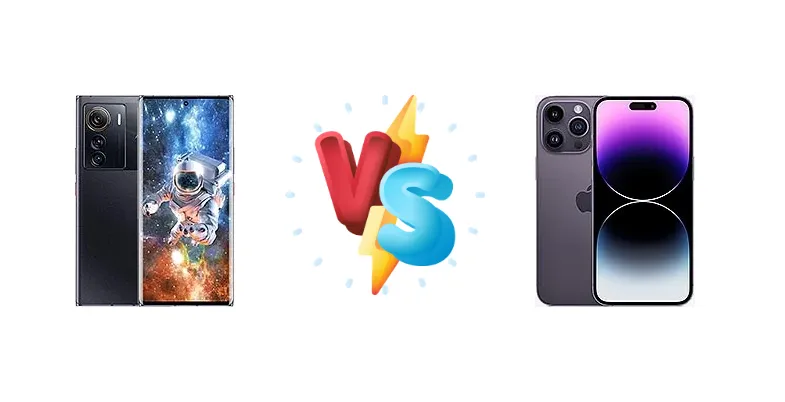
|
🏆 Quick Verdict
For the average user prioritizing ecosystem integration, long-term software support, and a refined user experience, the iPhone 14 Pro Max remains the superior choice. However, the ZTE Axon 50 Ultra offers compelling value with its significantly faster charging and competitive performance, making it a strong contender for Android enthusiasts.
| PHONES | ||
|---|---|---|
| Phone Names | ZTE Axon 50 Ultra | Apple iPhone 14 Pro Max |
| Network | ||
|---|---|---|
| 2G bands | GSM 850 / 900 / 1800 / 1900 | GSM 850 / 900 / 1800 / 1900 |
| 3G bands | HSDPA 850 / 900 / 1700(AWS) / 1900 / 2100 | HSDPA 850 / 900 / 1700(AWS) / 1900 / 2100 |
| 4G bands | LTE | 1, 2, 3, 4, 5, 7, 8, 12, 13, 17, 18, 19, 20, 25, 26, 28, 30, 32, 34, 38, 39, 40, 41, 42, 46, 48, 66 - A2894, A2896 |
| 5G bands | SA/NSA | 1, 2, 3, 5, 7, 8, 12, 20, 25, 26, 28, 30, 38, 40, 41, 48, 66, 70, 77, 78, 79 SA/NSA/Sub6 - A2894, A2896 |
| Speed | HSPA, LTE, 5G | HSPA, LTE, 5G, EV-DO Rev.A 3.1 Mbps |
| Technology | GSM / CDMA / HSPA / CDMA2000 / LTE / 5G | GSM / CDMA / HSPA / EVDO / LTE / 5G |
| CDMA2000 1x | 1, 2, 3, 5, 7, 8, 12, 20, 25, 26, 28, 30, 38, 40, 41, 48, 66, 70, 77, 78, 79 SA/NSA/Sub6 - A2895 | |
| Launch | ||
|---|---|---|
| Announced | 2023, April 12 | 2022, September 07 |
| Status | Cancelled | Available. Released 2022, September 16 |
| Body | ||
|---|---|---|
| Build | Glass front, glass back, aluminum frame | Glass front, glass back, stainless steel frame |
| Dimensions | 161.8 x 73.1 x 8.9 mm (6.37 x 2.88 x 0.35 in) | 160.7 x 77.6 x 7.9 mm (6.33 x 3.06 x 0.31 in) |
| SIM | Nano-SIM + Nano-SIM | · Nano-SIM + eSIM + eSIM (max 2 at a time; International)· eSIM + eSIM (8 or more, max 2 at a time; USA)· Nano-SIM + Nano-SIM (China) |
| Weight | 199 g (7.02 oz) | 240 g (8.47 oz) |
| - | IP68 dust/water resistant (up to 6m for 30 min) Apple Pay (Visa, MasterCard, AMEX certified) | |
| Display | ||
|---|---|---|
| Protection | - | Ceramic Shield glass |
| Resolution | 1080 x 2400 pixels, 20:9 ratio (~395 ppi density) | 1290 x 2796 pixels, 19.5:9 ratio (~460 ppi density) |
| Size | 6.67 inches, 107.4 cm2 (~90.8% screen-to-body ratio) | 6.7 inches, 110.2 cm2 (~88.3% screen-to-body ratio) |
| Type | AMOLED, 1B colors, 144Hz | LTPO Super Retina XDR OLED, 120Hz, HDR10, Dolby Vision, 1000 nits (typ), 2000 nits (HBM) |
| - | Always-On display | |
| Platform | ||
|---|---|---|
| CPU | Octa-core (1x3.0 GHz Cortex-X2 & 3x2.75 GHz Cortex-A710 & 4x2.0 GHz Cortex-A510) | Hexa-core (2x3.46 GHz Everest + 4x2.02 GHz Sawtooth) |
| Chipset | Qualcomm SM8475 Snapdragon 8+ Gen 1 (4 nm) | Apple A16 Bionic (4 nm) |
| GPU | Adreno 730 | Apple GPU (5-core graphics) |
| OS | Android 12, MyOS 12 | iOS 16, upgradable to iOS 26.1 |
| Memory | ||
|---|---|---|
| Card slot | No | No |
| Internal | 256GB 12GB RAM, 512GB 12GB RAM | 128GB 6GB RAM, 256GB 6GB RAM, 512GB 6GB RAM, 1TB 6GB RAM |
| UFS 3.1 | NVMe | |
| Main Camera | ||
|---|---|---|
| Features | Laser AF, Dual-LED dual-tone flash, panorama, HDR | Dual-LED dual-tone flash, HDR (photo/panorama) |
| Single | - | 12 MP, f/1.9, 23mm (wide), 1/3.6", PDAF, OIS (unconfirmed) SL 3D, (depth/biometrics sensor) |
| Triple | 64 MP, f/1.9, 24mm (wide), 1/1.73", 0.8µm, PDAF, OIS 50 MP, f/2.0, (telephoto), PDAF, 3x optical zoom 50 MP, f/2.2, 116˚ (ultrawide), PDAF | 48 MP, f/1.8, 24mm (wide), 1/1.28", 1.22µm, dual pixel PDAF, sensor-shift OIS 12 MP, f/2.8, 77mm (telephoto), 1/3.5", 1.0µm, PDAF, OIS, 3x optical zoom 12 MP, f/2.2, 13mm, 120˚ (ultrawide), 1/2.55", 1.4µm, dual pixel PDAF TOF 3D LiDAR scanner (depth) |
| Video | 8K@30fps, 4K@30/60/120fps, 1080p@30/60fps, gyro-EIS, HDR10, 10‑bit video | 4K@24/25/30/60fps, 1080p@25/30/60/120/240fps, 10-bit HDR, Dolby Vision HDR (up to 60fps), ProRes, stereo sound rec. |
| Selfie camera | ||
|---|---|---|
| Features | HDR | HDR |
| Single | 32 MP, f/2.5, (wide) | 12 MP, f/1.9, 23mm (wide), 1/3.6", 1.0µm, PDAF, OIS SL 3D, (depth/biometrics sensor) |
| Video | 1080p@30fps | 4K@24/25/30/60fps, 1080p@25/30/60/120fps, gyro-EIS |
| Sound | ||
|---|---|---|
| 3.5mm jack | No | No |
| 35mm jack | No | No |
| Loudspeaker | Yes, with stereo speakers | Yes, with stereo speakers |
| 24-bit/192kHz audio | - | |
| Comms | ||
|---|---|---|
| Bluetooth | 5.2, A2DP, LE, aptX HD, aptX Adaptive | 5.3, A2DP, LE |
| Infrared port | Yes | - |
| NFC | Yes | Yes |
| Positioning | GPS (L1+L5), GLONASS, BDS, GALILEO | GPS (L1+L5), GLONASS, GALILEO, BDS, QZSS |
| Radio | No | No |
| USB | USB Type-C 3.1, OTG | Lightning, USB 2.0 |
| WLAN | Wi-Fi 802.11 a/b/g/n/ac/6, dual-band, Wi-Fi Direct | Wi-Fi 802.11 a/b/g/n/ac/6, dual-band, hotspot |
| Features | ||
|---|---|---|
| Sensors | Fingerprint (under display, optical), accelerometer, gyro, proximity, compass | Face ID, accelerometer, gyro, proximity, compass, barometer |
| BDS Satellite Message (Emergency SOS service) | Ultra Wideband (UWB) support Emergency SOS via satellite (SMS sending/receiving) | |
| Battery | ||
|---|---|---|
| Charging | 80W wired, PD3.0, QC4 | Wired, PD2.0, 50% in 30 min 15W wireless (MagSafe) 15W wireless (Qi2) - requires iOS 17.2 update |
| Type | Li-Po 5000 mAh | Li-Ion 4323 mAh (16.68 Wh) |
| Misc | ||
|---|---|---|
| Colors | Black | Space Black, Silver, Gold, Deep Purple |
| Models | - | A2894, A2651, A2893, A2895, A2896, iphone15,3 |
| Price | - | € 530.79 / $ 489.81 / £ 446.75 |
| SAR | - | 1.15 W/kg (head) 1.07 W/kg (body) |
| SAR EU | - | 0.99 W/kg (head) 0.98 W/kg (body) |
| Tests | ||
|---|---|---|
| Battery life | - | Endurance rating 121h |
| Camera | - | Photo / Video |
| Display | - | Contrast ratio: Infinite (nominal) |
| Loudspeaker | - | -24.3 LUFS (Very good) |
| Performance | - | AnTuTu: 955884 (v9) GeekBench: 5423 (v5.1) GFXBench: 54fps (ES 3.1 onscreen) |
ZTE Axon 50 Ultra
- Significantly faster 80W wired charging
- Potentially lower price point
- High-performance Snapdragon 8+ Gen 1 processor
- Less established software support compared to iOS
- Camera system details are currently limited
Apple iPhone 14 Pro Max
- Seamless iOS ecosystem integration
- Long-term software update support
- Exceptional camera system with consistent results
- Slower charging speeds compared to the Axon 50 Ultra
- Higher price point
Display Comparison
The iPhone 14 Pro Max boasts a peak brightness of 1760 nits, ensuring excellent visibility even in direct sunlight. While the Axon 50 Ultra’s display specs aren’t provided, it’s likely lower, potentially impacting outdoor readability. Apple’s ‘infinite’ contrast ratio, typical of OLED panels, delivers deep blacks and vibrant colors. The iPhone’s ProMotion technology (LTPO) dynamically adjusts the refresh rate up to 120Hz for smoother scrolling and animations, a feature likely present on the Axon 50 Ultra as well, given its flagship status. Bezels are expected to be minimal on both devices, but Apple’s precision manufacturing often results in slightly tighter tolerances.
Camera Comparison
Both phones excel in photography and videography, but approach it differently. The iPhone 14 Pro Max’s camera system is renowned for its consistent image quality and cinematic mode. The Axon 50 Ultra’s camera specs are not detailed enough to make a direct comparison, but ZTE has historically focused on high megapixel counts. While megapixel count isn’t everything, a larger sensor (if present on the Axon 50 Ultra) can improve low-light performance. Apple’s image processing prioritizes natural colors, while ZTE often leans towards more vibrant, saturated images. OIS (Optical Image Stabilization) is expected on both devices, crucial for stable videos and sharp photos in challenging conditions. The absence of detailed camera specs for the Axon 50 Ultra makes a definitive assessment difficult.
Performance
The Apple A16 Bionic, built on a 4nm process, utilizes a hexa-core architecture (2x3.46 GHz Everest + 4x2.02 GHz Sawtooth) optimized for iOS. This contrasts with the Qualcomm Snapdragon 8+ Gen 1 (4nm) in the Axon 50 Ultra, featuring an octa-core configuration (1x3.0 GHz Cortex-X2 & 3x2.75 GHz Cortex-A710 & 4x2.0 GHz Cortex-A510). While core count differs, real-world performance is heavily influenced by software optimization. The A16’s Neural Engine provides a significant advantage in machine learning tasks, benefiting features like image processing and Siri. The Snapdragon 8+ Gen 1, however, offers excellent gaming performance, and the Axon 50 Ultra’s cooling system will be crucial to prevent throttling during sustained workloads. Both devices utilize LPDDR5 RAM, but the iPhone’s memory bandwidth is typically higher.
Battery Life
Both the ZTE Axon 50 Ultra and the iPhone 14 Pro Max achieve an endurance rating of 121 hours, suggesting comparable overall battery life despite potentially different battery capacities. However, the charging experience is where they diverge dramatically. The Axon 50 Ultra’s 80W wired charging, supporting PD3.0 and QC4, can significantly reduce charging times compared to the iPhone 14 Pro Max’s slower wired charging (50% in 30 minutes, using PD2.0). The iPhone offers 15W wireless charging via MagSafe and Qi2 (requiring iOS 17.2), while the Axon 50 Ultra’s wireless charging capabilities are not specified. For users who frequently need to top up their battery, the Axon 50 Ultra’s charging speed is a major advantage.
Buying Guide
Buy the ZTE Axon 50 Ultra if you need blazing-fast 80W charging, prioritize raw charging speed over ecosystem lock-in, and seek a high-performance Android experience at a potentially lower price point. Buy the Apple iPhone 14 Pro Max if you prefer a seamless iOS experience, guaranteed software updates for years to come, and a mature camera system with consistently excellent results, even if it means slower charging speeds.