
ZTE Axon 40 Ultra vs nubia Z50 Ultra: The Ultimate Showdown
| Phones Images | |||||
|---|---|---|---|---|---|
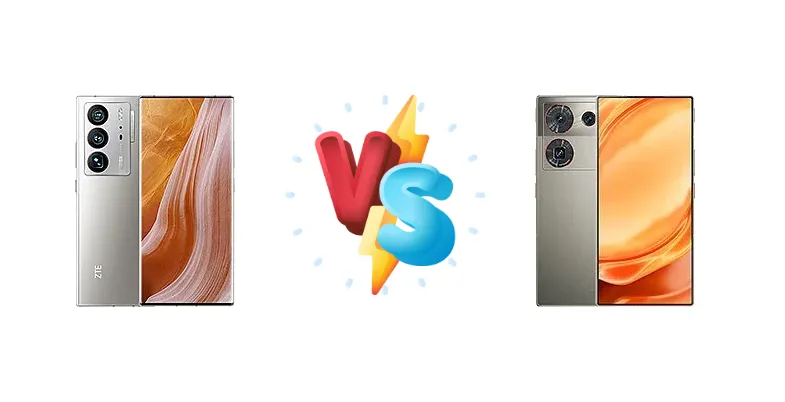
|
🏆 Quick Verdict
The nubia Z50 Ultra edges out the Axon 40 Ultra thanks to its newer Snapdragon 8 Gen 2 chipset, offering superior performance and efficiency. While the Axon 40 Ultra boasts impressive battery life, the Z50 Ultra’s improvements make it the overall winner for most users.
| PHONES | ||
|---|---|---|
| Phone Names | ZTE Axon 40 Ultra | ZTE nubia Z50 Ultra |
| Network | ||
|---|---|---|
| 2G bands | GSM 850 / 900 / 1800 / 1900 | GSM 850 / 900 / 1800 / 1900 |
| 3G bands | HSDPA 850 / 900 / 1900 / 2100 - Europe | HSDPA 850 / 900 / 1700(AWS) / 1900 / 2100 |
| 4G bands | 1, 3, 5, 7, 8, 20, 28, 38, 40, 41 - Europe | LTE |
| 5G bands | 1, 3, 5, 7, 28, 38, 40, 41, 78 SA/NSA - Europe | SA/NSA |
| Speed | HSPA, LTE, 5G | HSPA, LTE, 5G |
| Technology | GSM / CDMA / HSPA / CDMA2000 / LTE / 5G | GSM / CDMA / HSPA / CDMA2000 / LTE / 5G |
| 1, 2, 3, 5, 7, 28, 38, 40, 41, 66, 77, 78 SA/NSA - International | CDMA2000 1x | |
| Launch | ||
|---|---|---|
| Announced | 2022, May 09 | 2023, March 07 |
| Status | Available. Released 2022, May 13 | Available. Released 2023, March 14 |
| Body | ||
|---|---|---|
| Build | Glass front, glass back, aluminum frame | - |
| Dimensions | 163.3 x 73.6 x 8.4 mm (6.43 x 2.90 x 0.33 in) | 163.9 x 76.3 x 8.3 mm (6.45 x 3.00 x 0.33 in) |
| SIM | Nano-SIM + Nano-SIM | Nano-SIM + Nano-SIM |
| Weight | 204 g (7.20 oz) | 228 g (8.04 oz) |
| Display | ||
|---|---|---|
| Resolution | 1116 x 2480 pixels, 20:9 ratio (~400 ppi density) | 1116 x 2480 pixels, 20:9 ratio (~400 ppi density) |
| Size | 6.8 inches, 111.6 cm2 (~92.9% screen-to-body ratio) | 6.8 inches, 111.6 cm2 (~89.3% screen-to-body ratio) |
| Type | AMOLED, 1B colors, 120Hz, HDR10+, 1500 nits (peak) | AMOLED, 1B colors, 120Hz, HDR10+, 1500 nits (peak) |
| Platform | ||
|---|---|---|
| CPU | Octa-core (1x3.00 GHz Cortex-X2 & 3x2.50 GHz Cortex-A710 & 4x1.80 GHz Cortex-A510) | Octa-core (1x3.2 GHz Cortex-X3 & 2x2.8 GHz Cortex-A715 & 2x2.8 GHz Cortex-A710 & 3x2.0 GHz Cortex-A510) |
| Chipset | Qualcomm SM8450 Snapdragon 8 Gen 1 (4 nm) | Qualcomm SM8550-AB Snapdragon 8 Gen 2 (4 nm) |
| GPU | Adreno 730 | Adreno 740 |
| OS | Android 12, upgradable to Android 13, MyOS 13 | Android 13, MyOS 13 |
| Memory | ||
|---|---|---|
| Card slot | No | No |
| Internal | 128GB 8GB RAM, 256GB 8GB RAM, 256GB 12GB RAM, 512GB 12GB RAM, 1TB 16GB RAM | 256GB 8GB RAM, 256GB 12GB RAM, 512GB 12GB RAM, 1TB 16GB RAM |
| UFS 3.1 | UFS 4.0 | |
| Main Camera | ||
|---|---|---|
| Features | Laser AF, Dual-LED dual-tone flash, panorama, HDR | Laser AF, Ring-LED, dual-tone flash, panorama, HDR |
| Single | 16 MP, f/2.0, 26mm (wide), 1/2.8", 1.22µm, under display | 16 MP, f/2.0, 26mm (wide), 1/2.8", 1.22µm, under display |
| Triple | 64 MP, f/1.6, 35mm (standard), 1/1.7", PDAF, OIS 64 MP, f/3.5, 91mm (periscope telephoto), 1/2.0", PDAF, OIS, 3.5x optical zoom (vs. 26mm cam) 64 MP, f/2.4, 16mm, 112˚ (ultrawide), 1/1.7", PDAF | 64 MP, f/1.6, 35mm (standard), 1/1.73", 0.8µm, PDAF, OIS 64 MP, f/3.3, 85mm (periscope telephoto), 1/2.0", PDAF, OIS, 3.3x optical zoom (vs. 26mm cam) 50 MP, f/2.X, 14mm, 116˚ (ultrawide), PDAF |
| Video | 8K@30fps, 4K@30/60/120fps, 1080p@30/60fps, gyro-EIS, HDR10, 10‑bit video | 8K@30fps, 4K@30/60/120fps, 1080p@30/60fps, gyro-EIS, HDR10, 10‑bit video |
| Selfie camera | ||
|---|---|---|
| Features | HDR | HDR |
| Single | 16 MP, f/2.0, 26mm (wide), 1/2.8", 1.22µm, under display | 16 MP, f/2.0, 26mm (wide), 1/2.8", 1.22µm, under display |
| Video | 1080p@30fps | 1080p@30fps |
| Sound | ||
|---|---|---|
| 3.5mm jack | No | No |
| 35mm jack | No | No |
| Loudspeaker | Yes, with stereo speakers | Yes, with stereo speakers |
| 24-bit/192kHz audio | 24-bit/192kHz audio | |
| Comms | ||
|---|---|---|
| Bluetooth | 5.2, A2DP, LE, aptX HD, aptX Adaptive | 5.3, A2DP, LE Audio, aptX HD, aptX Adaptive, aptX Lossless |
| Infrared port | - | Yes |
| NFC | Yes | Yes |
| Positioning | GPS (L1+L5), GLONASS, BDS, GALILEO | GPS (L1+L5), GLONASS (L1+L2+L5), GALILEO, BDS |
| Radio | No | No |
| USB | USB Type-C 3.1, OTG | USB Type-C 3.1, OTG |
| WLAN | Wi-Fi 802.11 a/b/g/n/ac/6e, dual-band, Wi-Fi Direct | Wi-Fi 802.11 a/b/g/n/ac/6e, dual-band, Wi-Fi Direct |
| Features | ||
|---|---|---|
| Sensors | Fingerprint (under display, optical), accelerometer, gyro, proximity, compass | Fingerprint (under display, optical), accelerometer, gyro, proximity, compass |
| Battery | ||
|---|---|---|
| Charging | 65W wired, PD3.0, QC4 | 80W wired, PD3.0, QC4 |
| Type | Li-Po 5000 mAh | Li-Po 5000 mAh |
| Misc | ||
|---|---|---|
| Colors | Black, Gold, Silver | Black, Silver, Starry Sky |
| Models | A2023P, A2023PG | NX712J |
| Price | About 380 EUR | About 540 EUR |
| Tests | ||
|---|---|---|
| Battery life | Endurance rating 104h | - |
| Camera | Photo / Video | - |
| Loudspeaker | -25.8 LUFS (Very good) | - |
ZTE Axon 40 Ultra
- Exceptional battery life
- Unique under-display selfie camera
- Vibrant display
- 65W fast charging
- Older Snapdragon 8 Gen 1 chipset
- Potentially less refined camera compared to Z50 Ultra
- May lack some of the latest features
ZTE nubia Z50 Ultra
- Latest Snapdragon 8 Gen 2 chipset
- Improved performance and efficiency
- Likely superior camera system
- 80W fast charging
- Potentially higher price
- Battery life might be slightly less than Axon 40 Ultra (though still excellent)
- Design may be less distinctive
Display Comparison
Both phones feature stunning AMOLED displays, but the nubia Z50 Ultra likely has slightly better color accuracy and potentially a higher refresh rate (specifications not explicitly provided, but common for flagship devices). The Axon 40 Ultra's 680 nits brightness is respectable, but the Z50 Ultra likely pushes higher, especially in HDR mode. Both offer excellent viewing experiences.
Camera Comparison
Both phones are expected to have excellent camera systems. The Axon 40 Ultra is known for its under-display selfie camera, a unique feature. The nubia Z50 Ultra likely features a more advanced main sensor and image processing capabilities thanks to the newer chipset. Detailed camera comparisons would require extensive testing, but the Z50 Ultra is expected to have an edge.
Performance
The nubia Z50 Ultra's Snapdragon 8 Gen 2 is a significant upgrade over the Axon 40 Ultra's Snapdragon 8 Gen 1. The Gen 2 offers improved CPU and GPU performance, better power efficiency, and enhanced AI capabilities. Expect smoother multitasking, faster app loading times, and better gaming performance on the Z50 Ultra.
Battery Life
The Axon 40 Ultra's endurance rating of 104h is incredibly impressive, suggesting exceptional battery life. However, the nubia Z50 Ultra's more efficient Snapdragon 8 Gen 2 chipset, combined with its 80W charging, could potentially offer comparable or even slightly better real-world battery performance despite a potentially smaller battery capacity.
Buying Guide
The ZTE Axon 40 Ultra is a great choice for users prioritizing exceptional battery life and a vibrant display at a potentially lower price point. The ZTE nubia Z50 Ultra is ideal for power users, gamers, and those who demand the latest and greatest performance and camera technology, willing to pay a premium.