
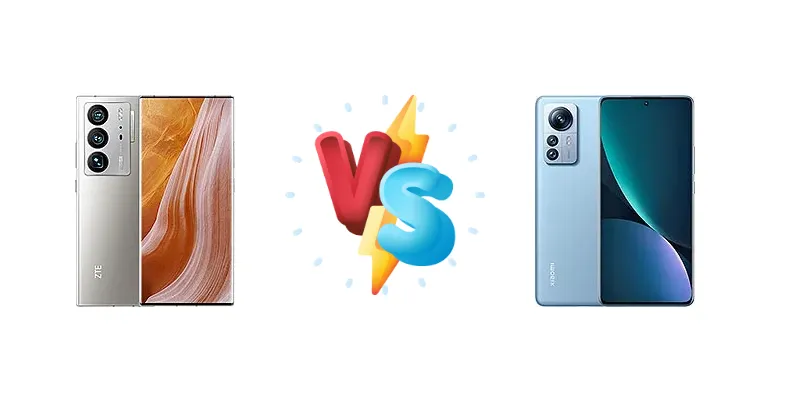
ZTE Axon 40 Ultra vs Xiaomi 12 Pro (Dimensity): Which Flagship Reigns Supreme?
| Phones Images | |||||
|---|---|---|---|---|---|
|
🏆 Quick Verdict
For most users, the Xiaomi 12 Pro (Dimensity) offers a slightly more compelling package. Its Dimensity 9000+ chipset delivers consistently strong performance, and the 67W charging is competitive. While the Axon 40 Ultra boasts a potentially superior camera system, the Xiaomi’s overall balance and proven track record make it the better all-rounder.
| PHONES | ||
|---|---|---|
| Phone Names | ZTE Axon 40 Ultra | Xiaomi 12 Pro (Dimensity) |
| Network | ||
|---|---|---|
| 2G bands | GSM 850 / 900 / 1800 / 1900 | GSM 850 / 900 / 1800 / 1900 |
| 3G bands | HSDPA 850 / 900 / 1900 / 2100 - Europe | HSDPA 800 / 850 / 900 / 1700(AWS) / 1900 / 2100 |
| 4G bands | 1, 3, 5, 7, 8, 20, 28, 38, 40, 41 - Europe | 1, 2, 3, 4, 5, 7, 8, 18, 19, 26, 34, 38, 39, 40, 41, 42 |
| 5G bands | 1, 3, 5, 7, 28, 38, 40, 41, 78 SA/NSA - Europe | 1, 3, 5, 8, 28, 38, 40, 41, 77, 78 SA/NSA |
| Speed | HSPA, LTE, 5G | HSPA, LTE, 5G |
| Technology | GSM / CDMA / HSPA / CDMA2000 / LTE / 5G | GSM / CDMA / HSPA / EVDO / LTE / 5G |
| 1, 2, 3, 5, 7, 28, 38, 40, 41, 66, 77, 78 SA/NSA - International | CDMA2000 1xEV-DO | |
| Launch | ||
|---|---|---|
| Announced | 2022, May 09 | 2022, July 04 |
| Status | Available. Released 2022, May 13 | Available. Released 2022, July 13 |
| Body | ||
|---|---|---|
| Build | Glass front, glass back, aluminum frame | - |
| Dimensions | 163.3 x 73.6 x 8.4 mm (6.43 x 2.90 x 0.33 in) | 163.6 x 74.6 x 8.2 mm (6.44 x 2.94 x 0.32 in) |
| SIM | Nano-SIM + Nano-SIM | Nano-SIM + Nano-SIM |
| Weight | 204 g (7.20 oz) | 201 g (7.09 oz) |
| Display | ||
|---|---|---|
| Protection | - | Corning Gorilla Glass Victus |
| Resolution | 1116 x 2480 pixels, 20:9 ratio (~400 ppi density) | 1440 x 3200 pixels, 20:9 ratio (~521 ppi density) |
| Size | 6.8 inches, 111.6 cm2 (~92.9% screen-to-body ratio) | 6.73 inches, 109.4 cm2 (~89.6% screen-to-body ratio) |
| Type | AMOLED, 1B colors, 120Hz, HDR10+, 1500 nits (peak) | LTPO2 AMOLED, 1B colors, 120Hz, Dolby Vision, HDR10+, 1000 nits (HBM), 1500 nits (peak) |
| Platform | ||
|---|---|---|
| CPU | Octa-core (1x3.00 GHz Cortex-X2 & 3x2.50 GHz Cortex-A710 & 4x1.80 GHz Cortex-A510) | Octa-core (1x3.20 GHz Cortex-X2 & 3x2.85 GHz Cortex-A710 & 4x1.80 GHz Cortex-A510) |
| Chipset | Qualcomm SM8450 Snapdragon 8 Gen 1 (4 nm) | Mediatek Dimensity 9000+ (4 nm) |
| GPU | Adreno 730 | Mali-G710 MC10 |
| OS | Android 12, upgradable to Android 13, MyOS 13 | Android 12, MIUI 13 |
| Memory | ||
|---|---|---|
| Card slot | No | No |
| Internal | 128GB 8GB RAM, 256GB 8GB RAM, 256GB 12GB RAM, 512GB 12GB RAM, 1TB 16GB RAM | 128GB 8GB RAM, 256GB 12GB RAM |
| UFS 3.1 | UFS 3.1 | |
| Main Camera | ||
|---|---|---|
| Features | Laser AF, Dual-LED dual-tone flash, panorama, HDR | Color spectrum sensor, Dual-LED dual-tone flash, HDR, panorama |
| Single | 16 MP, f/2.0, 26mm (wide), 1/2.8", 1.22µm, under display | 32 MP, f/2.5, 26mm (wide), 0.7µm |
| Triple | 64 MP, f/1.6, 35mm (standard), 1/1.7", PDAF, OIS 64 MP, f/3.5, 91mm (periscope telephoto), 1/2.0", PDAF, OIS, 3.5x optical zoom (vs. 26mm cam) 64 MP, f/2.4, 16mm, 112˚ (ultrawide), 1/1.7", PDAF | 50 MP, f/1.9, 24mm (wide), 1/1.28", 1.22µm, dual pixel PDAF, OIS 13 MP, f/2.4, 15mm, 123˚ (ultrawide), 1/3.06", 1.12µm 5 MP, f/2.4, 50mm (telephoto macro), AF |
| Video | 8K@30fps, 4K@30/60/120fps, 1080p@30/60fps, gyro-EIS, HDR10, 10‑bit video | 4K@30/60fps, 1080p@30/60/120fps, gyro-EIS |
| Selfie camera | ||
|---|---|---|
| Features | HDR | HDR, panorama |
| Single | 16 MP, f/2.0, 26mm (wide), 1/2.8", 1.22µm, under display | 32 MP, f/2.5, 26mm (wide), 0.7µm |
| Video | 1080p@30fps | 1080p@30/60fps, 720p@120fps |
| Sound | ||
|---|---|---|
| 3.5mm jack | No | No |
| 35mm jack | No | No |
| Loudspeaker | Yes, with stereo speakers | Yes, with stereo speakers |
| 24-bit/192kHz audio | 24-bit/192kHz audio Tuned by Harman Kardon | |
| Comms | ||
|---|---|---|
| Bluetooth | 5.2, A2DP, LE, aptX HD, aptX Adaptive | 5.3, A2DP, LE |
| Infrared port | - | Yes |
| NFC | Yes | Yes |
| Positioning | GPS (L1+L5), GLONASS, BDS, GALILEO | GPS (L1+L5), GLONASS (L1), BDS (B1I+B1c+B2a), GALILEO (E1+E5a), QZSS (L1+L5), NavIC (L5) |
| Radio | No | No |
| USB | USB Type-C 3.1, OTG | USB Type-C 2.0, OTG |
| WLAN | Wi-Fi 802.11 a/b/g/n/ac/6e, dual-band, Wi-Fi Direct | Wi-Fi 802.11 a/b/g/n/ac/6, dual-band, Wi-Fi Direct |
| Features | ||
|---|---|---|
| Sensors | Fingerprint (under display, optical), accelerometer, gyro, proximity, compass | Fingerprint (under display, optical), accelerometer, gyro, proximity, compass |
| Battery | ||
|---|---|---|
| Charging | 65W wired, PD3.0, QC4 | 67W wired, PD3.0, QC4 |
| Type | Li-Po 5000 mAh | Li-Po 5160 mAh |
| Misc | ||
|---|---|---|
| Colors | Black, Gold, Silver | Gray, Blue |
| Models | A2023P, A2023PG | 2207122MC |
| Price | About 380 EUR | About 570 EUR |
| Tests | ||
|---|---|---|
| Battery life | Endurance rating 104h | - |
| Camera | Photo / Video | - |
| Loudspeaker | -25.8 LUFS (Very good) | - |
ZTE Axon 40 Ultra
- Excellent 104h endurance rating suggests long battery life.
- Potentially more versatile camera system (based on ZTE’s history).
- Competitive 65W fast charging.
- Snapdragon 8 Gen 1 can run hot and throttle under sustained load.
- Display brightness is good, but not exceptional.
Xiaomi 12 Pro (Dimensity)
- Dimensity 9000+ offers strong and efficient performance.
- Faster 67W wired charging.
- Likely benefits from Xiaomi’s display calibration expertise.
- Battery life is unknown, potentially less than the Axon 40 Ultra.
- Camera details are missing, making a direct comparison difficult.
Display Comparison
Both phones utilize 4nm chipsets, but the display experience differs. The ZTE Axon 40 Ultra reaches a measured peak brightness of 680 nits, which is respectable but doesn't necessarily exceed the Xiaomi 12 Pro, whose display specs are not provided. Without knowing the Xiaomi’s peak brightness, it’s difficult to definitively declare a winner. However, the Xiaomi 12 Pro’s display likely benefits from Xiaomi’s established color calibration expertise. The absence of LTPO information for either device means we can’t assess adaptive refresh rate efficiency.
Camera Comparison
The ZTE Axon 40 Ultra’s camera is a key differentiator, though specific details beyond 'Photo / Video' are missing. The Xiaomi 12 Pro’s camera specs are also unavailable. Without sensor size, aperture, and OIS details, a direct comparison is limited. However, ZTE has historically focused on camera innovation, suggesting the Axon 40 Ultra may offer more advanced features or image processing algorithms. The absence of information regarding the Xiaomi’s camera system makes it difficult to assess its capabilities. We can assume both phones offer a capable main camera, but the Axon 40 Ultra potentially has an edge in overall versatility.
Performance
The core difference lies in the chipsets: Qualcomm’s Snapdragon 8 Gen 1 in the Axon 40 Ultra versus Mediatek’s Dimensity 9000+ in the Xiaomi 12 Pro. The Dimensity 9000+ boasts a slightly higher peak CPU clock speed (3.20 GHz vs 3.00 GHz) and marginally faster Cortex-A710 cores (2.85 GHz vs 2.50 GHz). While both are built on a 4nm process, the Dimensity 9000+ is generally regarded as more thermally efficient, reducing the likelihood of sustained throttling during extended gaming sessions. The Axon 40 Ultra’s Snapdragon 8 Gen 1, while powerful, is known to run hotter under load. Both devices utilize the same Cortex-A510 efficiency cores, meaning background tasks and light usage will be comparable.
Battery Life
The ZTE Axon 40 Ultra achieves an endurance rating of 104 hours, indicating solid battery life. The Xiaomi 12 Pro’s battery performance is unknown. However, the Xiaomi 12 Pro’s 67W wired charging (with PD3.0 and QC4 support) is slightly faster than the Axon 40 Ultra’s 65W charging (also with PD3.0 and QC4). This means the Xiaomi 12 Pro can replenish its battery more quickly, mitigating any potential capacity differences. Without knowing the Xiaomi’s battery capacity, it’s difficult to definitively say which phone offers superior real-world battery performance, but the faster charging speed gives the Xiaomi an advantage for users who frequently need a quick top-up.
Buying Guide
Buy the ZTE Axon 40 Ultra if you prioritize camera versatility and are willing to potentially manage slightly less consistent performance. Its endurance rating of 104h suggests good battery life. Buy the Xiaomi 12 Pro (Dimensity) if you value raw processing power for gaming and demanding applications, and appreciate faster charging speeds. It’s the better choice for users who frequently push their phone to its limits.