
ZTE Axon 40 Ultra vs vivo X80 Pro: A Deep Dive into Flagship Features
| Phones Images | |||||
|---|---|---|---|---|---|
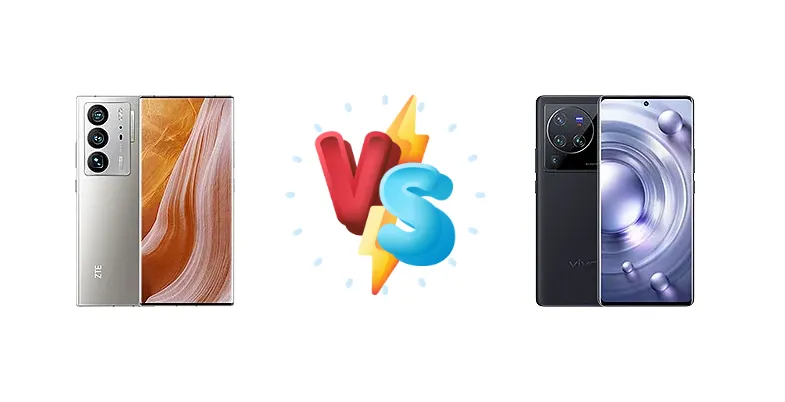
|
🏆 Quick Verdict
For the average user prioritizing longevity, the ZTE Axon 40 Ultra emerges as the winner. Its significantly superior 104-hour endurance rating outweighs the vivo X80 Pro’s brighter display and faster charging, especially for those who frequently find themselves away from a power outlet. However, the X80 Pro’s charging speed is a strong counterpoint.
| PHONES | ||
|---|---|---|
| Phone Names | ZTE Axon 40 Ultra | vivo X80 Pro |
| Network | ||
|---|---|---|
| 2G bands | GSM 850 / 900 / 1800 / 1900 | GSM 850 / 900 / 1800 / 1900 |
| 3G bands | HSDPA 850 / 900 / 1900 / 2100 - Europe | HSDPA 800 / 850 / 900 / 1700(AWS) / 1900 / 2100 |
| 4G bands | 1, 3, 5, 7, 8, 20, 28, 38, 40, 41 - Europe | 1, 2, 3, 4, 5, 7, 8, 12, 13, 17, 18, 19, 20, 26, 28, 32, 38, 39, 40, 41, 42, 66 - International |
| 5G bands | 1, 3, 5, 7, 28, 38, 40, 41, 78 SA/NSA - Europe | 1, 2, 3, 5, 7, 8, 20, 28, 38, 40, 41, 66, 77, 78 SA/NSA - International |
| Speed | HSPA, LTE, 5G | HSPA, LTE, 5G |
| Technology | GSM / CDMA / HSPA / CDMA2000 / LTE / 5G | GSM / CDMA / HSPA / EVDO / LTE / 5G |
| 1, 2, 3, 5, 7, 28, 38, 40, 41, 66, 77, 78 SA/NSA - International | 1, 3, 5, 7, 8, 12, 20, 28, 66, 38, 40, 41, 77, 78, 79 SA/NSA - China | |
| Launch | ||
|---|---|---|
| Announced | 2022, May 09 | 2022, April 25 |
| Status | Available. Released 2022, May 13 | Available. Released 2022, April 29 |
| Body | ||
|---|---|---|
| Build | Glass front, glass back, aluminum frame | Glass front (Schott Xensation Up), glass back or ceramic back or eco leather back, aluminum frame |
| Dimensions | 163.3 x 73.6 x 8.4 mm (6.43 x 2.90 x 0.33 in) | 164.6 x 75.3 x 9.1 mm (6.48 x 2.96 x 0.36 in) |
| SIM | Nano-SIM + Nano-SIM | Nano-SIM + Nano-SIM |
| Weight | 204 g (7.20 oz) | 215 g / 219 g (7.58 oz) |
| - | IP68 dust/water resistant (up to 1.5m for 30 min) | |
| Display | ||
|---|---|---|
| Protection | - | Schott Xensation Up |
| Resolution | 1116 x 2480 pixels, 20:9 ratio (~400 ppi density) | 1440 x 3200 pixels, 20:9 ratio (~517 ppi density) |
| Size | 6.8 inches, 111.6 cm2 (~92.9% screen-to-body ratio) | 6.78 inches, 111.4 cm2 (~89.9% screen-to-body ratio) |
| Type | AMOLED, 1B colors, 120Hz, HDR10+, 1500 nits (peak) | LTPO3 AMOLED, 1B colors, 120Hz, HDR10+, 1500 nits (peak) |
| Platform | ||
|---|---|---|
| CPU | Octa-core (1x3.00 GHz Cortex-X2 & 3x2.50 GHz Cortex-A710 & 4x1.80 GHz Cortex-A510) | Octa-core (1x3.00 GHz Cortex-X2 & 3x2.50 GHz Cortex-A710 & 4x1.80 GHz Cortex-A510)Octa-core (1x3.05 GHz Cortex-X2 & 3x2.85 GHz Cortex-A710 & 4x1.80 GHz Cortex-A510) |
| Chipset | Qualcomm SM8450 Snapdragon 8 Gen 1 (4 nm) | Qualcomm SM8450 Snapdragon 8 Gen 1 (4 nm)Mediatek Dimensity 9000 (4 nm) |
| GPU | Adreno 730 | Adreno 730Mali-G710 MC10 |
| OS | Android 12, upgradable to Android 13, MyOS 13 | Android 12, upgradable to Android 14, Funtouch 14 (Global), OriginOS Ocean (China) |
| Memory | ||
|---|---|---|
| Card slot | No | No |
| Internal | 128GB 8GB RAM, 256GB 8GB RAM, 256GB 12GB RAM, 512GB 12GB RAM, 1TB 16GB RAM | 256GB 8GB RAM, 256GB 12GB RAM, 512GB 12GB RAM |
| UFS 3.1 | UFS 3.1 | |
| Main Camera | ||
|---|---|---|
| Features | Laser AF, Dual-LED dual-tone flash, panorama, HDR | Laser AF, color spectrum sensor, Zeiss optics, Zeiss T* lens coating, Pixel Shift, dual-LED dual-tone flash, HDR, panorama |
| Quad | - | 50 MP, f/1.6, (wide), 1/1.3", PDAF, OIS 8 MP, f/3.4, (periscope telephoto), 1/4.4", 1.0µm, PDAF, OIS, 5x optical zoom 12 MP, f/1.9, 50mm (telephoto), 1/2.93", 1.22µm, dual pixel PDAF, 2x optical zoom, gimbal OIS 48 MP, f/2.2, 114˚ (ultrawide), 1/2.0", AF |
| Single | 16 MP, f/2.0, 26mm (wide), 1/2.8", 1.22µm, under display | 32 MP, f/2.5, 24mm (wide), 1/2.8", 0.8µm |
| Triple | 64 MP, f/1.6, 35mm (standard), 1/1.7", PDAF, OIS 64 MP, f/3.5, 91mm (periscope telephoto), 1/2.0", PDAF, OIS, 3.5x optical zoom (vs. 26mm cam) 64 MP, f/2.4, 16mm, 112˚ (ultrawide), 1/1.7", PDAF | - |
| Video | 8K@30fps, 4K@30/60/120fps, 1080p@30/60fps, gyro-EIS, HDR10, 10‑bit video | 8K@30fps, 4K@30/60fps, 1080p@30/60fps, gyro-EIS |
| Selfie camera | ||
|---|---|---|
| Features | HDR | HDR |
| Single | 16 MP, f/2.0, 26mm (wide), 1/2.8", 1.22µm, under display | 32 MP, f/2.5, 24mm (wide), 1/2.8", 0.8µm |
| Video | 1080p@30fps | 1080p@30fps |
| Sound | ||
|---|---|---|
| 3.5mm jack | No | No |
| 35mm jack | No | No |
| Loudspeaker | Yes, with stereo speakers | Yes, with stereo speakers |
| 24-bit/192kHz audio | 32-bit/192kHz audio | |
| Comms | ||
|---|---|---|
| Bluetooth | 5.2, A2DP, LE, aptX HD, aptX Adaptive | 5.2 (Snapdragon)/ 5.3 (Dimensity), A2DP, LE, aptX HD, aptX Adaptive, aptX Lossless |
| Infrared port | - | Yes |
| NFC | Yes | Yes |
| Positioning | GPS (L1+L5), GLONASS, BDS, GALILEO | GPS (L1+L5), GLONASS, BDS, GALILEO, QZSS, NavIC |
| Radio | No | No |
| USB | USB Type-C 3.1, OTG | USB Type-C 3.1 (Global)/ 3.2 (China), OTG |
| WLAN | Wi-Fi 802.11 a/b/g/n/ac/6e, dual-band, Wi-Fi Direct | Wi-Fi 802.11 a/b/g/n/ac/6, dual-band, Wi-Fi Direct |
| Features | ||
|---|---|---|
| Sensors | Fingerprint (under display, optical), accelerometer, gyro, proximity, compass | Fingerprint (under display, ultrasonic), accelerometer, gyro, proximity, compass |
| Battery | ||
|---|---|---|
| Charging | 65W wired, PD3.0, QC4 | 80W wired, 100% in 38 min 50W wireless, 100% in 50 min Reverse wired |
| Type | Li-Po 5000 mAh | 4700 mAh |
| Misc | ||
|---|---|---|
| Colors | Black, Gold, Silver | Cosmic Black, Blue, Orange |
| Models | A2023P, A2023PG | V2185A, V2145 |
| Price | About 380 EUR | About 850 EUR |
| Tests | ||
|---|---|---|
| Battery life | Endurance rating 104h | Endurance rating 79h |
| Camera | Photo / Video | Photo / Video |
| Display | - | Contrast ratio: Infinite (nominal) |
| Loudspeaker | -25.8 LUFS (Very good) | -25.1 LUFS (Very good) |
ZTE Axon 40 Ultra
- Exceptional battery endurance (104h)
- Competitive 65W fast charging
- Potentially more affordable price point
- Lower peak display brightness (680 nits)
- No wireless charging
vivo X80 Pro
- Significantly brighter display (1014 nits)
- Ultra-fast 80W wired and 50W wireless charging
- Chipset choice (Snapdragon or Dimensity)
- Lower battery endurance (79h)
- Potentially higher price
Display Comparison
The vivo X80 Pro boasts a significantly brighter display, reaching 1014 nits measured, compared to the Axon 40 Ultra’s 680 nits. This difference is immediately noticeable in direct sunlight. While both utilize high-quality panels, the X80 Pro’s higher brightness translates to better outdoor visibility. The X80 Pro also advertises an infinite contrast ratio, suggesting deep blacks, though this is a common marketing claim. Neither specification details refresh rate or panel type (OLED/AMOLED), but both are expected to be high refresh rate OLEDs given their flagship status.
Camera Comparison
Both devices are marketed as having strong camera systems, but detailed sensor information is lacking. The focus should be on image processing and lens quality. Without specifics, it’s difficult to definitively declare a winner. The presence of OIS (Optical Image Stabilization) is assumed on both, given their flagship positioning. The lack of detail regarding sensor sizes and apertures makes a detailed comparison impossible, but the marketing suggests both prioritize photo and video capabilities.
Performance
Both phones utilize the Qualcomm Snapdragon 8 Gen 1 (4nm), but the vivo X80 Pro adds a variant with the MediaTek Dimensity 9000 (4nm). While the Snapdragon 8 Gen 1 offers strong performance, the Dimensity 9000 generally exhibits slightly better thermal management and efficiency, potentially leading to less throttling during sustained workloads. Both CPUs feature the same core configuration (1x Cortex-X2, 3x Cortex-A710, 4x Cortex-A510), but the Dimensity 9000’s Cortex-X2 is clocked slightly higher at 3.05 GHz versus 3.00 GHz on the Snapdragon. RAM specifications are not provided, but both are expected to utilize LPDDR5x for fast memory access.
Battery Life
The ZTE Axon 40 Ultra’s 104-hour endurance rating is a clear advantage over the vivo X80 Pro’s 79-hour rating. This suggests the Axon 40 Ultra can last significantly longer on a single charge under typical usage. However, the X80 Pro compensates with faster charging: 80W wired (100% in 38 minutes) and 50W wireless (100% in 50 minutes), alongside reverse wired charging. The Axon 40 Ultra offers 65W wired charging with PD3.0 and QC4 support, which is still fast, but slower than the X80 Pro’s options. The X80 Pro’s wireless charging capability is also absent on the Axon 40 Ultra.
Buying Guide
Buy the ZTE Axon 40 Ultra if you need exceptional battery life and value for money, and aren't overly concerned with the absolute brightest display. It’s ideal for power users, travelers, or anyone who dislikes frequent charging. Buy the vivo X80 Pro if you prioritize a vibrant, exceptionally bright display, and the convenience of incredibly fast wired and wireless charging. It’s a better fit for users who frequently consume media and want a quick power boost.