
ZTE Axon 40 Ultra vs Oppo Find X5 Pro: Which Flagship Delivers More?
| Phones Images | |||||
|---|---|---|---|---|---|
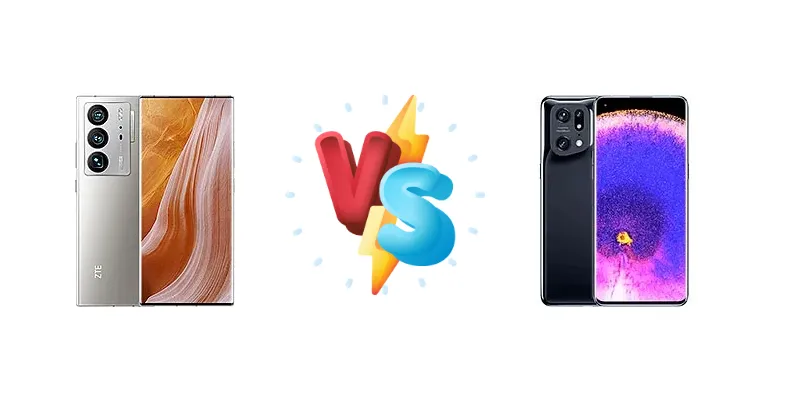
|
🏆 Quick Verdict
For most users, the Oppo Find X5 Pro emerges as the slightly stronger choice. Its brighter display (762 nits vs 680 nits) and significantly faster charging – including 50W wireless – provide tangible benefits. While the Axon 40 Ultra offers comparable performance, the X5 Pro’s charging ecosystem and refined software experience give it an edge.
| PHONES | ||
|---|---|---|
| Phone Names | ZTE Axon 40 Ultra | Oppo Find X5 Pro |
| Network | ||
|---|---|---|
| 2G bands | GSM 850 / 900 / 1800 / 1900 | GSM 850 / 900 / 1800 / 1900 |
| 3G bands | HSDPA 850 / 900 / 1900 / 2100 - Europe | HSDPA 800 / 850 / 900 / 1700(AWS) / 1900 / 2100 |
| 4G bands | 1, 3, 5, 7, 8, 20, 28, 38, 40, 41 - Europe | 1, 2, 3, 4, 5, 7, 8, 12, 13, 17, 18, 19, 20, 25, 26, 28, 32, 34, 38, 39, 40, 41, 42, 66 - Global |
| 5G bands | 1, 3, 5, 7, 28, 38, 40, 41, 78 SA/NSA - Europe | 1, 2, 3, 5, 7, 8, 12, 13, 18, 20, 25, 26, 28, 38, 40, 41, 66, 77, 78, 79 SA/NSA - Global |
| Speed | HSPA, LTE, 5G | HSPA, LTE, 5G |
| Technology | GSM / CDMA / HSPA / CDMA2000 / LTE / 5G | GSM / CDMA / HSPA / CDMA2000 / LTE / 5G |
| 1, 2, 3, 5, 7, 28, 38, 40, 41, 66, 77, 78 SA/NSA - International | 1, 2, 3, 5, 8, 20, 28, 38, 41, 66, 77, 78, 79 SA/NSA - China | |
| Launch | ||
|---|---|---|
| Announced | 2022, May 09 | 2022, February 24 |
| Status | Available. Released 2022, May 13 | Available. Released 2022, March 14 |
| Body | ||
|---|---|---|
| Build | Glass front, glass back, aluminum frame | Glass front (Gorilla Glass Victus), ceramic back or eco leather back, aluminum frame |
| Dimensions | 163.3 x 73.6 x 8.4 mm (6.43 x 2.90 x 0.33 in) | 163.7 x 73.9 x 8.5 or 8.8 mm |
| SIM | Nano-SIM + Nano-SIM | Nano-SIM + eSIM |
| Weight | 204 g (7.20 oz) | 218 g or 195 g (6.88 oz) |
| - | IP68 dust/water resistant (up to 1.5m for 30 min) | |
| Display | ||
|---|---|---|
| Protection | - | Corning Gorilla Glass Victus |
| Resolution | 1116 x 2480 pixels, 20:9 ratio (~400 ppi density) | 1440 x 3216 pixels, 20:9 ratio (~525 ppi density) |
| Size | 6.8 inches, 111.6 cm2 (~92.9% screen-to-body ratio) | 6.7 inches, 108.4 cm2 (~89.6% screen-to-body ratio) |
| Type | AMOLED, 1B colors, 120Hz, HDR10+, 1500 nits (peak) | LTPO2 AMOLED, 1B colors, 120Hz, HDR10+, BT.2020, 500 nits (typ), 800 nits (HBM), 1300 nits (peak) |
| Platform | ||
|---|---|---|
| CPU | Octa-core (1x3.00 GHz Cortex-X2 & 3x2.50 GHz Cortex-A710 & 4x1.80 GHz Cortex-A510) | Octa-core (1x3.00 GHz Cortex-X2 & 3x2.50 GHz Cortex-A710 & 4x1.80 GHz Cortex-A510) - GlobalOcta-core (1x3.05 GHz Cortex-X2 & 3x2.85 GHz Cortex-A710 & 4x1.80 GHz Cortex-A510) - China |
| Chipset | Qualcomm SM8450 Snapdragon 8 Gen 1 (4 nm) | Qualcomm SM8450 Snapdragon 8 Gen 1 (4 nm) - GlobalMediatek Dimensity 9000 (4 nm) - China |
| GPU | Adreno 730 | Adreno 730 - GlobalMali-G710 MC10 - China |
| OS | Android 12, upgradable to Android 13, MyOS 13 | Android 12, upgradable to Android 14, ColorOS 14 |
| Memory | ||
|---|---|---|
| Card slot | No | No |
| Internal | 128GB 8GB RAM, 256GB 8GB RAM, 256GB 12GB RAM, 512GB 12GB RAM, 1TB 16GB RAM | 256GB 8GB RAM, 256GB 12GB RAM, 512GB 12GB RAM |
| UFS 3.1 | UFS 3.1 | |
| Main Camera | ||
|---|---|---|
| Features | Laser AF, Dual-LED dual-tone flash, panorama, HDR | Hasselblad Color Calibration, color spectrum sensor, LED flash, HDR, panorama |
| Single | 16 MP, f/2.0, 26mm (wide), 1/2.8", 1.22µm, under display | 32 MP, f/2.4, 21mm (wide), 1/2.74", 0.8µm |
| Triple | 64 MP, f/1.6, 35mm (standard), 1/1.7", PDAF, OIS 64 MP, f/3.5, 91mm (periscope telephoto), 1/2.0", PDAF, OIS, 3.5x optical zoom (vs. 26mm cam) 64 MP, f/2.4, 16mm, 112˚ (ultrawide), 1/1.7", PDAF | 50 MP, f/1.7, 25mm (wide), 1/1.56", 1.0µm, multi-directional PDAF, OIS (3-axis sensor-shift, 2-axis lens-shift) 13 MP, f/2.4, 52mm (telephoto), 1/3.4", 2x optical zoom, PDAF 50 MP, f/2.2, 15mm, 110˚ (ultrawide), 1/1.56", 1.0µm, multi-directional PDAF |
| Video | 8K@30fps, 4K@30/60/120fps, 1080p@30/60fps, gyro-EIS, HDR10, 10‑bit video | 4K@30/60fps, 1080p@30/60/240fps; gyro-EIS; HDR, 10‑bit video |
| Selfie camera | ||
|---|---|---|
| Features | HDR | Panorama |
| Single | 16 MP, f/2.0, 26mm (wide), 1/2.8", 1.22µm, under display | 32 MP, f/2.4, 21mm (wide), 1/2.74", 0.8µm |
| Video | 1080p@30fps | 1080p@30fps, gyro-EIS |
| Sound | ||
|---|---|---|
| 3.5mm jack | No | No |
| 35mm jack | No | No |
| Loudspeaker | Yes, with stereo speakers | Yes, with stereo speakers |
| 24-bit/192kHz audio | - | |
| Comms | ||
|---|---|---|
| Bluetooth | 5.2, A2DP, LE, aptX HD, aptX Adaptive | 5.2, A2DP, LE, aptX HD |
| NFC | Yes | Yes |
| Positioning | GPS (L1+L5), GLONASS, BDS, GALILEO | GPS (L1), GLONASS (L1), BDS (B1I+B1c), GALILEO (E1+E5a), QZSS (L1) |
| Radio | No | No |
| USB | USB Type-C 3.1, OTG | USB Type-C 3.1, OTG |
| WLAN | Wi-Fi 802.11 a/b/g/n/ac/6e, dual-band, Wi-Fi Direct | Wi-Fi 802.11 a/b/g/n/ac/6e, dual-band, Wi-Fi Direct |
| Features | ||
|---|---|---|
| Sensors | Fingerprint (under display, optical), accelerometer, gyro, proximity, compass | Fingerprint (under display, optical), accelerometer, gyro, proximity, compass |
| - | Oppo Find X5 Pro Dimensity model has no MariSilicon X image chip, 5-axis OIS and Hasselblad’s color calibration | |
| Battery | ||
|---|---|---|
| Charging | 65W wired, PD3.0, QC4 | 80W wired, PD, 50% in 12 min 50W wireless, 100% in 47 min 10W reverse wireless |
| Type | Li-Po 5000 mAh | Li-Po 5000 mAh |
| Misc | ||
|---|---|---|
| Colors | Black, Gold, Silver | Ceramic Black, Ceramic White, Blue (eco leather) |
| Models | A2023P, A2023PG | PFEM10, CPH2305, PFFM20 |
| Price | About 380 EUR | € 449.00 / $ 430.24 / £ 1,049.00 |
| Tests | ||
|---|---|---|
| Battery life | Endurance rating 104h | Endurance rating 101h |
| Camera | Photo / Video | Photo / Video |
| Display | - | Contrast ratio: Infinite (nominal) |
| Loudspeaker | -25.8 LUFS (Very good) | -24.7 LUFS (Very good) |
| Performance | - | AnTuTu: 1012896 (v9) GeekBench: 3433 (v5.1) GFXBench: 44fps (ES 3.1 onscreen) |
ZTE Axon 40 Ultra
- Potentially lower price point
- Comparable Snapdragon 8 Gen 1 performance
- Solid battery endurance (104h)
- Dimmer display (680 nits)
- Lacks wireless charging
- Less refined software experience (potentially)
Oppo Find X5 Pro
- Brighter display (762 nits)
- Significantly faster wired and wireless charging
- More polished software experience
- Slightly lower battery endurance (101h)
- Potentially higher price
- Dimensity 9000 variant only available in China
Display Comparison
The Oppo Find X5 Pro boasts a significantly brighter display, reaching 762 nits compared to the Axon 40 Ultra’s 680 nits. This translates to better visibility outdoors under direct sunlight. While both utilize high-quality panels, the X5 Pro’s infinite contrast ratio (nominal) suggests deeper blacks and a more dynamic image. Neither specification details refresh rate or panel type (LTPO), but both are expected to offer smooth scrolling and efficient power consumption. The brightness difference is the key differentiator for users who frequently consume content outdoors.
Camera Comparison
Both devices feature capable camera systems, but detailed sensor information is lacking. The focus should be on image processing and lens quality. Without specific details on sensor sizes and apertures, it’s difficult to declare a clear winner. However, the inclusion of OIS (Optical Image Stabilization) is expected on both, crucial for stable video recording and low-light photography. The absence of details regarding the quality of the secondary cameras (ultrawide, telephoto) makes a comprehensive comparison impossible. Ignoring the likely low-resolution macro cameras, the primary sensor and image processing algorithms will be the deciding factors.
Performance
Both phones are equipped with the Qualcomm Snapdragon 8 Gen 1 (4nm), ensuring comparable raw processing power. However, the Oppo Find X5 Pro, in China, utilizes the MediaTek Dimensity 9000 (4nm) which offers a slightly higher CPU clock speed (3.05 GHz Cortex-X2 vs 3.00 GHz). While the real-world performance difference is likely minimal, the Dimensity variant may exhibit slightly better sustained performance due to potentially improved thermal management. Both devices feature the same CPU core configuration (1x Cortex-X2, 3x Cortex-A710, 4x Cortex-A510), and the impact of RAM speed (likely LPDDR5x on both) is negligible in most everyday tasks.
Battery Life
The ZTE Axon 40 Ultra achieves an endurance rating of 104 hours, slightly exceeding the Oppo Find X5 Pro’s 101 hours. However, this difference is marginal. The X5 Pro compensates with significantly faster charging: 80W wired (50% in 12 minutes) and 50W wireless (100% in 47 minutes), alongside 10W reverse wireless charging. The Axon 40 Ultra offers 65W wired charging with PD3.0 and QC4 support, but lacks wireless charging. For users who prioritize quick top-ups, the Oppo Find X5 Pro is the clear winner. The slightly longer endurance of the Axon 40 Ultra is offset by the X5 Pro’s superior charging speed and versatility.
Buying Guide
Buy the ZTE Axon 40 Ultra if you prioritize a potentially lower price point and are comfortable with a slightly less polished software experience. It delivers flagship-level performance and a capable camera system. Buy the Oppo Find X5 Pro if you value a brighter, more vibrant display, incredibly fast wired and wireless charging, and a more refined, feature-rich user experience. It’s the better choice for power users and those who demand the best in convenience.