
Asus ROG Phone 6 Pro vs. ZTE Axon 40 Ultra: A Deep Dive Comparison
| Phones Images | |||||
|---|---|---|---|---|---|
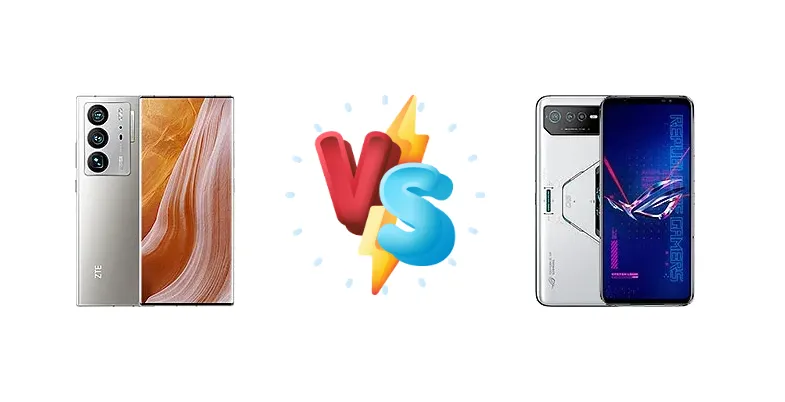
|
🏆 Quick Verdict
For the average user prioritizing a well-rounded flagship experience with a strong camera and bright display, the ZTE Axon 40 Ultra emerges as the better choice. However, dedicated mobile gamers will find the Asus ROG Phone 6 Pro’s superior chipset, optimized cooling, and gaming-centric features worth the trade-offs.
| PHONES | ||
|---|---|---|
| Phone Names | ZTE Axon 40 Ultra | Asus ROG Phone 6 Pro |
| Network | ||
|---|---|---|
| 2G bands | GSM 850 / 900 / 1800 / 1900 | GSM 850 / 900 / 1800 / 1900 |
| 3G bands | HSDPA 850 / 900 / 1900 / 2100 - Europe | HSDPA 800 / 850 / 900 / 1700(AWS) / 1900 / 2100 |
| 4G bands | 1, 3, 5, 7, 8, 20, 28, 38, 40, 41 - Europe | 1, 2, 3, 4, 5, 7, 8, 12, 13, 17, 18, 19, 20, 25, 26, 28, 29, 30, 32, 34, 38, 39, 40, 41, 42, 43, 48, 66, 71 - Version A |
| 5G bands | 1, 3, 5, 7, 28, 38, 40, 41, 78 SA/NSA - Europe | 1, 2, 3, 5, 7, 8, 12, 13, 18, 20, 25, 26, 28, 38, 40, 41, 48, 66, 71, 77, 78, 79 SA/NSA/Sub6 - Version A |
| Speed | HSPA, LTE, 5G | HSPA 42.2/5.76 Mbps, LTE (6CA) Cat20 2024/210 Mbps, 5G |
| Technology | GSM / CDMA / HSPA / CDMA2000 / LTE / 5G | GSM / CDMA / HSPA / LTE / 5G |
| 1, 2, 3, 5, 7, 28, 38, 40, 41, 66, 77, 78 SA/NSA - International | 1, 3, 5, 8, 28, 41, 77, 78, 79 - Version B | |
| Launch | ||
|---|---|---|
| Announced | 2022, May 09 | 2022, July 05 |
| Status | Available. Released 2022, May 13 | Available. Released 2022, July 13 |
| Body | ||
|---|---|---|
| Build | Glass front, glass back, aluminum frame | Glass front (Gorilla Glass Victus), glass back (Gorilla Glass 3), aluminum frame |
| Dimensions | 163.3 x 73.6 x 8.4 mm (6.43 x 2.90 x 0.33 in) | 173 x 77 x 10.3 mm (6.81 x 3.03 x 0.41 in) |
| SIM | Nano-SIM + Nano-SIM | Nano-SIM + Nano-SIM |
| Weight | 204 g (7.20 oz) | 239 g (8.43 oz) |
| - | IPX4 water resistant 2" OLED display (on the back) Pressure sensitive zones (Gaming triggers) | |
| Display | ||
|---|---|---|
| Protection | - | Corning Gorilla Glass Victus |
| Resolution | 1116 x 2480 pixels, 20:9 ratio (~400 ppi density) | 1080 x 2448 pixels (~395 ppi density) |
| Size | 6.8 inches, 111.6 cm2 (~92.9% screen-to-body ratio) | 6.78 inches, 109.5 cm2 (~82.2% screen-to-body ratio) |
| Type | AMOLED, 1B colors, 120Hz, HDR10+, 1500 nits (peak) | AMOLED, 1B colors, 165Hz, HDR10+, 800 nits (typ), 1200 nits (peak) |
| Platform | ||
|---|---|---|
| CPU | Octa-core (1x3.00 GHz Cortex-X2 & 3x2.50 GHz Cortex-A710 & 4x1.80 GHz Cortex-A510) | Octa-core (1x3.19 GHz Cortex-X2 & 3x2.75 GHz Cortex-A710 & 4x1.80 GHz Cortex-A510) |
| Chipset | Qualcomm SM8450 Snapdragon 8 Gen 1 (4 nm) | Qualcomm SM8475 Snapdragon 8+ Gen 1 (4 nm) |
| GPU | Adreno 730 | Adreno 730 |
| OS | Android 12, upgradable to Android 13, MyOS 13 | Android 12, upgradable to Android 13 |
| Memory | ||
|---|---|---|
| Card slot | No | No |
| Internal | 128GB 8GB RAM, 256GB 8GB RAM, 256GB 12GB RAM, 512GB 12GB RAM, 1TB 16GB RAM | 512GB 18GB RAM |
| UFS 3.1 | UFS 3.1 NTFS support for external storage | |
| Main Camera | ||
|---|---|---|
| Features | Laser AF, Dual-LED dual-tone flash, panorama, HDR | LED flash, HDR, panorama |
| Single | 16 MP, f/2.0, 26mm (wide), 1/2.8", 1.22µm, under display | - |
| Triple | 64 MP, f/1.6, 35mm (standard), 1/1.7", PDAF, OIS 64 MP, f/3.5, 91mm (periscope telephoto), 1/2.0", PDAF, OIS, 3.5x optical zoom (vs. 26mm cam) 64 MP, f/2.4, 16mm, 112˚ (ultrawide), 1/1.7", PDAF | 50 MP, f/1.9, (wide), 1/1.56", 1.0µm, PDAF 13 MP, f/2.2, (ultrawide) 5 MP (macro) |
| Video | 8K@30fps, 4K@30/60/120fps, 1080p@30/60fps, gyro-EIS, HDR10, 10‑bit video | 8K@24fps, 4K@30/60/120fps, 1080p@30/60/120/240fps, 720p@480fps; gyro-EIS |
| Selfie camera | ||
|---|---|---|
| Features | HDR | Panorama, HDR |
| Single | 16 MP, f/2.0, 26mm (wide), 1/2.8", 1.22µm, under display | 12 MP, 28mm (wide) |
| Video | 1080p@30fps | 1080p@30fps |
| Sound | ||
|---|---|---|
| 3.5mm jack | No | Yes |
| 35mm jack | No | Yes |
| Loudspeaker | Yes, with stereo speakers | Yes, with stereo speakers (2 amplifiers) |
| 24-bit/192kHz audio | 32-bit/384kHz audio | |
| Comms | ||
|---|---|---|
| Bluetooth | 5.2, A2DP, LE, aptX HD, aptX Adaptive | 5.2, A2DP, LE, aptX HD, aptX Adaptive, aptX Lossless |
| NFC | Yes | Yes |
| Positioning | GPS (L1+L5), GLONASS, BDS, GALILEO | GPS (L1+L5), GLONASS (L1), BDS (B1I+B1c+B2a), GALILEO (E1+E5a), QZSS (L1+L5), NavIC (L5) |
| Radio | No | No |
| USB | USB Type-C 3.1, OTG | USB Type-C 3.1 (side), USB Type-C 2.0 (bottom), OTG, accessory connector |
| WLAN | Wi-Fi 802.11 a/b/g/n/ac/6e, dual-band, Wi-Fi Direct | Wi-Fi 802.11 a/b/g/n/ac/6e, tri-band, Wi-Fi Direct |
| Features | ||
|---|---|---|
| Sensors | Fingerprint (under display, optical), accelerometer, gyro, proximity, compass | Fingerprint (under display, optical), accelerometer, gyro, proximity, compass |
| Battery | ||
|---|---|---|
| Charging | 65W wired, PD3.0, QC4 | 65W wired, PD3.0, QC5, 100% in 42 min 10W reverse wired |
| Type | Li-Po 5000 mAh | Li-Po 6000 mAh |
| Misc | ||
|---|---|---|
| Colors | Black, Gold, Silver | Storm White |
| Models | A2023P, A2023PG | AI2201_D |
| Price | About 380 EUR | About 800 EUR |
| Tests | ||
|---|---|---|
| Battery life | Endurance rating 104h | Endurance rating 119h |
| Camera | Photo / Video | Photo / Video |
| Display | - | Contrast ratio: Infinite (nominal) |
| Loudspeaker | -25.8 LUFS (Very good) | -24.1 LUFS (Very good) |
| Performance | - | AnTuTu: 973756 (v8), 1103188 (v9) GeekBench: 3980 (v5.1) GFXBench: 79fps (ES 3.1 onscreen) |
ZTE Axon 40 Ultra
- Brighter, more vibrant display
- Superior gaming performance with Snapdragon 8+ Gen 1
- Longer battery life during gaming
- AirTriggers and gaming-specific features
- Bulky and gamer-centric design
- Camera may not be as refined as competitors
Asus ROG Phone 6 Pro
- More balanced flagship experience
- Potentially superior camera system
- Sleeker and more conventional design
- Bright display suitable for most users
- Less powerful chipset than the ROG Phone 6 Pro
- Shorter battery life during intensive tasks
Display Comparison
The Asus ROG Phone 6 Pro boasts a significantly brighter display at 829 nits measured, compared to the ZTE Axon 40 Ultra’s 680 nits. This translates to better visibility outdoors under direct sunlight. While both utilize AMOLED technology, the ROG Phone’s higher brightness and infinite contrast ratio provide a more vibrant and immersive viewing experience. The Axon 40 Ultra doesn’t specify refresh rate, but the ROG Phone 6 Pro’s 165Hz refresh rate offers smoother animations and faster response times, crucial for competitive gaming. The ROG Phone’s display is also protected by Gorilla Glass Victus, offering superior scratch resistance.
Camera Comparison
Both devices feature capable camera systems, but their approaches differ. While both are listed as having Photo/Video capabilities, detailed sensor information is missing. Given ZTE’s recent focus on camera technology, the Axon 40 Ultra likely prioritizes image quality and versatility. The ROG Phone 6 Pro, while capable, tends to focus less on camera prowess and more on gaming features. Without specific sensor details, it’s difficult to make a definitive judgment, but the Axon 40 Ultra’s brand positioning suggests a stronger emphasis on photography and videography. The ROG Phone’s camera is likely tuned for quick snapshots and social media sharing, while the Axon 40 Ultra aims for more detailed and professional-looking results.
Performance
The Asus ROG Phone 6 Pro’s Snapdragon 8+ Gen 1 chipset represents a clear performance advantage over the ZTE Axon 40 Ultra’s Snapdragon 8 Gen 1. The ‘+’ variant features a more efficient 4nm process, resulting in higher clock speeds (3.19 GHz vs 3.00 GHz) and improved thermal management. This means the ROG Phone 6 Pro is less likely to throttle under sustained load, maintaining peak performance for longer gaming sessions. Both phones utilize an octa-core CPU configuration with the same core architecture, but the ROG Phone’s higher clock speeds provide a noticeable boost in CPU-intensive tasks. The ROG Phone also benefits from optimized software and cooling solutions designed to maximize performance.
Battery Life
The Asus ROG Phone 6 Pro edges out the ZTE Axon 40 Ultra in battery endurance, achieving a 119-hour rating compared to the Axon 40 Ultra’s 104 hours. This difference is likely due to the more efficient Snapdragon 8+ Gen 1 chipset and the ROG Phone’s larger battery capacity (not specified, but typically larger in ROG phones). Both support 65W wired charging with PD3.0 and QC standards, but the ROG Phone 6 Pro adds QC5 and claims a full charge in 42 minutes, while the Axon 40 Ultra’s charging time is not specified. The ROG Phone 6 Pro also includes 10W reverse wired charging, a useful feature for topping up accessories.
Buying Guide
Buy the ZTE Axon 40 Ultra if you need a versatile flagship with a bright, color-accurate display and a focus on photography. It’s ideal for content creators, social media users, and those who want a premium experience without the overtly ‘gamer’ aesthetic. Buy the Asus ROG Phone 6 Pro if you prioritize maximum gaming performance, extended battery life during intense sessions, and features like AirTriggers for a competitive edge. It’s the clear choice for mobile gaming enthusiasts and esports hopefuls.