
ZTE Axon 40 Ultra Space Edition vs Xiaomi 13 Pro: A Deep Dive Comparison
| Phones Images | |||||
|---|---|---|---|---|---|
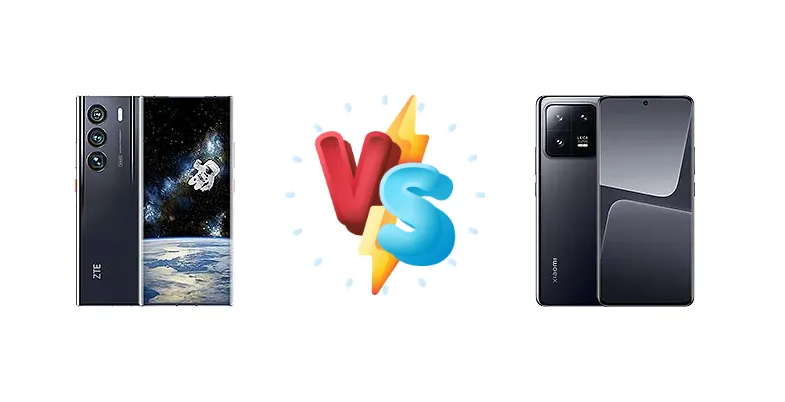
|
🏆 Quick Verdict
For most users, the Xiaomi 13 Pro emerges as the superior choice. The Snapdragon 8 Gen 2 provides a noticeable performance uplift, coupled with significantly faster charging – reaching 100% in just 19 minutes. While the Axon 40 Ultra offers a competitive package, the 13 Pro’s efficiency and speed justify its price premium.
| PHONES | ||
|---|---|---|
| Phone Names | ZTE Axon 40 Ultra Space Edition | Xiaomi 13 Pro |
| Network | ||
|---|---|---|
| 2G bands | GSM 850 / 900 / 1800 / 1900 | GSM 850 / 900 / 1800 / 1900 |
| 3G bands | HSDPA 850 / 900 / 1700(AWS) / 1900 / 2100 | HSDPA 800 / 850 / 900 / 1700(AWS) / 1900 / 2100 |
| 4G bands | 1, 2, 3, 4, 5, 7, 8, 12, 17, 20, 28, 38, 40, 41, 66 | 1, 2, 3, 4, 5, 7, 8, 12, 13, 17, 18, 19, 20, 25, 26, 28, 32, 38, 39, 40, 41, 42, 48, 66 - International |
| 5G bands | 1, 2, 3, 5, 7, 28, 38, 40, 41, 66, 77, 78 | 1, 3, 5, 7, 8, 20, 28, 38, 40, 41, 66, 71, 75, 77, 78 SA/NSA - International |
| Speed | HSPA, LTE, 5G | HSPA, LTE, 5G |
| Technology | GSM / CDMA / HSPA / CDMA2000 / LTE / 5G | GSM / CDMA / HSPA / CDMA2000 / LTE / 5G |
| CDMA2000 1x | 1, 3, 5, 8, 28, 38, 40, 41, 77, 78, 79 SA/NSA - China | |
| Launch | ||
|---|---|---|
| Announced | 2022, November 29 | 2022, December 11 |
| Status | Available. Released 2022, December 06 | Available. Released 2022, December 14 |
| Body | ||
|---|---|---|
| Build | Glass front, ceramic back, aluminum frame | Glass front (Gorilla Glass Victus), ceramic back or silicone polymer back, aluminum frame |
| Dimensions | 163.3 x 73.6 x 8.4 mm (6.43 x 2.90 x 0.33 in) | 162.9 x 74.6 x 8.4 mm or 8.7 mm |
| SIM | Nano-SIM + Nano-SIM | · Nano-SIM + eSIM· Nano-SIM + Nano-SIM |
| Weight | 204 g (7.20 oz) | 210 g or 229 g (7.41 oz) |
| - | IP68 dust/water resistant (up to 1.5m for 30 min) | |
| Display | ||
|---|---|---|
| Protection | - | Corning Gorilla Glass Victus |
| Resolution | 1116 x 2480 pixels, 20:9 ratio (~400 ppi density) | 1440 x 3200 pixels, 20:9 ratio (~522 ppi density) |
| Size | 6.8 inches, 111.6 cm2 (~92.9% screen-to-body ratio) | 6.73 inches, 108.9 cm2 (~89.6% screen-to-body ratio) |
| Type | AMOLED, 1B colors, 120Hz, HDR10+, 1500 nits (peak) | LTPO AMOLED, 1B colors, 120Hz, Dolby Vision, HDR10+, 1200 nits (HBM), 1900 nits (peak) |
| Platform | ||
|---|---|---|
| CPU | Octa-core (1x3.00 GHz Cortex-X2 & 3x2.50 GHz Cortex-A710 & 4x1.80 GHz Cortex-A510) | Octa-core (1x3.2 GHz Cortex-X3 & 2x2.8 GHz Cortex-A715 & 2x2.8 GHz Cortex-A710 & 3x2.0 GHz Cortex-A510) |
| Chipset | Qualcomm SM8450 Snapdragon 8 Gen 1 (4 nm) | Qualcomm SM8550-AB Snapdragon 8 Gen 2 (4 nm) |
| GPU | Adreno 730 | Adreno 740 |
| OS | Android 12, MyOS 12 | Android 13, upgradable to Android 14, HyperOS |
| Memory | ||
|---|---|---|
| Card slot | No | No |
| Internal | 512GB 12GB RAM, 1TB 18GB RAM | 128GB 8GB RAM, 256GB 8GB RAM, 256GB 12GB RAM, 512GB 12GB RAM |
| UFS 3.1 | UFS 3.1 - 128GB UFS 4.0 - 256/512GB | |
| Main Camera | ||
|---|---|---|
| Features | Laser AF, Dual-LED dual-tone flash, panorama, HDR | Laser AF, color spectrum sensor, Leica lens, Dual-LED dual-tone flash, HDR, panorama |
| Single | 16 MP, f/2.0, 26mm (wide), 1/2.8", 1.22µm, under display | - |
| Triple | 64 MP, f/1.6, 35mm (standard), 1/1.7", PDAF, OIS 64 MP, f/3.5, 91mm (periscope telephoto), 1/2.0", PDAF, OIS, 3.5x optical zoom (vs. 26mm cam) 64 MP, f/2.4, 16mm, 112˚ (ultrawide), 1/1.7", PDAF | 50.3 MP, f/1.9, 23mm (wide), 1.0"-type, 1.6µm, dual pixel PDAF, OIS 50 MP, f/2.0, 75mm (telephoto), PDAF (10cm - ∞), 3.2x optical zoom 50 MP, f/2.2, 14mm, 115˚ (ultrawide), AF |
| Video | 8K@30fps, 4K@30/60/120fps, 1080p@30/60fps, gyro-EIS, HDR10, 10‑bit video | 8K@24fps (HDR), 4K@24/30/60fps (HDR10+, 10-bit Dolby Vision HDR, 10-bit LOG), 1080p@30/120/240/960fps, 1080p@1920fps, gyro-EIS |
| Selfie camera | ||
|---|---|---|
| Features | HDR | HDR, panorama |
| Single | 16 MP, f/2.0, 26mm (wide), 1/2.8", 1.22µm, under display | 32 MP, f/2.0, 22mm (wide), 1/3.14", 0.7µm |
| Video | 1080p@30fps | 1080p@30fps |
| Sound | ||
|---|---|---|
| 3.5mm jack | No | No |
| 35mm jack | No | No |
| Loudspeaker | Yes, with stereo speakers | Yes, with stereo speakers |
| 24-bit/192kHz audio | 24-bit/192kHz audio | |
| Comms | ||
|---|---|---|
| Bluetooth | 5.2, A2DP, LE, aptX HD, aptX Adaptive | 5.3, A2DP, aptX HD, aptX Adaptive |
| Infrared port | - | Yes |
| NFC | Yes | Yes |
| Positioning | GPS (L1+L5), GLONASS, BDS, GALILEO | GPS (L1+L5), GLONASS (G1), BDS (B1I+B1c+B2a), GALILEO (E1+E5a), QZSS (L1+L5), NavIC (L5) |
| Radio | No | No |
| USB | USB Type-C 3.1, OTG | USB Type-C 2.0, OTG |
| WLAN | Wi-Fi 802.11 a/b/g/n/ac/6e, dual-band, Wi-Fi Direct | Wi-Fi 802.11 a/b/g/n/ac/6e, dual-band, Wi-Fi Direct |
| Features | ||
|---|---|---|
| Sensors | Fingerprint (under display, optical), accelerometer, gyro, proximity, compass | Fingerprint (under display, optical), accelerometer, proximity, gyro, compass, barometer |
| Battery | ||
|---|---|---|
| Charging | 80W wired, PD3.0, QC4 | 120W wired, PD3.0, QC4, 100% in 19 min 50W wireless, 100% in 36 min 10W reverse wireless |
| Type | Li-Po 5000 mAh | Li-Po 4820 mAh |
| Misc | ||
|---|---|---|
| Colors | Black | Ceramic White, Ceramic Black, Ceramic Flora Green, Mountain Blue |
| Models | A2023P | 2210132G, 2210132C |
| Price | About 800 EUR | About 750 EUR |
| Tests | ||
|---|---|---|
| Battery life | - | Endurance rating 115h |
| Camera | - | Photo / Video |
| Display | - | Contrast ratio: Infinite (nominal) |
| Loudspeaker | - | -25.6 LUFS (Very good) |
| Performance | - | AnTuTu: 1281666 (v9) GeekBench: 5087 (v5.1), 5323 (v6) GFXBench: 64fps (ES 3.1 onscreen) |
ZTE Axon 40 Ultra Space Edition
- Potentially lower price point
- Feature-rich package
- 80W fast charging
- Older Snapdragon 8 Gen 1 chipset
- Slower charging compared to Xiaomi 13 Pro
- Limited display brightness data
Xiaomi 13 Pro
- Latest Snapdragon 8 Gen 2 chipset
- Blazing-fast 120W wired and 50W wireless charging
- High peak display brightness (1253 nits)
- Higher price tag
- May not offer significant camera improvements over competitors
- Potential for software bloat (typical of Xiaomi)
Display Comparison
The Xiaomi 13 Pro boasts a measured peak brightness of 1253 nits, suggesting a more vibrant and readable display in direct sunlight compared to the Axon 40 Ultra (brightness data unavailable). Both devices likely feature high contrast ratios, with the Xiaomi 13 Pro explicitly stating an 'Infinite' (nominal) ratio. While both are expected to have excellent displays, the Xiaomi 13 Pro’s higher peak brightness gives it an edge for outdoor visibility. The absence of refresh rate data for the Axon 40 Ultra makes a direct comparison difficult, but the 13 Pro is expected to have an adaptive refresh rate for smoother scrolling and animations.
Camera Comparison
Both devices are advertised as having strong camera capabilities, but detailed sensor information beyond 'Photo / Video' is lacking for both. However, the Xiaomi 13 Pro’s lineage suggests a focus on image quality and computational photography. The larger sensor size typically found in Xiaomi’s Pro models would likely provide better low-light performance and dynamic range. The absence of specific details on the Axon 40 Ultra’s camera system makes a direct comparison challenging, but the Xiaomi 13 Pro’s established reputation and likely superior image processing algorithms give it an advantage. We can assume both will offer a variety of shooting modes, but the Xiaomi 13 Pro is expected to excel in video recording quality.
Performance
The Xiaomi 13 Pro’s Snapdragon 8 Gen 2 (4nm) represents a significant architectural leap over the ZTE Axon 40 Ultra’s Snapdragon 8 Gen 1 (4nm). The Gen 2 features a new Cortex-X3 prime core clocked at 3.2 GHz, alongside improved Cortex-A715 and A710 performance cores, resulting in faster processing speeds and improved efficiency. The Axon 40 Ultra’s CPU configuration (1x3.00 GHz Cortex-X2, 3x2.50 GHz Cortex-A710, 4x1.80 GHz Cortex-A510) is demonstrably less powerful. This translates to quicker app launches, smoother multitasking, and better sustained performance during demanding tasks like gaming on the Xiaomi 13 Pro. The 4nm process node on both chips contributes to thermal efficiency, but the Gen 2’s architectural improvements likely result in less throttling under sustained load.
Battery Life
The Xiaomi 13 Pro’s battery life is rated at an endurance rating of 115 hours with an active use score of 10:55h, indicating solid all-day battery life. Crucially, the 13 Pro supports 120W wired charging, achieving a full charge in just 19 minutes, and 50W wireless charging (36 minutes). The ZTE Axon 40 Ultra, with 80W wired charging, is significantly slower. While battery capacity isn’t specified for either device, the Xiaomi 13 Pro’s faster charging speeds mitigate any potential capacity disadvantage. The 10W reverse wireless charging on the 13 Pro is also a useful addition for topping up accessories.
Buying Guide
Buy the ZTE Axon 40 Ultra Space Edition if you prioritize a feature-rich experience at a potentially lower price point and aren't overly concerned with having the absolute latest chipset. Buy the Xiaomi 13 Pro if you demand top-tier performance, blazing-fast charging (including wireless), and a refined user experience, and are willing to pay a premium for it.