
ZTE Axon 40 Ultra Space Edition vs OnePlus 11R: A Deep Dive into Snapdragon Generations
| Phones Images | |||||
|---|---|---|---|---|---|
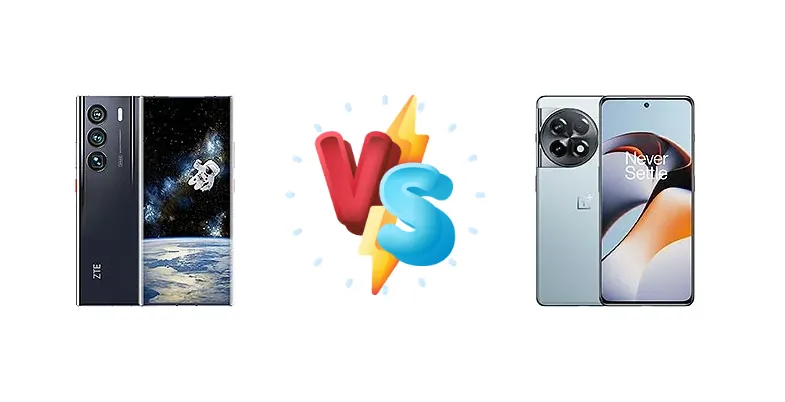
|
🏆 Quick Verdict
For most users, the OnePlus 11R emerges as the stronger choice. The Snapdragon 8+ Gen 1 offers superior thermal efficiency and sustained performance compared to the Snapdragon 8 Gen 1 in the ZTE Axon 40 Ultra Space Edition, coupled with faster 100W charging. While the ZTE may appeal to those prioritizing a specific aesthetic, the OnePlus delivers a more consistently smooth experience.
| PHONES | ||
|---|---|---|
| Phone Names | ZTE Axon 40 Ultra Space Edition | OnePlus 11R |
| Network | ||
|---|---|---|
| 2G bands | GSM 850 / 900 / 1800 / 1900 | GSM 850 / 900 / 1800 / 1900 |
| 3G bands | HSDPA 850 / 900 / 1700(AWS) / 1900 / 2100 | HSDPA 850 / 900 / 1700(AWS) / 2100 |
| 4G bands | 1, 2, 3, 4, 5, 7, 8, 12, 17, 20, 28, 38, 40, 41, 66 | 1, 3, 4, 5, 8, 28, 34, 38, 39, 40, 41 |
| 5G bands | 1, 2, 3, 5, 7, 28, 38, 40, 41, 66, 77, 78 | 1, 3, 5, 8, 28, 40, 41, 77, 78 SA/NSA |
| Speed | HSPA, LTE, 5G | HSPA, LTE (3CA), 5G |
| Technology | GSM / CDMA / HSPA / CDMA2000 / LTE / 5G | GSM / CDMA / HSPA / LTE / 5G |
| CDMA2000 1x | CDMA 800 | |
| Launch | ||
|---|---|---|
| Announced | 2022, November 29 | 2023, February 07 |
| Status | Available. Released 2022, December 06 | Available. Released 2023, February 21 |
| Body | ||
|---|---|---|
| Build | Glass front, ceramic back, aluminum frame | Glass front, glass back (Gorilla Glass 5), plastic frame |
| Dimensions | 163.3 x 73.6 x 8.4 mm (6.43 x 2.90 x 0.33 in) | 163.4 x 74.3 x 8.7 mm (6.43 x 2.93 x 0.34 in) |
| SIM | Nano-SIM + Nano-SIM | Nano-SIM + Nano-SIM |
| Weight | 204 g (7.20 oz) | 204 g (7.20 oz) |
| Display | ||
|---|---|---|
| Resolution | 1116 x 2480 pixels, 20:9 ratio (~400 ppi density) | 1240 x 2772 pixels, 20:9 ratio (~451 ppi density) |
| Size | 6.8 inches, 111.6 cm2 (~92.9% screen-to-body ratio) | 6.74 inches, 109.2 cm2 (~90.0% screen-to-body ratio) |
| Type | AMOLED, 1B colors, 120Hz, HDR10+, 1500 nits (peak) | Fluid AMOLED, 1B colors, 120Hz, HDR10+, 1450 nits (peak) |
| Platform | ||
|---|---|---|
| CPU | Octa-core (1x3.00 GHz Cortex-X2 & 3x2.50 GHz Cortex-A710 & 4x1.80 GHz Cortex-A510) | Octa-core (1x3.0 GHz Cortex-X2 & 3x2.5 GHz Cortex-A710 & 4x1.80 GHz Cortex-A510) |
| Chipset | Qualcomm SM8450 Snapdragon 8 Gen 1 (4 nm) | Qualcomm SM8475 Snapdragon 8+ Gen 1 (4 nm) |
| GPU | Adreno 730 | Adreno 730 |
| OS | Android 12, MyOS 12 | Android 13, upgradable to Android 15, OxygenOS 15 |
| Memory | ||
|---|---|---|
| Card slot | No | No |
| Internal | 512GB 12GB RAM, 1TB 18GB RAM | 128GB 8GB RAM, 256GB 16GB RAM, 512GB 18GB RAM |
| UFS 3.1 | UFS 3.1 | |
| Main Camera | ||
|---|---|---|
| Features | Laser AF, Dual-LED dual-tone flash, panorama, HDR | Color spectrum sensor, LED flash, HDR, panorama |
| Single | 16 MP, f/2.0, 26mm (wide), 1/2.8", 1.22µm, under display | 16 MP, f/2.4, 24mm (wide), 1/3.09", 1.0µm |
| Triple | 64 MP, f/1.6, 35mm (standard), 1/1.7", PDAF, OIS 64 MP, f/3.5, 91mm (periscope telephoto), 1/2.0", PDAF, OIS, 3.5x optical zoom (vs. 26mm cam) 64 MP, f/2.4, 16mm, 112˚ (ultrawide), 1/1.7", PDAF | 50 MP, f/1.8, 24mm (wide), 1/1.56", 1.0µm, multi-directional PDAF, OIS 8 MP, f/2.2, 120˚ (ultrawide), 1/4.0", 1.12µm 2 MP (macro) |
| Video | 8K@30fps, 4K@30/60/120fps, 1080p@30/60fps, gyro-EIS, HDR10, 10‑bit video | 4K@30/60fps, 1080p@30/60/240fps, gyro-EIS |
| Selfie camera | ||
|---|---|---|
| Features | HDR | HDR |
| Single | 16 MP, f/2.0, 26mm (wide), 1/2.8", 1.22µm, under display | 16 MP, f/2.4, 24mm (wide), 1/3.09", 1.0µm |
| Video | 1080p@30fps | 1080p@30fps |
| Sound | ||
|---|---|---|
| 3.5mm jack | No | No |
| 35mm jack | No | No |
| Loudspeaker | Yes, with stereo speakers | Yes, with stereo speakers |
| 24-bit/192kHz audio | 24-bit/192kHz audio | |
| Comms | ||
|---|---|---|
| Bluetooth | 5.2, A2DP, LE, aptX HD, aptX Adaptive | 5.3, A2DP, LE, aptX HD |
| Infrared port | - | Yes |
| NFC | Yes | Yes |
| Positioning | GPS (L1+L5), GLONASS, BDS, GALILEO | GPS (L1+L5), GLONASS (G1), BDS (B1I+B1c+B2a), GALILEO (E1+E5a), QZSS (L1+L5) |
| Radio | No | No |
| USB | USB Type-C 3.1, OTG | USB Type-C 2.0 |
| WLAN | Wi-Fi 802.11 a/b/g/n/ac/6e, dual-band, Wi-Fi Direct | Wi-Fi 802.11 a/b/g/n/ac/6, dual-band |
| Features | ||
|---|---|---|
| Sensors | Fingerprint (under display, optical), accelerometer, gyro, proximity, compass | Fingerprint (under display, optical), accelerometer, gyro, proximity, compass |
| Battery | ||
|---|---|---|
| Charging | 80W wired, PD3.0, QC4 | 100W wired |
| Type | Li-Po 5000 mAh | Li-Po 5000 mAh |
| Misc | ||
|---|---|---|
| Colors | Black | Galactic Silver, Sonic Black, Solar Red |
| Models | A2023P | CPH2487 |
| Price | About 800 EUR | About 600 EUR |
| SAR | - | 1.16 W/kg (head) 0.61 W/kg (body) |
ZTE Axon 40 Ultra Space Edition
- Potentially unique design aesthetic.
- 80W fast charging with broad compatibility (PD3.0, QC4).
- May offer a more competitive price point depending on region.
- Snapdragon 8 Gen 1 prone to thermal throttling.
- Potentially lower sustained performance compared to the 8+ Gen 1.
- Charging speed is slower than the OnePlus 11R.
OnePlus 11R
- Snapdragon 8+ Gen 1 offers superior efficiency and sustained performance.
- 100W SuperVOOC charging for incredibly fast top-ups.
- Likely better thermal management for extended gaming.
- SuperVOOC charging may not be as widely compatible as PD/QC.
- May be slightly more expensive than the ZTE Axon 40 Ultra Space Edition.
- Design may be less distinctive.
Display Comparison
Both devices utilize 6.7-inch AMOLED displays, but detailed specifications like resolution and refresh rate are missing. However, the core difference lies in the underlying processors impacting the display's responsiveness. The Snapdragon 8+ Gen 1 in the OnePlus 11R will likely provide a slightly smoother experience, especially during fast-paced gaming, due to its more efficient architecture. Without knowing the PWM dimming rates, it's difficult to assess which is better for users sensitive to flicker, but OnePlus generally employs higher frequencies.
Camera Comparison
Without detailed camera specifications beyond the chipsets, a direct comparison is limited. However, the image signal processor (ISP) within the Snapdragon 8+ Gen 1 generally offers improved image processing capabilities. The ZTE Axon 40 Ultra Space Edition is known for its camera, but the 8+ Gen 1 in the OnePlus 11R will provide a competitive experience. The absence of information regarding sensor sizes and OIS makes a definitive judgment impossible, but the OnePlus 11R’s more efficient chipset allows for more processing power dedicated to computational photography.
Performance
The OnePlus 11R’s Snapdragon 8+ Gen 1 (4nm) represents a significant architectural improvement over the ZTE Axon 40 Ultra Space Edition’s Snapdragon 8 Gen 1 (4nm). While both chips share the same core configuration – 1x Cortex-X2, 3x Cortex-A710, and 4x Cortex-A510 – the 8+ Gen 1 benefits from a more refined process node and higher clock speeds. This translates to better sustained performance and reduced thermal throttling, particularly during prolonged gaming sessions. The 4nm process of both chips is efficient, but the 8+ Gen 1’s optimizations give it an edge. Both devices likely feature LPDDR5X RAM, but the chipset's efficiency will be the primary determinant of overall responsiveness.
Battery Life
The OnePlus 11R’s 100W wired charging is a clear advantage over the ZTE Axon 40 Ultra Space Edition’s 80W charging. This translates to significantly faster charging times, potentially reducing a full charge from 0-100% by 20-30 minutes. While battery capacity is unknown for both devices, the Snapdragon 8+ Gen 1’s superior efficiency in the OnePlus 11R means it will likely deliver comparable or better battery life despite potentially having a smaller battery cell. The inclusion of PD3.0 and QC4 in the ZTE is a plus for compatibility, but the speed advantage goes to the OnePlus.
Buying Guide
Buy the ZTE Axon 40 Ultra Space Edition if you prioritize a potentially unique design and are willing to accept some performance throttling under sustained load. Buy the OnePlus 11R if you value consistent performance, faster charging, and a more efficient chipset for extended gaming or demanding tasks. The OnePlus 11R is the better all-rounder for power users.