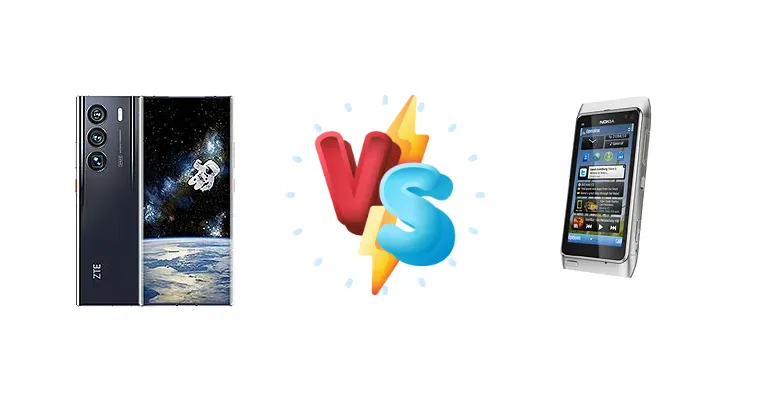
The smartphone landscape has changed dramatically since the Nokia N8's heyday. Now, we pit a modern powerhouse, the ZTE Axon 40 Ultra Space Edition, against a beloved classic. Can the N8's legacy hold up against today's technology?
🏆 Quick Verdict
The ZTE Axon 40 Ultra utterly dominates in almost every category. Its Snapdragon 8 Gen 1 chipset, advanced camera, and modern features leave the Nokia N8 in the dust. However, the N8 holds nostalgic value and a surprising sunlight display contrast.
| Network |
|---|
| 2G bands | GSM 850 / 900 / 1800 / 1900 | GSM 850 / 900 / 1800 / 1900 |
| 3G bands | HSDPA 850 / 900 / 1700(AWS) / 1900 / 2100 | HSDPA 850 / 900 / 1700 / 1900 / 2100 |
| 4G bands | 1, 2, 3, 4, 5, 7, 8, 12, 17, 20, 28, 38, 40, 41, 66 | - |
| 5G bands | 1, 2, 3, 5, 7, 28, 38, 40, 41, 66, 77, 78 | - |
| Speed | HSPA, LTE, 5G | HSPA 10.2/2 Mbps |
| Technology | GSM / CDMA / HSPA / CDMA2000 / LTE / 5G | GSM / HSPA |
| | CDMA2000 1x | - |
| Launch |
|---|
| Announced | 2022, November 29 | 2010, April. Released 2010, October |
| Status | Available. Released 2022, December 06 | Discontinued |
| Body |
|---|
| Build | Glass front, ceramic back, aluminum frame | - |
| Dimensions | 163.3 x 73.6 x 8.4 mm (6.43 x 2.90 x 0.33 in) | 113.5 x 59.1 x 12.9 mm, 86 cc (4.47 x 2.33 x 0.51 in) |
| SIM | Nano-SIM + Nano-SIM | Mini-SIM |
| Weight | 204 g (7.20 oz) | 135 g (4.76 oz) |
| Display |
|---|
| Protection | - | Corning Gorilla Glass |
| Resolution | 1116 x 2480 pixels, 20:9 ratio (~400 ppi density) | 360 x 640 pixels, 16:9 ratio (~210 ppi density) |
| Size | 6.8 inches, 111.6 cm2 (~92.9% screen-to-body ratio) | 3.5 inches, 33.8 cm2 (~50.3% screen-to-body ratio) |
| Type | AMOLED, 1B colors, 120Hz, HDR10+, 1500 nits (peak) | AMOLED |
| Platform |
|---|
| CPU | Octa-core (1x3.00 GHz Cortex-X2 & 3x2.50 GHz Cortex-A710 & 4x1.80 GHz Cortex-A510) | 680 MHz ARM 11 |
| Chipset | Qualcomm SM8450 Snapdragon 8 Gen 1 (4 nm) | - |
| GPU | Adreno 730 | Broadcom BCM2727 |
| OS | Android 12, MyOS 12 | Symbian^3, upgradable to Nokia Belle Refresh |
| Memory |
|---|
| Card slot | No | microSDHC (dedicated slot) |
| Internal | 512GB 12GB RAM, 1TB 18GB RAM | 16GB 256MB RAM |
| | UFS 3.1 | - |
| Main Camera |
|---|
| Features | Laser AF, Dual-LED dual-tone flash, panorama, HDR | Carl Zeiss optics, Xenon flash, ND filter |
| Single | 16 MP, f/2.0, 26mm (wide), 1/2.8", 1.22µm, under display | 12 MP, 1/1.83", AF |
| Triple | 64 MP, f/1.6, 35mm (standard), 1/1.7", PDAF, OIS
64 MP, f/3.5, 91mm (periscope telephoto), 1/2.0", PDAF, OIS, 3.5x optical zoom (vs. 26mm cam)
64 MP, f/2.4, 16mm, 112˚ (ultrawide), 1/1.7", PDAF | - |
| Video | 8K@30fps, 4K@30/60/120fps, 1080p@30/60fps, gyro-EIS, HDR10, 10‑bit video | 720p@25fps, 720p@30fps (via SW update) |
| Selfie camera |
|---|
| Features | HDR | - |
| Single | 16 MP, f/2.0, 26mm (wide), 1/2.8", 1.22µm, under display | VGA videocall camera |
| Video | 1080p@30fps | - |
| Sound |
|---|
| 3.5mm jack | No | Yes |
| 35mm jack | No | Yes |
| Loudspeaker | Yes, with stereo speakers | Yes |
| | 24-bit/192kHz audio | - |
| Comms |
|---|
| Bluetooth | 5.2, A2DP, LE, aptX HD, aptX Adaptive | 3.0, A2DP |
| NFC | Yes | - |
| Positioning | GPS (L1+L5), GLONASS, BDS, GALILEO | GPS, A-GPS; Ovi Maps 3.0 |
| Radio | No | Stereo FM radio, RDS; FM transmitter |
| USB | USB Type-C 3.1, OTG | microUSB 2.0, OTG |
| WLAN | Wi-Fi 802.11 a/b/g/n/ac/6e, dual-band, Wi-Fi Direct | Wi-Fi 802.11 b/g/n, UPnP technology |
| Features |
|---|
| Browser | - | WAP 2.0/xHTML, HTML, Adobe Flash Lite |
| Sensors | Fingerprint (under display, optical), accelerometer, gyro, proximity, compass | Accelerometer, proximity, compass |
| | - | TV-out (720p video) via HDMI with Dolby Digital Plus sound
Anodized aluminum casing |
| Battery |
|---|
| Charging | 80W wired, PD3.0, QC4 | - |
| Music play | - | Up to 50 h |
| Stand-by | - | Up to 390 h (2G) / Up to 400 h (3G) |
| Talk time | - | Up to 12 h (2G) / Up to 5 h 50 min (3G) |
| Type | Li-Po 5000 mAh | Non-removable Li-Ion 1200 mAh battery (BL-4D) |
| Misc |
|---|
| Colors | Black | Dark Grey, Silver White, Green, Blue, Orange, Pink, Bronze |
| Models | A2023P | - |
| Price | About 800 EUR | About 140 EUR |
| SAR | - | 1.09 W/kg (head) 0.85 W/kg (body) |
| SAR EU | - | 1.02 W/kg (head) |
| Tests |
|---|
| Audio quality | - |
Noise -89.9dB / Crosstalk -90.9dB |
| Camera | - |
Photo / Video |
| Display | - |
Contrast ratio: 2.144:1 (sunlight) |
| Loudspeaker | - |
Voice 75dB / Noise 66dB / Ring 82dB |
ZTE Axon 40 Ultra Space Edition
- Blazing-fast performance
- Excellent camera system
- Fast charging (80W)
- Vibrant AMOLED display
- Modern Android features
- Can be expensive
- Potential for overheating with Snapdragon 8 Gen 1
- Space Edition branding might not appeal to everyone
Nokia N8
- Excellent sunlight display contrast
- Durable build quality (typical Nokia)
- Nostalgic appeal
- Simple and easy to use
- Extremely slow performance
- Outdated camera
- Limited storage
- Poor battery life by modern standards
- No modern features
Display Comparison
The Axon 40 Ultra boasts a vibrant AMOLED display with a high refresh rate, offering superior color accuracy and smoothness. The Nokia N8, while impressive for its time with a 2.144:1 contrast ratio in sunlight, lacks the resolution, brightness, and modern features of the Axon. The N8's display is a testament to its era, but the Axon is the clear winner.
Camera Comparison
The Axon 40 Ultra's camera system, likely featuring multiple sensors and advanced image processing, offers significantly better image quality, dynamic range, and features compared to the Nokia N8's camera. While the N8 was a pioneer in smartphone photography, the Axon's capabilities are far superior.
Performance
The Snapdragon 8 Gen 1 in the Axon 40 Ultra provides blistering performance, handling demanding games and multitasking with ease. The Nokia N8's 680 MHz ARM 11 processor feels incredibly slow by today's standards. The difference is night and day; the Axon is in a different league entirely.
Battery Life
While specific battery capacities are missing for the N8, the Axon 40 Ultra's 80W wired charging provides significantly faster charging speeds. The N8 likely had a smaller battery and much slower charging, making the Axon a more practical choice for daily use.
Buying Guide
The ZTE Axon 40 Ultra Space Edition is for users seeking a high-performance Android phone with a great camera and fast charging. The Nokia N8 is for collectors, nostalgia enthusiasts, or those seeking a simple, durable phone with excellent sunlight readability, understanding its limitations.
Frequently Asked Questions
❓ Is the Nokia N8 still usable in 2024?
Yes, but with significant limitations. It can handle basic tasks, but its performance is severely outdated. It's best suited for nostalgia or as a secondary device.
❓ Why was the Nokia N8 so popular?
The N8 was popular for its durable build, excellent camera for its time, and bright display, making it a strong contender in the early smartphone market.