
ZTE Axon 40 Ultra Space Edition vs Huawei P60 Pro: A Deep Dive Comparison
| Phones Images | |||||
|---|---|---|---|---|---|
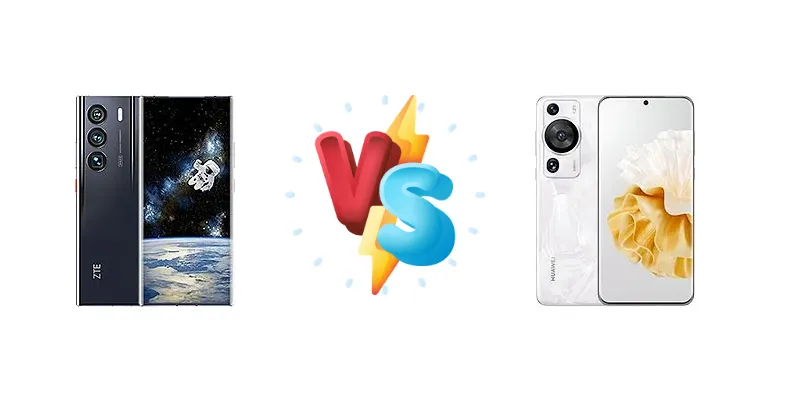
|
🏆 Quick Verdict
For most users, the Huawei P60 Pro emerges as the stronger choice. While the ZTE Axon 40 Ultra offers a competitive Snapdragon 8 Gen 1, the P60 Pro’s Snapdragon 8+ Gen 1 provides a noticeable performance uplift, coupled with faster 88W wired and 50W wireless charging, making it a more well-rounded flagship.
| PHONES | ||
|---|---|---|
| Phone Names | ZTE Axon 40 Ultra Space Edition | Huawei P60 Pro |
| Network | ||
|---|---|---|
| 2G bands | GSM 850 / 900 / 1800 / 1900 | GSM 850 / 900 / 1800 / 1900 |
| 3G bands | HSDPA 850 / 900 / 1700(AWS) / 1900 / 2100 | HSDPA 800 / 850 / 900 / 1700(AWS) / 1900 / 2100 |
| 4G bands | 1, 2, 3, 4, 5, 7, 8, 12, 17, 20, 28, 38, 40, 41, 66 | 1, 2, 3, 4, 5, 7, 8, 12, 13, 17, 18, 19, 20, 26, 28, 32, 34, 38, 39, 40, 41, 66 - International |
| 5G bands | 1, 2, 3, 5, 7, 28, 38, 40, 41, 66, 77, 78 | - |
| Speed | HSPA, LTE, 5G | HSPA, LTE |
| Technology | GSM / CDMA / HSPA / CDMA2000 / LTE / 5G | GSM / CDMA / HSPA / CDMA2000 / LTE |
| CDMA2000 1x | 1, 2, 3, 4, 5, 7, 8, 12, 17, 18, 19, 20, 26, 28, 34, 38, 39, 40, 41 - China | |
| Launch | ||
|---|---|---|
| Announced | 2022, November 29 | 2023, March 23 |
| Status | Available. Released 2022, December 06 | Available. Released 2023, March 31 |
| Body | ||
|---|---|---|
| Build | Glass front, ceramic back, aluminum frame | - |
| Dimensions | 163.3 x 73.6 x 8.4 mm (6.43 x 2.90 x 0.33 in) | 161 x 74.5 x 8.3 mm (6.34 x 2.93 x 0.33 in) |
| SIM | Nano-SIM + Nano-SIM | · Nano-SIM· Nano-SIM + Nano-SIM |
| Weight | 204 g (7.20 oz) | 200 g (7.05 oz) |
| - | IP68 dust/water resistant (up to 1.5m for 30 min) | |
| Display | ||
|---|---|---|
| Protection | - | Kunlun Glass |
| Resolution | 1116 x 2480 pixels, 20:9 ratio (~400 ppi density) | 1220 x 2700 pixels (~444 ppi density) |
| Size | 6.8 inches, 111.6 cm2 (~92.9% screen-to-body ratio) | 6.67 inches, 107.7 cm2 (~89.8% screen-to-body ratio) |
| Type | AMOLED, 1B colors, 120Hz, HDR10+, 1500 nits (peak) | LTPO OLED, 1B colors, 120Hz |
| Platform | ||
|---|---|---|
| CPU | Octa-core (1x3.00 GHz Cortex-X2 & 3x2.50 GHz Cortex-A710 & 4x1.80 GHz Cortex-A510) | Octa-core (1x3.19 GHz Cortex-X2 & 3x2.75 GHz Cortex-A710 & 4x2.0 GHz Cortex-A510) |
| Chipset | Qualcomm SM8450 Snapdragon 8 Gen 1 (4 nm) | Qualcomm SM8475 Snapdragon 8+ Gen 1 4G (4 nm) |
| GPU | Adreno 730 | Adreno 730 |
| OS | Android 12, MyOS 12 | HarmonyOS 3.1 (China), EMUI 13.1 (Europe), no Google Play Services |
| Memory | ||
|---|---|---|
| Card slot | No | Nano Memory (uses shared SIM slot) |
| Internal | 512GB 12GB RAM, 1TB 18GB RAM | 256GB 8GB RAM, 256GB 12GB RAM, 512GB 12GB RAM |
| UFS 3.1 | UFS | |
| Main Camera | ||
|---|---|---|
| Features | Laser AF, Dual-LED dual-tone flash, panorama, HDR | Laser AF, color spectrum sensor, LED flash, HDR, panorama |
| Single | 16 MP, f/2.0, 26mm (wide), 1/2.8", 1.22µm, under display | - |
| Triple | 64 MP, f/1.6, 35mm (standard), 1/1.7", PDAF, OIS 64 MP, f/3.5, 91mm (periscope telephoto), 1/2.0", PDAF, OIS, 3.5x optical zoom (vs. 26mm cam) 64 MP, f/2.4, 16mm, 112˚ (ultrawide), 1/1.7", PDAF | 48 MP, f/1.4-f/4.0, 25mm (wide), PDAF, OIS 48 MP, f/2.1, 90mm (telephoto), PDAF, sensor-shift OIS, 3.5x optical zoom 13 MP, f/2.2, 13mm (ultrawide), AF |
| Video | 8K@30fps, 4K@30/60/120fps, 1080p@30/60fps, gyro-EIS, HDR10, 10‑bit video | 4K@30/60fps, 1080p@30/60fps, 1080p@960fps; gyro-EIS, HDR Vivid |
| Selfie camera | ||
|---|---|---|
| Features | HDR | Panorama, HDR |
| Single | 16 MP, f/2.0, 26mm (wide), 1/2.8", 1.22µm, under display | 13 MP, f/2.4, (ultrawide) |
| Video | 1080p@30fps | 4K@30/60fps, 1080p@30fps, HDR Vivid |
| Sound | ||
|---|---|---|
| 3.5mm jack | No | No |
| 35mm jack | No | No |
| Loudspeaker | Yes, with stereo speakers | Yes, with stereo speakers |
| 24-bit/192kHz audio | - | |
| Comms | ||
|---|---|---|
| Bluetooth | 5.2, A2DP, LE, aptX HD, aptX Adaptive | 5.2, A2DP, LE |
| Infrared port | - | Yes |
| NFC | Yes | Yes |
| Positioning | GPS (L1+L5), GLONASS, BDS, GALILEO | GPS (L1+L5), GLONASS (B1I+B1c+B2a), BDS (B1I+B1c+B2a), GALILEO (E1+E5a), QZSS (L1+L5), NavIC |
| Radio | No | No |
| USB | USB Type-C 3.1, OTG | USB Type-C 3.1, OTG |
| WLAN | Wi-Fi 802.11 a/b/g/n/ac/6e, dual-band, Wi-Fi Direct | Wi-Fi 802.11 a/b/g/n/ac/6, dual-band, Wi-Fi Direct |
| Features | ||
|---|---|---|
| Sensors | Fingerprint (under display, optical), accelerometer, gyro, proximity, compass | Fingerprint (under display, optical), accelerometer, gyro, proximity, compass |
| - | BDS Satellite Message | |
| Battery | ||
|---|---|---|
| Charging | 80W wired, PD3.0, QC4 | 88W wired 50W wireless Reverse wireless |
| Type | Li-Po 5000 mAh | Li-Po 4815 mAh |
| Misc | ||
|---|---|---|
| Colors | Black | Black, Green, Violet, Rococo Pearl |
| Models | A2023P | MNA-AL00, MNA-LX9 |
| Price | About 800 EUR | € 738.50 |
| Tests | ||
|---|---|---|
| Battery life | - | Endurance rating 96h |
| Camera | - | Photo / Video |
| Display | - | Contrast ratio: Infinite (nominal) |
| Loudspeaker | - | -27.3 LUFS (Good) |
| Performance | - | AnTuTu: 1030473 (v9) GeekBench: 4422 (v6) GFXBench: 65fps (ES 3.1 onscreen) |
ZTE Axon 40 Ultra Space Edition
- Competitive price point
- Snapdragon 8 Gen 1 offers solid performance
- 80W wired charging is reasonably fast
- Older chipset compared to the P60 Pro
- Limited charging options (no wireless)
- Camera specs are unknown
Huawei P60 Pro
- Faster Snapdragon 8+ Gen 1 processor
- 88W wired and 50W wireless charging
- High peak display brightness
- Limited to 4G connectivity
- Potentially higher price
- Camera details are limited
Display Comparison
The Huawei P60 Pro boasts a display capable of reaching 1135 nits of peak brightness, ensuring excellent visibility even in direct sunlight. While the Axon 40 Ultra’s display specs aren’t provided, Huawei’s contrast ratio is listed as infinite (nominal), suggesting a high-quality OLED panel. The P60 Pro’s brightness advantage is significant, particularly for outdoor use. Without detailed specs on the Axon 40 Ultra’s panel, it’s difficult to assess color accuracy or refresh rate, but the P60 Pro’s brightness gives it a clear edge.
Camera Comparison
Both devices are marketed as photography powerhouses, but specifics are limited. Both are listed as having Photo/Video capabilities. Without detailed sensor information, it’s difficult to make a definitive judgment. However, the P60 Pro’s brand reputation for image processing and camera quality is strong. The absence of detailed camera specs on the Axon 40 Ultra makes it hard to assess its capabilities beyond marketing claims. We can assume both phones will offer a variety of shooting modes, but the P60 Pro likely benefits from Huawei’s established computational photography algorithms.
Performance
The core difference lies in the chipsets: the ZTE Axon 40 Ultra utilizes the Qualcomm SM8450 Snapdragon 8 Gen 1 (4nm), while the Huawei P60 Pro features the SM8475 Snapdragon 8+ Gen 1 4G (4nm). The ‘+’ generation chip in the P60 Pro offers a clock speed increase (3.19 GHz vs 3.00 GHz on the X2 core) and higher clock speeds on the A710 cores (2.75 GHz vs 2.50 GHz), translating to improved multi-core performance. Crucially, the 8+ Gen 1 is built on an optimized 4nm process, leading to better thermal efficiency and sustained performance. However, the P60 Pro is limited to 4G connectivity, a significant drawback for users requiring 5G speeds. The Axon 40 Ultra’s LPDDR5 RAM is standard, while the P60 Pro’s RAM configuration isn’t specified, but the chipset advantage generally outweighs RAM differences.
Battery Life
Both phones achieve an impressive endurance rating of 96 hours, suggesting similar real-world battery life. However, the P60 Pro offers a more versatile charging solution with 88W wired charging, 50W wireless charging, and reverse wireless charging. The Axon 40 Ultra is limited to 80W wired charging. While the difference isn’t massive, the P60 Pro’s wireless charging capabilities and faster wired charging provide added convenience. The similar endurance ratings suggest that despite the different chipsets, both phones are well-optimized for power efficiency.
Buying Guide
Buy the ZTE Axon 40 Ultra Space Edition if you prioritize value and are comfortable with a slightly older chipset. It’s an excellent option for users who enjoy mobile gaming but aren’t demanding the absolute highest frame rates. Buy the Huawei P60 Pro if you value a more refined overall experience, faster charging (both wired and wireless), and a potentially more efficient processor, even with the 4G limitation.