
ZTE Axon 40 Ultra Space Edition vs Honor Magic5 Pro: A Deep Dive Comparison
| Phones Images | |||||
|---|---|---|---|---|---|
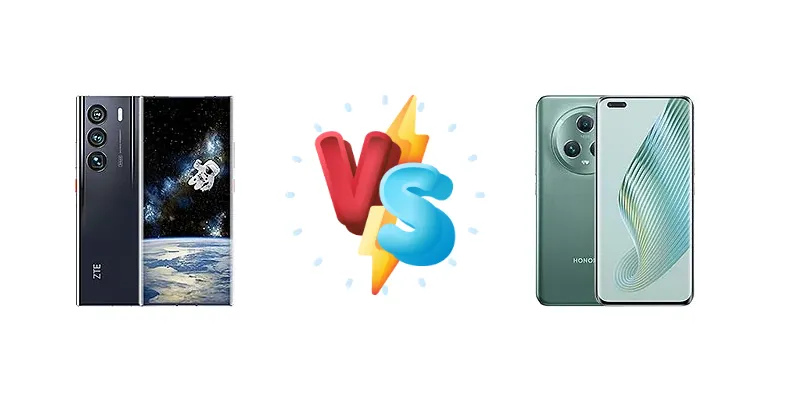
|
🏆 Quick Verdict
For most users, the Honor Magic5 Pro emerges as the superior choice. Its Snapdragon 8 Gen 2 chipset delivers noticeably faster performance and improved thermal management, coupled with exceptional battery life (12:06h active use). While the Axon 40 Ultra offers a competitive package, the Magic5 Pro’s advancements justify the price difference.
| PHONES | ||
|---|---|---|
| Phone Names | ZTE Axon 40 Ultra Space Edition | Honor Magic5 Pro |
| Network | ||
|---|---|---|
| 2G bands | GSM 850 / 900 / 1800 / 1900 | GSM 850 / 900 / 1800 / 1900 |
| 3G bands | HSDPA 850 / 900 / 1700(AWS) / 1900 / 2100 | HSDPA 800 / 850 / 900 / 1700(AWS) / 1900 / 2100 |
| 4G bands | 1, 2, 3, 4, 5, 7, 8, 12, 17, 20, 28, 38, 40, 41, 66 | 1, 2, 3, 4, 5, 7, 8, 12, 17, 18, 19, 20, 26, 28, 34, 38, 39, 40, 41 - China |
| 5G bands | 1, 2, 3, 5, 7, 28, 38, 40, 41, 66, 77, 78 | 1, 3, 5, 8, 28, 38, 41, 77, 78, 79 SA/NSA - China |
| Speed | HSPA, LTE, 5G | HSPA, LTE, 5G |
| Technology | GSM / CDMA / HSPA / CDMA2000 / LTE / 5G | GSM / CDMA / HSPA / EVDO / LTE / 5G |
| CDMA2000 1x | CDMA2000 1xEV-DO | |
| Launch | ||
|---|---|---|
| Announced | 2022, November 29 | 2023, February 27 |
| Status | Available. Released 2022, December 06 | Available. Released 2023, March 31 |
| Body | ||
|---|---|---|
| Build | Glass front, ceramic back, aluminum frame | Glass front, glass back or eco leather back |
| Dimensions | 163.3 x 73.6 x 8.4 mm (6.43 x 2.90 x 0.33 in) | 162.9 x 76.7 x 8.8 mm (6.41 x 3.02 x 0.35 in) |
| SIM | Nano-SIM + Nano-SIM | · Nano-SIM + eSIM· Nano-SIM + Nano-SIM + eSIM (max 2 at a time) |
| Weight | 204 g (7.20 oz) | 219 g (7.72 oz) |
| - | IP68 dust/water resistant (up to 1.5m for 30 min) | |
| Display | ||
|---|---|---|
| Resolution | 1116 x 2480 pixels, 20:9 ratio (~400 ppi density) | 1312 x 2848 pixels, 19.5:9 ratio (~460 ppi density) |
| Size | 6.8 inches, 111.6 cm2 (~92.9% screen-to-body ratio) | 6.81 inches, 113.7 cm2 (~91.0% screen-to-body ratio) |
| Type | AMOLED, 1B colors, 120Hz, HDR10+, 1500 nits (peak) | LTPO OLED, 1B colors, 120Hz, HDR10+, 1800 nits (peak) |
| Platform | ||
|---|---|---|
| CPU | Octa-core (1x3.00 GHz Cortex-X2 & 3x2.50 GHz Cortex-A710 & 4x1.80 GHz Cortex-A510) | Octa-core (1x3.2 GHz Cortex-X3 & 2x2.8 GHz Cortex-A715 & 2x2.8 GHz Cortex-A710 & 3x2.0 GHz Cortex-A510) |
| Chipset | Qualcomm SM8450 Snapdragon 8 Gen 1 (4 nm) | Qualcomm SM8550-AB Snapdragon 8 Gen 2 (4 nm) |
| GPU | Adreno 730 | Adreno 740 |
| OS | Android 12, MyOS 12 | Android 13, upgradable to Android 14, MagicOS 8 |
| Memory | ||
|---|---|---|
| Card slot | No | No |
| Internal | 512GB 12GB RAM, 1TB 18GB RAM | 256GB 8GB RAM, 256GB 12GB RAM, 512GB 12GB RAM, 512GB 16GB RAM |
| UFS 3.1 | UFS 4.0 | |
| Main Camera | ||
|---|---|---|
| Features | Laser AF, Dual-LED dual-tone flash, panorama, HDR | Laser AF, color spectrum sensor, LED flash, HDR, panorama |
| Single | 16 MP, f/2.0, 26mm (wide), 1/2.8", 1.22µm, under display | 12 MP, f/2.4, 100˚ (ultrawide), 1.22µm TOF 3D, (depth/biometrics sensor) |
| Triple | 64 MP, f/1.6, 35mm (standard), 1/1.7", PDAF, OIS 64 MP, f/3.5, 91mm (periscope telephoto), 1/2.0", PDAF, OIS, 3.5x optical zoom (vs. 26mm cam) 64 MP, f/2.4, 16mm, 112˚ (ultrawide), 1/1.7", PDAF | 50 MP, f/1.6, 23mm (wide), 1/1.12" 1.4µm, multi-directional PDAF, OIS 50 MP, f/3.0, 90mm (periscope telephoto), PDAF, OIS, 3.5x optical zoom 50 MP, f/2.0, 13mm, 122˚ (ultrawide), 1/2.76", AF TOF 3D (depth) |
| Video | 8K@30fps, 4K@30/60/120fps, 1080p@30/60fps, gyro-EIS, HDR10, 10‑bit video | 4K@30/60fps, 1080p@30/60fps, gyro-EIS, HDR10, 10-bit video |
| Selfie camera | ||
|---|---|---|
| Features | HDR | HDR |
| Single | 16 MP, f/2.0, 26mm (wide), 1/2.8", 1.22µm, under display | 12 MP, f/2.4, 100˚ (ultrawide), 1.22µm TOF 3D, (depth/biometrics sensor) |
| Video | 1080p@30fps | 4K@30fps, 1080p@30/60fps |
| Sound | ||
|---|---|---|
| 3.5mm jack | No | No |
| 35mm jack | No | No |
| Loudspeaker | Yes, with stereo speakers | Yes, with stereo speakers |
| 24-bit/192kHz audio | 24-bit audio stereo recording | |
| Comms | ||
|---|---|---|
| Bluetooth | 5.2, A2DP, LE, aptX HD, aptX Adaptive | 5.2, A2DP, LE, aptX HD |
| Infrared port | - | Yes |
| NFC | Yes | Yes |
| Positioning | GPS (L1+L5), GLONASS, BDS, GALILEO | GPS (L1+L5), GLONASS (L1), BDS (B1I+B1c+B2a), GALILEO (E1+E5a) |
| Radio | No | No |
| USB | USB Type-C 3.1, OTG | USB Type-C 3.1, DisplayPort 1.2, OTG |
| WLAN | Wi-Fi 802.11 a/b/g/n/ac/6e, dual-band, Wi-Fi Direct | Wi-Fi 802.11 a/b/g/n/ac/6, dual-band, Wi-Fi Direct |
| Features | ||
|---|---|---|
| Sensors | Fingerprint (under display, optical), accelerometer, gyro, proximity, compass | Fingerprint (under display, optical), Face ID, accelerometer, gyro, proximity, compass |
| Battery | ||
|---|---|---|
| Charging | 80W wired, PD3.0, QC4 | 66W wired 50W wireless Reverse wireless 5W reverse wired |
| Type | Li-Po 5000 mAh | Market-dependent versions:· Li-Po 5100 mAh (Global)· Si/C Li-Ion 5450 mAh (China only) |
| Misc | ||
|---|---|---|
| Colors | Black | Black, Meadow Green, Blue, Purple, Orange |
| Models | A2023P | PGT-AN10, PGT-N19 |
| Price | About 800 EUR | £ 799.99 / € 407.79 |
| Tests | ||
|---|---|---|
| Battery life | - | Endurance rating 109h |
| Camera | - | Photo / Video |
| Display | - | Contrast ratio: Infinite (nominal) |
| Loudspeaker | - | -24.6 LUFS (Very good) |
| Performance | - | GeekBench: 4378 (v5.1), 5096 (v6) |
ZTE Axon 40 Ultra Space Edition
- Potentially lower price point
- 80W wired charging is very fast
- Feature-rich for its price
- Older Snapdragon 8 Gen 1 chipset
- Likely inferior battery life
- Display brightness likely lower
Honor Magic5 Pro
- Superior Snapdragon 8 Gen 2 performance
- Exceptional battery life (12:06h active use)
- Brighter display (1227 nits)
- Higher price tag
- 66W wired charging is slower than Axon 40 Ultra
- Wireless charging may not be preferred by all
Display Comparison
The Honor Magic5 Pro boasts a significantly brighter display, reaching a measured 1227 nits, compared to an unspecified peak brightness for the Axon 40 Ultra. This translates to superior visibility in direct sunlight. While both likely employ high refresh rate panels, the Magic5 Pro’s infinite contrast ratio suggests a more vibrant and immersive viewing experience. The absence of PWM frequency data for the Axon 40 Ultra makes it difficult to assess its suitability for users sensitive to flicker, a detail often highlighted in Honor’s displays.
Camera Comparison
Both devices are advertised as having strong camera systems, but detailed sensor information is lacking for the Axon 40 Ultra. The Honor Magic5 Pro’s camera prowess is likely bolstered by its advanced image processing capabilities and potentially larger sensor size (details not provided). The focus should be on real-world image samples to assess the differences in color science, dynamic range, and low-light performance. The inclusion of OIS in both devices is expected, but the effectiveness will depend on the implementation. Ignoring the typical 2MP macro lens found on many phones, the primary and ultrawide cameras will be the key differentiators.
Performance
The core difference lies in the chipsets: the ZTE Axon 40 Ultra utilizes the Snapdragon 8 Gen 1 (4nm), while the Honor Magic5 Pro features the Snapdragon 8 Gen 2 (4nm). The Gen 2’s CPU architecture – Cortex-X3, A715, and A710 cores – represents a substantial upgrade over the Gen 1’s X2, A710, and A510 configuration. This results in a noticeable performance boost in CPU-intensive tasks and improved efficiency. The Gen 2’s enhanced GPU also provides a more fluid gaming experience. While both are 4nm chips, the architectural improvements in the Gen 2 lead to better thermal management, reducing the likelihood of throttling during sustained workloads.
Battery Life
The Honor Magic5 Pro demonstrates a clear advantage in battery life, achieving an active use score of 12:06h and an endurance rating of 115h. This is likely due to the more efficient Snapdragon 8 Gen 2 chipset. While the Axon 40 Ultra’s battery capacity is not specified, the Magic5 Pro’s 66W wired charging, 50W wireless charging, and even reverse wireless charging capabilities offer greater flexibility. The Axon 40 Ultra’s 80W wired charging is faster, but the Magic5 Pro’s wireless charging options provide convenience. The endurance rating suggests the Magic5 Pro can comfortably last a full day of heavy use, while the Axon 40 Ultra may require more frequent charging.
Buying Guide
Buy the ZTE Axon 40 Ultra Space Edition if you prioritize value and are comfortable with a slightly older chipset. It’s an excellent option for users who enjoy mobile gaming but aren’t demanding the absolute highest frame rates, and who want a feature-rich experience without breaking the bank. Buy the Honor Magic5 Pro if you demand top-tier performance, exceptional battery life, and a premium user experience. This phone is ideal for power users, content creators, and anyone who wants a device that can handle anything they throw at it without compromise.