
ZTE Axon 40 Ultra Space Edition vs Google Pixel 7a: A Clash of Titans
| Phones Images | |||||
|---|---|---|---|---|---|
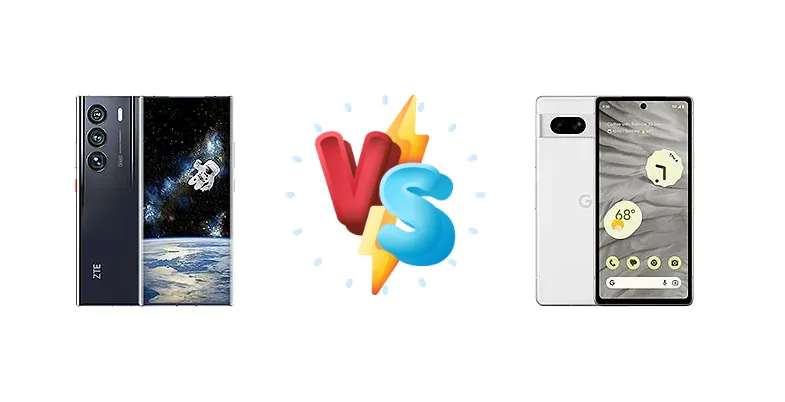
|
🏆 Quick Verdict
The ZTE Axon 40 Ultra Space Edition offers significantly faster performance and quicker charging. However, the Pixel 7a shines with its superior camera, cleaner software, and longer software support. Ultimately, the choice depends on your priorities: raw power or photographic excellence.
| PHONES | ||
|---|---|---|
| Phone Names | ZTE Axon 40 Ultra Space Edition | Google Pixel 7a |
| Network | ||
|---|---|---|
| 2G bands | GSM 850 / 900 / 1800 / 1900 | GSM 850 / 900 / 1800 / 1900 |
| 3G bands | HSDPA 850 / 900 / 1700(AWS) / 1900 / 2100 | HSDPA 800 / 850 / 900 / 1700(AWS) / 1900 / 2100 |
| 4G bands | 1, 2, 3, 4, 5, 7, 8, 12, 17, 20, 28, 38, 40, 41, 66 | 1, 2, 3, 4, 5, 7, 8, 12, 13, 14, 17, 20, 25, 26, 28, 29, 30, 38, 40, 41, 48, 66, 71 - GWKK3, G0DZQ |
| 5G bands | 1, 2, 3, 5, 7, 28, 38, 40, 41, 66, 77, 78 | 1, 2, 3, 5, 7, 8, 12, 14, 20, 25, 28, 30, 38, 41, 48, 66, 71, 77, 78 SA/NSA/Sub6 - GWKK3 |
| Speed | HSPA, LTE, 5G | HSPA, LTE, 5G |
| Technology | GSM / CDMA / HSPA / CDMA2000 / LTE / 5G | GSM / HSPA / LTE / 5G |
| CDMA2000 1x | 1, 2, 3, 5, 7, 8, 12, 20, 25, 28, 38, 40, 41, 66, 75, 76, 77, 78, 79 SA/NSA/Sub6 - GHL1X, G82U8 | |
| Launch | ||
|---|---|---|
| Announced | 2022, November 29 | 2023, May 10 |
| Status | Available. Released 2022, December 06 | Available. Released 2023, May 10 |
| Body | ||
|---|---|---|
| Build | Glass front, ceramic back, aluminum frame | Glass front (Gorilla Glass 3), aluminum frame, plastic back |
| Dimensions | 163.3 x 73.6 x 8.4 mm (6.43 x 2.90 x 0.33 in) | 152 x 72.9 x 9 mm (5.98 x 2.87 x 0.35 in) |
| SIM | Nano-SIM + Nano-SIM | Nano-SIM + eSIM |
| Weight | 204 g (7.20 oz) | 193.5 g (6.84 oz) |
| - | IP67 dust/water resistant (up to 1m for 30 min) | |
| Display | ||
|---|---|---|
| Protection | - | Corning Gorilla Glass 3 |
| Resolution | 1116 x 2480 pixels, 20:9 ratio (~400 ppi density) | 1080 x 2400 pixels, 20:9 ratio (~429 ppi density) |
| Size | 6.8 inches, 111.6 cm2 (~92.9% screen-to-body ratio) | 6.1 inches, 90.7 cm2 (~81.8% screen-to-body ratio) |
| Type | AMOLED, 1B colors, 120Hz, HDR10+, 1500 nits (peak) | OLED, HDR, 90Hz |
| - | Always-on display | |
| Platform | ||
|---|---|---|
| CPU | Octa-core (1x3.00 GHz Cortex-X2 & 3x2.50 GHz Cortex-A710 & 4x1.80 GHz Cortex-A510) | Octa-core (2x2.85 GHz Cortex-X1 & 2x2.35 GHz Cortex-A78 & 4x1.80 GHz Cortex-A55) |
| Chipset | Qualcomm SM8450 Snapdragon 8 Gen 1 (4 nm) | Google Tensor G2 (5 nm) |
| GPU | Adreno 730 | Mali-G710 MP7 |
| OS | Android 12, MyOS 12 | Android 13, upgradable to Android 15, up to 5 major Android upgrades |
| Memory | ||
|---|---|---|
| Card slot | No | No |
| Internal | 512GB 12GB RAM, 1TB 18GB RAM | 128GB 8GB RAM |
| UFS 3.1 | UFS 3.1 | |
| Main Camera | ||
|---|---|---|
| Dual | - | 64 MP, f/1.9, 26mm (wide), 1/1.73", 0.8µm, dual pixel PDAF, OIS 13 MP, f/2.2, 120˚ (ultrawide), 1.12µm |
| Features | Laser AF, Dual-LED dual-tone flash, panorama, HDR | Dual-LED flash, Pixel Shift, Auto-HDR, panorama |
| Single | 16 MP, f/2.0, 26mm (wide), 1/2.8", 1.22µm, under display | - |
| Triple | 64 MP, f/1.6, 35mm (standard), 1/1.7", PDAF, OIS 64 MP, f/3.5, 91mm (periscope telephoto), 1/2.0", PDAF, OIS, 3.5x optical zoom (vs. 26mm cam) 64 MP, f/2.4, 16mm, 112˚ (ultrawide), 1/1.7", PDAF | - |
| Video | 8K@30fps, 4K@30/60/120fps, 1080p@30/60fps, gyro-EIS, HDR10, 10‑bit video | 4K@30/60fps, 1080p@30/60/120/240fps, OIS |
| Selfie camera | ||
|---|---|---|
| Features | HDR | HDR, panorama |
| Single | 16 MP, f/2.0, 26mm (wide), 1/2.8", 1.22µm, under display | 13 MP, f/2.2, 20mm (ultrawide), 1.12µm |
| Video | 1080p@30fps | 4K@30fps, 1080p@30fps |
| Sound | ||
|---|---|---|
| 3.5mm jack | No | No |
| 35mm jack | No | No |
| Loudspeaker | Yes, with stereo speakers | Yes, with stereo speakers |
| 24-bit/192kHz audio | - | |
| Comms | ||
|---|---|---|
| Bluetooth | 5.2, A2DP, LE, aptX HD, aptX Adaptive | 5.3, A2DP, LE |
| NFC | Yes | Yes |
| Positioning | GPS (L1+L5), GLONASS, BDS, GALILEO | GPS, GLONASS, GALILEO, BDS, QZSS, NavIC |
| Radio | No | No |
| USB | USB Type-C 3.1, OTG | USB Type-C 3.2 |
| WLAN | Wi-Fi 802.11 a/b/g/n/ac/6e, dual-band, Wi-Fi Direct | Wi-Fi 802.11 a/b/g/n/ac/6e, tri-band |
| Features | ||
|---|---|---|
| Sensors | Fingerprint (under display, optical), accelerometer, gyro, proximity, compass | Fingerprint (under display, optical), accelerometer, gyro, proximity, compass, barometer |
| Battery | ||
|---|---|---|
| Charging | 80W wired, PD3.0, QC4 | 18W wired, PD3.0 7.5W wireless |
| Type | Li-Po 5000 mAh | Li-Po 4385 mAh |
| Misc | ||
|---|---|---|
| Colors | Black | Charcoal, Snow, Sea, Coral |
| Models | A2023P | GWKK3, GHL1X, G0DZQ, G82U8 |
| Price | About 800 EUR | € 179.90 / $ 150.00 / £ 170.00 / ₹ 25,980 |
ZTE Axon 40 Ultra Space Edition
- Blazing-fast Snapdragon 8 Gen 1 processor
- 80W fast charging
- High-resolution main camera
- Vibrant AMOLED display (likely)
- Software support may be limited
- Camera processing not as refined as Pixel
- Potential for thermal throttling
Google Pixel 7a
- Exceptional camera with Google's computational photography
- Clean and intuitive Android experience
- Guaranteed software updates
- Excellent battery life
- Slower processor compared to Axon
- 18W charging is slow
- Tensor G2 can be less responsive at times
Display Comparison
The Pixel 7a boasts a measured peak brightness of 1070 nits, making it excellent for outdoor visibility. The Axon 40 Ultra likely has a vibrant AMOLED display, but specific brightness figures are harder to find. While both offer good quality, the Pixel 7a has a clear edge in brightness.
Camera Comparison
This is where the Pixel 7a truly shines. Google's computational photography is unmatched, delivering consistently excellent photos and videos. While the Axon 40 Ultra has a high-resolution main sensor, it likely won't match the Pixel's image processing and overall quality. The Pixel 7a also benefits from Google's software features like Magic Eraser.
Performance
The Snapdragon 8 Gen 1 in the Axon 40 Ultra is a powerhouse, significantly outperforming the Google Tensor G2 in the Pixel 7a. Expect smoother multitasking, faster app loading, and better gaming performance on the Axon. The Tensor G2 is still capable, but not in the same league.
Battery Life
The Pixel 7a's endurance rating of 76 hours suggests exceptional battery life. The Axon 40 Ultra's battery capacity is likely comparable, but the Snapdragon 8 Gen 1's power efficiency is questionable. The Axon 40 Ultra's 80W charging is a massive advantage, allowing for incredibly fast top-ups.
Buying Guide
Who should buy the ZTE Axon 40 Ultra Space Edition? Power users, gamers, and those seeking a high-performance Android experience with fast charging. Who should buy the Google Pixel 7a? Photography enthusiasts, those prioritizing a clean and intuitive software experience, and users who value guaranteed software updates.