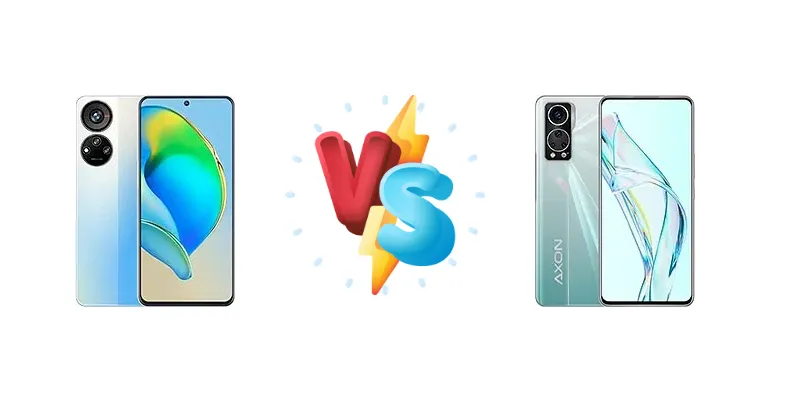
ZTE has been steadily carving out a niche in the smartphone market, offering compelling devices at competitive prices. The Axon 40 SE and Axon 30 5G represent different points in their product evolution. Let's dive into a detailed comparison to help you decide which one best suits your needs.
🏆 Quick Verdict
The ZTE Axon 30 5G is the clear winner, boasting a significantly more powerful Snapdragon 870 chipset, faster 65W charging, and a brighter display. While the Axon 40 SE might be more budget-friendly, the Axon 30 5G offers a superior overall experience.
| Network |
|---|
| 2G bands | GSM 850 / 900 / 1800 / 1900 | GSM 850 / 900 / 1800 / 1900 |
| 3G bands | HSDPA 850 / 900 / 2100 | HSDPA 850 / 900 / 1700(AWS) / 1900 / 2100 - International |
| 4G bands | 1, 2, 3, 4, 5, 7, 12, 13, 28, 66 | 1, 2, 3, 4, 5, 7, 8, 12, 17, 20, 26, 28, 18, 19, 34, 38, 39, 40, 41 - Europe |
| 5G bands | - | 1, 3, 28, 38, 41, 77, 78 SA/NSA - Europe |
| Speed | HSPA, LTE | HSPA, LTE, 5G |
| Technology | GSM / HSPA / LTE | GSM / CDMA / HSPA / LTE / 5G |
| | - | 1, 3, 28, 41, 78 SA/NSA - China |
| Launch |
|---|
| Announced | 2022, October 20 | 2021, July 27 |
| Status | Available. Released 2022, October 25 | Available. Released 2021, August 03 |
| Body |
|---|
| Build | - | Glass front, plastic back, plastic frame |
| Dimensions | 163.5 x 75.8 x 7.6 mm (6.44 x 2.98 x 0.30 in) | 170.2 x 77.8 x 7.8 mm (6.70 x 3.06 x 0.31 in) |
| SIM | Nano-SIM + Nano-SIM | Nano-SIM + Nano-SIM |
| Weight | 182 g (6.42 oz) | 189 g (6.67 oz) |
| Display |
|---|
| Protection | - | Corning Gorilla Glass |
| Resolution | 1080 x 2400 pixels, 20:9 ratio (~395 ppi density) | 1080 x 2460 pixels (~400 ppi density) |
| Size | 6.67 inches, 107.4 cm2 (~86.7% screen-to-body ratio) | 6.92 inches, 107.0 cm2 (~80.8% screen-to-body ratio) |
| Type | AMOLED | AMOLED, 1B colors, 120Hz |
| | - | Always-on display |
| Platform |
|---|
| CPU | Octa-core (2x2.0 GHz Cortex-A75 & 6x2.0 GHz Cortex-A55) | Octa-core (1x3.2 GHz Kryo 585 & 3x2.42 GHz Kryo 585 & 4x1.80 GHz Kryo 585) |
| Chipset | Unisoc UMS512T T618 (12 nm) | Qualcomm SM8250-AC Snapdragon 870 5G (7 nm) |
| GPU | Mali-G52 MP2 | Adreno 650 |
| OS | Android 12, MyOS 12 | Android 11, MyOS 11 |
| Memory |
|---|
| Card slot | microSDXC (dedicated slot) | microSDXC (uses shared SIM slot) |
| Internal | 128GB 4GB RAM | 128GB 6GB RAM, 128GB 8GB RAM, 256GB 8GB RAM, 256GB 12GB RAM |
| | - | UFS 3.1 |
| Main Camera |
|---|
| Features | LED flash, HDR, panorama | Dual-LED flash, HDR, panorama |
| Quad | - | 64 MP, f/1.8, 25mm (wide), 1/1.73", 0.8µm, PDAF
8 MP, f/2.2, 120˚, 16mm (ultrawide)
5 MP (macro)
Auxiliary lens |
| Single | 8 MP, f/2.0, (wide) | 16 MP, f/2.5, (wide), under display |
| Triple | 50 MP, f/1.8, 26mm (wide), PDAF
5 MP (macro)
Auxiliary lens | - |
| Video | 1080p@30fps | 4K@30/60fps, 1080p@30fps, gyro-EIS, HDR, 10‑bit video |
| Selfie camera |
|---|
| Features | - | HDR |
| Single | 8 MP, f/2.0, (wide) | 16 MP, f/2.5, (wide), under display |
| Video | 1080p@30fps | 1080p@30fps |
| Sound |
|---|
| 3.5mm jack | Yes | No |
| 35mm jack | Yes | No |
| Loudspeaker | Yes | Yes |
| | - | 24-bit/192kHz audio |
| Comms |
|---|
| Bluetooth | 5.0, A2DP, LE | 5.1, A2DP, LE |
| NFC | Yes | Yes |
| Positioning | GPS | GPS, GLONASS, GALILEO, BDS |
| Radio | Unspecified | No |
| USB | USB Type-C 2.0, OTG | USB Type-C 3.0, OTG |
| WLAN | Yes | Wi-Fi 802.11 a/b/g/n/ac/6, dual-band, Wi-Fi Direct |
| Features |
|---|
| Sensors | Fingerprint (side-mounted), accelerometer, gyro, proximity, compass | Fingerprint (under display, optical), accelerometer, gyro, proximity, compass |
| Battery |
|---|
| Charging | 22.5W wired | 65W wired, PD, QC4 |
| Type | Li-Ion 4500 mAh | Li-Ion 4200 mAh |
| Misc |
|---|
| Colors | Blue, Black | Black, Aqua |
| Models | 9047 | A2322, A2322G |
| Price | About 300 EUR | About 500 EUR |
| Tests |
|---|
| Battery life | - |
Endurance rating 86h
|
| Camera | - |
Photo / Video |
| Display | - |
Contrast ratio: Infinite (nominal) |
| Loudspeaker | - |
-27.7 LUFS (Good)
|
| Performance | - |
AnTuTu: 701991 (v9)
GeekBench: 3160 (v5.1)
GFXBench: 59fps (ES 3.1 onscreen) |
ZTE Axon 40 SE
- More affordable
- Decent battery life (86h endurance)
- Lightweight design (assumed)
- Weaker chipset (Unisoc T618)
- Slower charging (22.5W)
- Likely less vibrant display
- Lower camera performance (assumed)
ZTE Axon 30 5G
- Powerful Snapdragon 870 chipset
- Fast 65W charging
- Brighter display (438 nits)
- Likely better camera performance
- Excellent battery life (86h endurance)
- Higher price
- Potentially larger and heavier (assumed)
Display Comparison
The Axon 30 5G's display shines with a measured 438 nits of brightness and an impressive (though nominal) infinite contrast ratio, offering vibrant colors and deep blacks. The Axon 40 SE's display is likely adequate but lacks the same level of visual fidelity. Expect a more immersive viewing experience on the Axon 30 5G.
Camera Comparison
While both phones offer photo and video capabilities, the Axon 30 5G's Snapdragon 870 likely provides better image processing and overall camera performance. Expect improved low-light performance and more detailed photos from the Axon 30 5G. Specific camera specs are missing for both, but the chipset advantage is significant.
Performance
Here's where the Axon 30 5G truly pulls ahead. Its Snapdragon 870 chipset is a powerhouse, delivering significantly faster performance for gaming, multitasking, and demanding applications. The Axon 40 SE's Unisoc T618 is a budget chipset, suitable for everyday tasks but struggling with heavier workloads.
Battery Life
Both phones boast an impressive endurance rating of 86 hours, suggesting excellent battery life. However, the Axon 30 5G's 65W charging is a game-changer, allowing for significantly faster charging times compared to the Axon 40 SE's 22.5W wired charging.
Buying Guide
The ZTE Axon 40 SE is a good option for users on a tight budget who prioritize affordability and basic functionality. The ZTE Axon 30 5G is ideal for those seeking a smoother performance, faster charging, and a better camera experience, even if it comes at a slightly higher price.
Frequently Asked Questions
❓ Is the ZTE Axon 40 SE good for gaming?
The Axon 40 SE's Unisoc T618 chipset is not ideal for demanding games. It can handle lighter titles, but you may experience lag or reduced graphics settings in more intensive games.
❓ How long does it take to fully charge the ZTE Axon 30 5G?
With its 65W charging, the ZTE Axon 30 5G can typically fully charge in around 35-45 minutes, depending on usage and conditions.