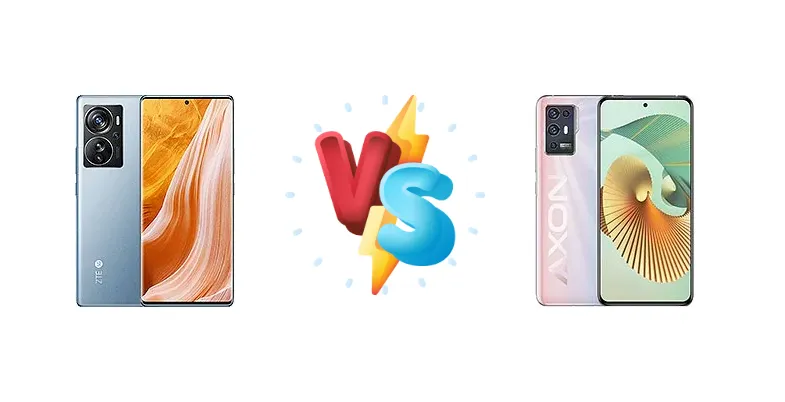
ZTE has been steadily improving its smartphone offerings, and the Axon series is a testament to that. The Axon 40 Pro and Axon 30 Pro 5G are two compelling options, but which one reigns supreme? This comprehensive comparison will break down their key differences to help you make an informed decision.
🏆 Quick Verdict
The ZTE Axon 40 Pro edges out the Axon 30 Pro 5G thanks to its more efficient Snapdragon 870 chipset, faster 65W charging, and potentially improved camera software. While the 888 offers raw power, the 870 provides a smoother, more power-efficient experience overall.
| Network |
|---|
| 2G bands | GSM 850 / 900 / 1800 / 1900 | GSM 850 / 900 / 1800 / 1900 |
| 3G bands | HSDPA 850 / 900 / 1900 / 2100 - Europe | HSDPA 850 / 900 / 1700(AWS) / 1900 / 2100 |
| 4G bands | 1, 3, 5, 7, 8, 20, 28, 38, 40, 41 - Europe | 1, 3, 5, 7, 8, 4, 12, 17, 20, 34, 38, 39, 40, 41 |
| 5G bands | 1, 3, 5, 7, 28, 38, 40, 41, 78 SA/NSA - Europe | 1, 3, 28, 41, 78 SA/NSA |
| Speed | HSPA, LTE, 5G | HSPA, LTE, 5G |
| Technology | GSM / CDMA / HSPA / LTE / 5G | GSM / CDMA / HSPA / LTE / 5G |
| | 1, 2, 3, 5, 7, 28, 38, 40, 41, 66, 77, 78 SA/NSA - ROW | CDMA 800 |
| Launch |
|---|
| Announced | 2022, May 09 | 2021, April 15 |
| Status | Available. Released 2022, May 31 | Available. Released 2021, April 26 |
| Body |
|---|
| Dimensions | 162.9 x 72.9 x 8.7 mm (6.41 x 2.87 x 0.34 in) | 163.6 x 75.3 x 7.9 mm (6.44 x 2.96 x 0.31 in) |
| SIM | Nano-SIM + Nano-SIM | Nano-SIM + Nano-SIM |
| Weight | 199 g (7.02 oz) | 186 g (6.56 oz) |
| Display |
|---|
| Protection | - | Corning Gorilla Glass 5 |
| Resolution | 1080 x 2400 pixels, 20:9 ratio (~395 ppi density) | 1080 x 2400 pixels, 20:9 ratio (~395 ppi density) |
| Size | 6.67 inches, 107.4 cm2 (~90.4% screen-to-body ratio) | 6.67 inches, 107.4 cm2 (~87.2% screen-to-body ratio) |
| Type | AMOLED, 1B colors, 144Hz, 1000 nits (peak) | AMOLED, 1B colors, 120Hz, HDR10+ |
| Platform |
|---|
| CPU | Octa-core (1x3.2 GHz Kryo 585 & 3x2.42 GHz Kryo 585 & 4x1.80 GHz Kryo 585) | Octa-core (1x2.84 GHz Cortex-X1 & 3x2.42 GHz Cortex-A78 & 4x1.80 GHz Cortex-A55) |
| Chipset | Qualcomm SM8250-AC Snapdragon 870 5G (7 nm) | Qualcomm SM8350 Snapdragon 888 5G (5 nm) |
| GPU | Adreno 650 | Adreno 660 |
| OS | Android 12, MyOS 12 | Android 11, MyOS 11 |
| Memory |
|---|
| Card slot | No | No |
| Internal | 128GB 8GB RAM, 256GB 8GB RAM, 256GB 12GB RAM, 512GB 12GB RAM | 128GB 6GB RAM, 128GB 8GB RAM, 256GB 8GB RAM |
| | UFS 3.1 | UFS 3.1 |
| Main Camera |
|---|
| Features | Dual-LED flash, HDR, panorama | Dual-LED flash, panorama, HDR |
| Quad | 108 MP, f/1.9, (wide), 1/1.52", PDAF
8 MP, f/2.2, 16mm, 120˚ (ultrawide)
2 MP (macro)
Auxiliary lens | 64 MP, f/1.8, 26mm (wide), 1/1.73", 0.8µm, PDAF
64 MP, f/2.4, 13mm, 120˚ (ultrawide)
5 MP (macro)
Auxiliary lens |
| Single | 16 MP, (wide) | 16 MP, (wide) |
| Video | 4K@30/60fps, 1080p@30fps, gyro-EIS, HDR10, 10‑bit video | 4K@30/60fps, 1080p@30fps, gyro-EIS, HDR10, 10‑bit video |
| Selfie camera |
|---|
| Features | HDR | HDR |
| Single | 16 MP, (wide) | 16 MP, (wide) |
| Video | 4K@30fps, 1080p@30fps | 4K@30fps, 1080p@30fps |
| Sound |
|---|
| 3.5mm jack | No | No |
| 35mm jack | No | No |
| Loudspeaker | Yes, with stereo speakers | Yes |
| | 24-bit/192kHz audio | 24-bit/192kHz audio |
| Comms |
|---|
| Bluetooth | 5.2, A2DP, LE | 5.2, A2DP, LE |
| NFC | Yes | Yes |
| Positioning | GPS, GLONASS, GALILEO, BDS | GPS, GLONASS, GALILEO, BDS |
| Radio | No | No |
| USB | USB Type-C 3.1, OTG | USB Type-C 3.1, OTG |
| WLAN | Wi-Fi 802.11 a/b/g/n/ac/6, dual-band, Wi-Fi Direct | Wi-Fi 802.11 a/b/g/n/ac/6, dual-band, Wi-Fi Direct |
| Features |
|---|
| Sensors | Fingerprint (under display, optical), accelerometer, gyro, proximity, compass | Fingerprint (under display, optical), accelerometer, gyro, proximity, compass |
| Battery |
|---|
| Charging | 65W wired, PD, QC4 | 55W wired, QC4 |
| Type | Li-Po 5000 mAh | Li-Po 4200 mAh |
| Misc |
|---|
| Colors | Dream black, Crystal blue, Gold | Black, Pink |
| Models | A2023G, A2023 | A2022 |
| Price | About 410 EUR | About 400 EUR |
ZTE Axon 40 Pro
- More efficient Snapdragon 870 chipset
- Faster 65W charging
- Potentially improved camera software
- Likely better thermal management
- Snapdragon 888 offers slightly higher peak performance
- May have a slightly higher price
ZTE Axon 30 Pro 5G
- Raw power of Snapdragon 888
- Potentially slightly lower price
- Good display quality
- Less efficient chipset
- Slower 55W charging
- Potential for thermal throttling under heavy load
Display Comparison
Both phones feature AMOLED displays with high refresh rates (likely 120Hz). The Axon 40 Pro may have a slightly brighter display and potentially improved color accuracy, though specific panel details are needed for a definitive comparison. Expect vibrant colors and smooth scrolling on both.
Camera Comparison
Both phones likely feature a triple-camera setup with a primary sensor, ultrawide, and potentially a telephoto lens. The Axon 40 Pro may benefit from improved image processing algorithms and potentially a newer sensor, leading to better low-light performance and overall image quality. Expect detailed photos and videos from both.
Performance
The Axon 30 Pro 5G boasts the Snapdragon 888, known for its raw power. However, the Snapdragon 870 in the Axon 40 Pro is more efficient and often delivers smoother, more consistent performance in everyday use and gaming due to better thermal management. The 870 is generally considered a 'sweet spot' for performance and efficiency.
Battery Life
The Axon 40 Pro's 65W charging is a significant advantage over the Axon 30 Pro's 55W. While both offer all-day battery life with moderate usage, the Axon 40 Pro will charge significantly faster. Battery capacity is likely similar (around 4500-5000mAh), but the 870's efficiency gives the 40 Pro an edge.
Buying Guide
The ZTE Axon 40 Pro is ideal for users prioritizing smooth performance, efficient battery life, and fast charging. The Axon 30 Pro 5G is a good choice for those seeking raw processing power for demanding games or applications, and who don't mind potentially shorter battery life.
Frequently Asked Questions
❓ Is the Snapdragon 888 better than the Snapdragon 870?
The Snapdragon 888 offers higher peak performance, but the Snapdragon 870 is more efficient and generally provides a smoother, more consistent experience due to better thermal management.
❓ Which phone has better battery life?
The ZTE Axon 40 Pro likely has slightly better battery life due to the more efficient Snapdragon 870 chipset and faster charging speeds.