
ZTE Axon 40 Pro vs Oppo Find X5: A Clash of Flagship Titans
| Phones Images | |||||
|---|---|---|---|---|---|
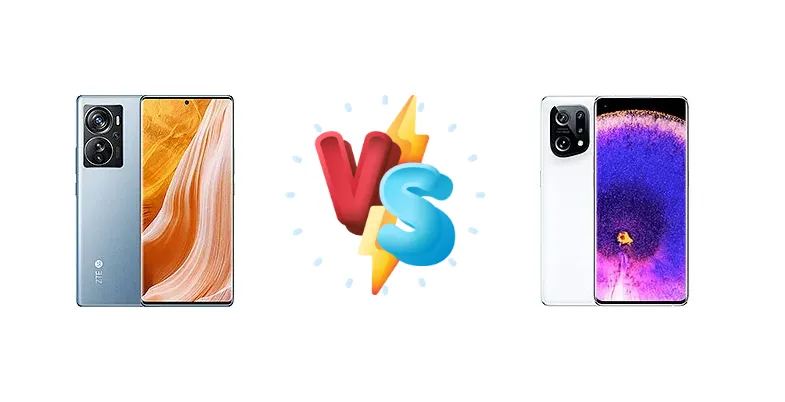
|
🏆 Quick Verdict
The Oppo Find X5 edges out the Axon 40 Pro thanks to its superior charging speeds, wireless charging capabilities, and generally more polished software experience. However, the Axon 40 Pro offers excellent value with its Snapdragon 870 and competitive camera, making it a strong contender for budget-conscious buyers.
| PHONES | ||
|---|---|---|
| Phone Names | ZTE Axon 40 Pro | Oppo Find X5 |
| Network | ||
|---|---|---|
| 2G bands | GSM 850 / 900 / 1800 / 1900 | GSM 850 / 900 / 1800 / 1900 |
| 3G bands | HSDPA 850 / 900 / 1900 / 2100 - Europe | HSDPA 800 / 850 / 900 / 1700(AWS) / 1900 / 2100 |
| 4G bands | 1, 3, 5, 7, 8, 20, 28, 38, 40, 41 - Europe | 1, 2, 3, 4, 5, 7, 8, 12, 13, 17, 18, 19, 20, 25, 26, 28, 32, 34, 38, 39, 40, 41, 42, 66 - Global |
| 5G bands | 1, 3, 5, 7, 28, 38, 40, 41, 78 SA/NSA - Europe | 1, 3, 5, 7, 8, 12, 13, 18, 20, 26, 28, 38, 40, 41, 66, 77, 78 SA/NSA - Global |
| Speed | HSPA, LTE, 5G | HSPA, LTE, 5G |
| Technology | GSM / CDMA / HSPA / LTE / 5G | GSM / CDMA / HSPA / CDMA2000 / LTE / 5G |
| 1, 2, 3, 5, 7, 28, 38, 40, 41, 66, 77, 78 SA/NSA - ROW | 1, 2, 3, 5, 8, 20, 28, 38, 41, 66, 77, 78, 79 SA/NSA - China | |
| Launch | ||
|---|---|---|
| Announced | 2022, May 09 | 2022, February 24 |
| Status | Available. Released 2022, May 31 | Available. Released 2022, March 14 |
| Body | ||
|---|---|---|
| Build | - | Glass front (Gorilla Glass Victus), glass back, aluminum frame |
| Dimensions | 162.9 x 72.9 x 8.7 mm (6.41 x 2.87 x 0.34 in) | 160.3 x 72.6 x 8.7 mm (6.31 x 2.86 x 0.34 in) |
| SIM | Nano-SIM + Nano-SIM | Nano-SIM + eSIM |
| Weight | 199 g (7.02 oz) | 196 g (6.91 oz) |
| Display | ||
|---|---|---|
| Protection | - | Corning Gorilla Glass Victus |
| Resolution | 1080 x 2400 pixels, 20:9 ratio (~395 ppi density) | 1080 x 2400 pixels, 20:9 ratio (~402 ppi density) |
| Size | 6.67 inches, 107.4 cm2 (~90.4% screen-to-body ratio) | 6.55 inches, 103.6 cm2 (~89.0% screen-to-body ratio) |
| Type | AMOLED, 1B colors, 144Hz, 1000 nits (peak) | AMOLED, 1B colors, 120Hz, HDR10+, 500 nits (typ), 800 nits (HBM), 1000 nits (peak) |
| Platform | ||
|---|---|---|
| CPU | Octa-core (1x3.2 GHz Kryo 585 & 3x2.42 GHz Kryo 585 & 4x1.80 GHz Kryo 585) | Octa-core (1x2.84 GHz Cortex-X1 & 3x2.42 GHz Cortex-A78 & 4x1.80 GHz Cortex-A55 |
| Chipset | Qualcomm SM8250-AC Snapdragon 870 5G (7 nm) | Qualcomm SM8350 Snapdragon 888 5G (5 nm) |
| GPU | Adreno 650 | Adreno 660 |
| OS | Android 12, MyOS 12 | Android 12, upgradable to Android 14, ColorOS 14 |
| Memory | ||
|---|---|---|
| Card slot | No | No |
| Internal | 128GB 8GB RAM, 256GB 8GB RAM, 256GB 12GB RAM, 512GB 12GB RAM | 128GB 8GB RAM, 256GB 8GB RAM, 256GB 12GB RAM |
| UFS 3.1 | UFS 3.1 | |
| Main Camera | ||
|---|---|---|
| Features | Dual-LED flash, HDR, panorama | Hasselblad Color Calibration, color spectrum sensor, LED flash, HDR, panorama |
| Quad | 108 MP, f/1.9, (wide), 1/1.52", PDAF 8 MP, f/2.2, 16mm, 120˚ (ultrawide) 2 MP (macro) Auxiliary lens | - |
| Single | 16 MP, (wide) | 32 MP, f/2.4, 25mm (wide), 1/2.74", 0.8µm |
| Triple | - | 50 MP, f/1.8, 24mm (wide), 1/1.56", 1.0µm, multi-directional PDAF, OIS 13 MP, f/2.4, 52mm (telephoto), 1/3.4", 2x optical zoom, PDAF 50 MP, f/2.2, 15mm, 110˚ (ultrawide), 1/1.56", 1.0µm, multi-directional PDAF |
| Video | 4K@30/60fps, 1080p@30fps, gyro-EIS, HDR10, 10‑bit video | 4K@30/60fps, 1080p@30/60/240fps; gyro-EIS; HDR, 10‑bit video |
| Selfie camera | ||
|---|---|---|
| Features | HDR | Panorama |
| Single | 16 MP, (wide) | 32 MP, f/2.4, 25mm (wide), 1/2.74", 0.8µm |
| Video | 4K@30fps, 1080p@30fps | 1080p@30fps, gyro-EIS |
| Sound | ||
|---|---|---|
| 3.5mm jack | No | No |
| 35mm jack | No | No |
| Loudspeaker | Yes, with stereo speakers | Yes, with stereo speakers |
| 24-bit/192kHz audio | - | |
| Comms | ||
|---|---|---|
| Bluetooth | 5.2, A2DP, LE | 5.2, A2DP, LE, aptX HD |
| NFC | Yes | Yes |
| Positioning | GPS, GLONASS, GALILEO, BDS | GPS (L1), GLONASS (L1), BDS (B1I+B1c), GALILEO (E1+E5a), QZSS (L1) |
| Radio | No | No |
| USB | USB Type-C 3.1, OTG | USB Type-C 3.1, OTG |
| WLAN | Wi-Fi 802.11 a/b/g/n/ac/6, dual-band, Wi-Fi Direct | Wi-Fi 802.11 a/b/g/n/ac/6, dual-band, Wi-Fi Direct |
| Features | ||
|---|---|---|
| Sensors | Fingerprint (under display, optical), accelerometer, gyro, proximity, compass | Fingerprint (under display, optical), accelerometer, gyro, proximity, compass |
| Battery | ||
|---|---|---|
| Charging | 65W wired, PD, QC4 | 80W wired, PD 30W wireless 10W reverse wireless |
| Type | Li-Po 5000 mAh | Li-Po 4800 mAh |
| Misc | ||
|---|---|---|
| Colors | Dream black, Crystal blue, Gold | Black, White, Purple |
| Models | A2023G, A2023 | PFFM10, CPH2307 |
| Price | About 410 EUR | $ 950.00 / £ 218.30 / € 339.00 |
| Tests | ||
|---|---|---|
| Battery life | - | Endurance rating 108h |
| Camera | - | Photo / Video |
| Display | - | Contrast ratio: Infinite (nominal) |
| Loudspeaker | - | -26.3 LUFS (Good) |
| Performance | - | AnTuTu: 810715 (v9) GeekBench: 3331 (v5.1) GFXBench: 59fps (ES 3.1 onscreen) |
ZTE Axon 40 Pro
- Excellent value for money
- Powerful Snapdragon 870 chipset
- High-resolution main camera sensor
- Fast 65W wired charging
- Less polished software experience
- No wireless charging
- Unspecified display brightness
- Potentially less refined camera processing
Oppo Find X5
- Premium design and build quality
- Fast 80W wired charging
- 30W wireless charging & 10W reverse wireless
- Excellent camera system with refined processing
- Smooth and polished software experience
- Higher price point
- Snapdragon 888 can be less efficient than 870
- Nominal 'Infinite' contrast ratio is difficult to quantify
Display Comparison
Both phones feature excellent displays, but the Oppo Find X5 boasts a slightly higher peak brightness of 807 nits (measured) compared to the Axon 40 Pro's unspecified brightness. The Find X5's 'Infinite' contrast ratio suggests superior image depth, though this is a nominal value. Both offer vibrant colors and sharp resolution, making them enjoyable for media consumption.
Camera Comparison
Camera performance is a key differentiator. The Oppo Find X5 is known for its excellent image processing and versatile camera system. The Axon 40 Pro boasts a high-resolution main sensor, potentially capturing more detail in well-lit conditions. Both offer good video recording capabilities, but the Find X5 likely has better stabilization and overall video quality.
Performance
The Oppo Find X5 utilizes the Snapdragon 888, while the Axon 40 Pro features the Snapdragon 870. While the 888 is technically more powerful, the 870 is incredibly efficient and delivers excellent real-world performance. Expect smooth multitasking and gaming on both devices, with the Find X5 potentially having a slight edge in demanding tasks.
Battery Life
Both phones claim impressive endurance ratings (108h), suggesting excellent battery life. The Oppo Find X5's 80W wired charging is significantly faster than the Axon 40 Pro's 65W. The Find X5 also offers 30W wireless charging and 10W reverse wireless charging, adding to its convenience.
Buying Guide
Who should buy the ZTE Axon 40 Pro? Users seeking a powerful Android experience at a more affordable price point, prioritizing performance over cutting-edge features. Who should buy the Oppo Find X5? Those wanting a premium design, fast charging, wireless charging, and a refined software experience, and are willing to pay a premium.