
ZTE Axon 40 Pro vs OnePlus 11: A Clash of Flagship Titans
| Phones Images | |||||
|---|---|---|---|---|---|
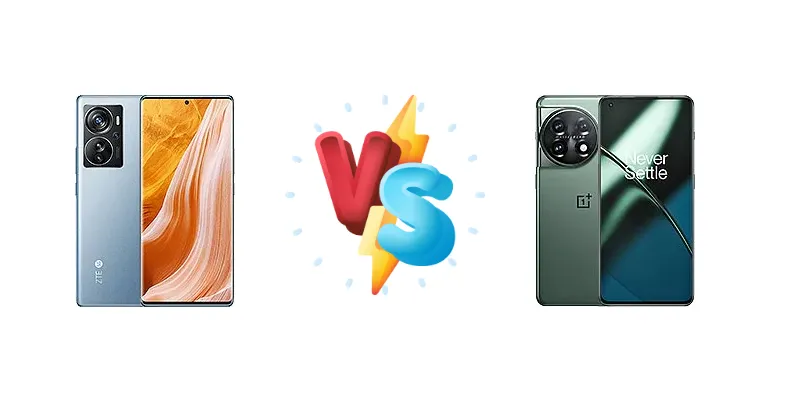
|
🏆 Quick Verdict
The OnePlus 11 emerges as the overall winner thanks to its superior Snapdragon 8 Gen 2 chipset, faster charging, and generally more polished software experience. While the Axon 40 Pro offers impressive value with its under-display camera and Snapdragon 870, the OnePlus 11 provides a more complete flagship package.
| PHONES | ||
|---|---|---|
| Phone Names | ZTE Axon 40 Pro | OnePlus 11 |
| Network | ||
|---|---|---|
| 2G bands | GSM 850 / 900 / 1800 / 1900 | GSM 850 / 900 / 1800 / 1900 |
| 3G bands | HSDPA 850 / 900 / 1900 / 2100 - Europe | HSDPA 800 / 850 / 900 / 1700(AWS) / 1900 / 2100 |
| 4G bands | 1, 3, 5, 7, 8, 20, 28, 38, 40, 41 - Europe | 1, 2, 3, 4, 5, 7, 8, 12, 13, 17, 18, 19, 20, 25, 26, 28, 30, 32, 38, 39, 41, 40, 46, 48, 66, 71 - International |
| 5G bands | 1, 3, 5, 7, 28, 38, 40, 41, 78 SA/NSA - Europe | 1, 2, 3, 5, 7, 8, 20, 25, 28, 30, 38, 40, 41, 66, 71, 75, 77, 78 SA/NSA - International |
| Speed | HSPA, LTE, 5G | HSPA, LTE, 5G |
| Technology | GSM / CDMA / HSPA / LTE / 5G | GSM / CDMA / HSPA / EVDO / LTE / 5G |
| 1, 2, 3, 5, 7, 28, 38, 40, 41, 66, 77, 78 SA/NSA - ROW | 1, 3, 5, 7, 8, 20, 28, 38, 40, 41, 66, 77, 78 SA/NSA - China | |
| Launch | ||
|---|---|---|
| Announced | 2022, May 09 | 2023, January 04 |
| Status | Available. Released 2022, May 31 | Available. Released 2023, January 09 |
| Body | ||
|---|---|---|
| Build | - | Glass front (Gorilla Glass Victus), glass back (Gorilla Glass 5), aluminum frame |
| Dimensions | 162.9 x 72.9 x 8.7 mm (6.41 x 2.87 x 0.34 in) | 163.1 x 74.1 x 8.5 mm (6.42 x 2.92 x 0.33 in) |
| SIM | Nano-SIM + Nano-SIM | · Nano-SIM· Nano-SIM + Nano-SIM + eSIM (max 2 at a time) |
| Weight | 199 g (7.02 oz) | 205 g (7.23 oz) |
| - | IP64 | |
| Display | ||
|---|---|---|
| Protection | - | Corning Gorilla Glass Victus |
| Resolution | 1080 x 2400 pixels, 20:9 ratio (~395 ppi density) | 1440 x 3216 pixels, 20:9 ratio (~525 ppi density) |
| Size | 6.67 inches, 107.4 cm2 (~90.4% screen-to-body ratio) | 6.7 inches, 108.4 cm2 (~89.7% screen-to-body ratio) |
| Type | AMOLED, 1B colors, 144Hz, 1000 nits (peak) | LTPO3 Fluid AMOLED, 1B colors, 120Hz, Dolby Vision, HDR10+, 500 nits (typ), 800 nits (HBM), 1300 nits (peak) |
| - | Always-on display | |
| Platform | ||
|---|---|---|
| CPU | Octa-core (1x3.2 GHz Kryo 585 & 3x2.42 GHz Kryo 585 & 4x1.80 GHz Kryo 585) | Octa-core (1x3.2 GHz Cortex-X3 & 2x2.8 GHz Cortex-A715 & 2x2.8 GHz Cortex-A710 & 3x2.0 GHz Cortex-A510) |
| Chipset | Qualcomm SM8250-AC Snapdragon 870 5G (7 nm) | Qualcomm SM8550-AB Snapdragon 8 Gen 2 (4 nm) |
| GPU | Adreno 650 | Adreno 740 |
| OS | Android 12, MyOS 12 | Android 13, upgradable to Android 15, OxygenOS 15 (International), ColorOS 14 (China) |
| Memory | ||
|---|---|---|
| Card slot | No | No |
| Internal | 128GB 8GB RAM, 256GB 8GB RAM, 256GB 12GB RAM, 512GB 12GB RAM | 128GB 8GB RAM, 256GB 12GB RAM, 256GB 16GB RAM, 512GB 16GB RAM |
| UFS 3.1 | UFS 3.1 - 128GB only UFS 4.0 | |
| Main Camera | ||
|---|---|---|
| Features | Dual-LED flash, HDR, panorama | Hasselblad Color Calibration, color spectrum sensor, Dual-LED flash, HDR, panorama |
| Quad | 108 MP, f/1.9, (wide), 1/1.52", PDAF 8 MP, f/2.2, 16mm, 120˚ (ultrawide) 2 MP (macro) Auxiliary lens | - |
| Single | 16 MP, (wide) | 16 MP, f/2.5, 25mm (wide), 1.0µm |
| Triple | - | 50 MP, f/1.8, 24mm (wide), 1/1.56", 1.0µm, multi-directional PDAF, OIS 32 MP, f/2.0, 48mm (telephoto), 1/2.74", PDAF, 2x optical zoom 48 MP, f/2.2, 115˚, (ultrawide), 1/2.0", AF |
| Video | 4K@30/60fps, 1080p@30fps, gyro-EIS, HDR10, 10‑bit video | 8K@24fps, 4K@30/60fps, 1080p@30/60/240fps, Auto HDR, gyro-EIS |
| Selfie camera | ||
|---|---|---|
| Features | HDR | HDR, panorama |
| Single | 16 MP, (wide) | 16 MP, f/2.5, 25mm (wide), 1.0µm |
| Video | 4K@30fps, 1080p@30fps | 1080p@30fps, gyro-EIS |
| Sound | ||
|---|---|---|
| 3.5mm jack | No | No |
| 35mm jack | No | No |
| Loudspeaker | Yes, with stereo speakers | Yes, with stereo speakers |
| 24-bit/192kHz audio | 24-bit/192kHz audio | |
| Comms | ||
|---|---|---|
| Bluetooth | 5.2, A2DP, LE | 5.3, A2DP, LE, aptX HD |
| NFC | Yes | Yes |
| Positioning | GPS, GLONASS, GALILEO, BDS | GPS (L1+L5), GLONASS (G1), BDS (B1I+B1c+B2a), GALILEO (E1+E5a), QZSS (L1+L5) |
| Radio | No | No |
| USB | USB Type-C 3.1, OTG | USB Type-C 2.0, OTG |
| WLAN | Wi-Fi 802.11 a/b/g/n/ac/6, dual-band, Wi-Fi Direct | Wi-Fi 802.11 a/b/g/n/ac/6/7, dual-band, Wi-Fi Direct |
| Features | ||
|---|---|---|
| Sensors | Fingerprint (under display, optical), accelerometer, gyro, proximity, compass | Fingerprint (under display, optical), accelerometer, gyro, proximity, compass |
| Battery | ||
|---|---|---|
| Charging | 65W wired, PD, QC4 | 100W wired, PD, 50% in 10 min, 100% in 25 min - International 80W wired, PD - USA |
| Type | Li-Po 5000 mAh | Li-Po 5000 mAh |
| Misc | ||
|---|---|---|
| Colors | Dream black, Crystal blue, Gold | Titan Black, Eternal Green, Jupiter Rock |
| Models | A2023G, A2023 | PHB110, CPH2449, CPH2447, CPH2451 |
| Price | About 410 EUR | $ 379.99 / ₹ 33,990 |
| SAR | - | 1.19 W/kg (head) 0.99 W/kg (body) |
| Tests | ||
|---|---|---|
| Battery life | - | Endurance rating 108h |
| Camera | - | Photo / Video |
| Display | - | Contrast ratio: Infinite (nominal) |
| Loudspeaker | - | -25.2 LUFS (Very good) |
| Performance | - | AnTuTu: 1140661 (v9) GeekBench: 4899 (v5.1) GFXBench: 57fps (ES 3.1 onscreen) |
ZTE Axon 40 Pro
- Unique under-display camera
- Powerful Snapdragon 870 processor
- 65W fast charging
- Competitive price
- Potentially compromised camera quality due to under-display tech
- Less efficient processor compared to Snapdragon 8 Gen 2
- Slower charging speeds than OnePlus 11
- Software support may be less consistent
OnePlus 11
- Top-tier Snapdragon 8 Gen 2 processor
- Blazing-fast 100W charging (International) / 80W (USA)
- Excellent battery life
- Bright and vibrant display
- Refined software experience
- Higher price point
- Design may not appeal to everyone
- Alert slider missing compared to older OnePlus models
Display Comparison
Both phones boast vibrant AMOLED displays, but the OnePlus 11 takes the lead with a measured peak brightness of 767 nits, offering better visibility in direct sunlight. The OnePlus 11 also boasts an 'infinite' contrast ratio, suggesting deeper blacks and richer colors. The Axon 40 Pro's display is still excellent, but lacks the same level of brightness and contrast.
Camera Comparison
While both phones offer capable camera systems, the OnePlus 11 is expected to deliver superior image quality, particularly in challenging lighting conditions. The OnePlus 11 likely benefits from better image processing and potentially larger sensors. The Axon 40 Pro's unique under-display camera is a novelty, but image quality may be compromised compared to a traditional camera setup.
Performance
The OnePlus 11's Snapdragon 8 Gen 2 is significantly faster and more efficient than the Axon 40 Pro's Snapdragon 870. Expect smoother multitasking, quicker app loading times, and better gaming performance on the OnePlus 11. While the 870 is still a capable chip, the 8 Gen 2 represents a substantial generational leap.
Battery Life
The OnePlus 11 demonstrates exceptional battery life with an endurance rating of 108 hours and active use lasting over 11 hours. The Axon 40 Pro's battery life is respectable, but likely falls short of the OnePlus 11's longevity. The OnePlus 11 also boasts significantly faster charging speeds (100W wired), allowing for a full charge in under 30 minutes.
Buying Guide
The ZTE Axon 40 Pro is ideal for users seeking a unique under-display camera experience and a powerful processor at a more affordable price point. The OnePlus 11 is perfect for those prioritizing top-tier performance, blazing-fast charging, and a refined user experience, willing to spend a bit more.