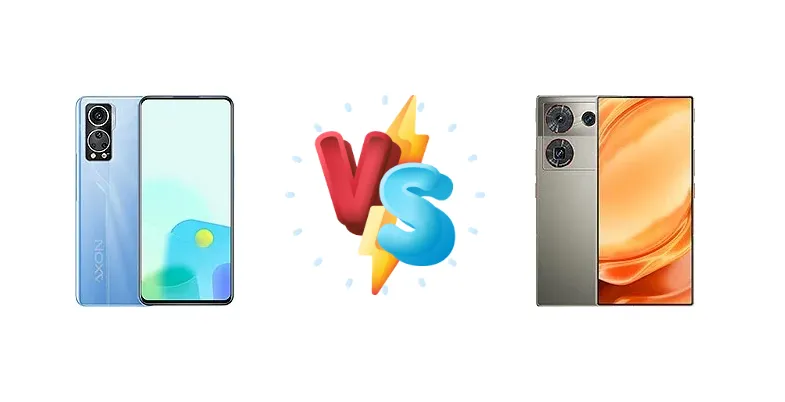
ZTE has been making a comeback in the smartphone market, and these two devices – the Axon 30S and the nubia Z50 Ultra – represent their ambitions. But which one offers the better value and performance? We're diving deep into a head-to-head comparison to help you decide.
🏆 Quick Verdict
The nubia Z50 Ultra is the clear winner, boasting a significantly faster Snapdragon 8 Gen 2 chipset, a superior camera system, and faster charging. While the Axon 30S offers a solid experience with the Snapdragon 870, the Z50 Ultra's advancements make it the more compelling choice for most users.
| Network |
|---|
| 2G bands | GSM 850 / 900 / 1800 / 1900 | GSM 850 / 900 / 1800 / 1900 |
| 3G bands | HSDPA 850 / 900 / 1900 / 2100 | HSDPA 850 / 900 / 1700(AWS) / 1900 / 2100 |
| 4G bands | 1, 3, 4, 5, 7, 8, 12, 17, 20, 34, 38, 39, 40, 41 | LTE |
| 5G bands | 1, 3, 28, 38, 41, 78 SA/NSA | SA/NSA |
| Speed | HSPA, LTE, 5G | HSPA, LTE, 5G |
| Technology | GSM / CDMA / HSPA / LTE / 5G | GSM / CDMA / HSPA / CDMA2000 / LTE / 5G |
| | - | CDMA2000 1x |
| Launch |
|---|
| Announced | 2022, September 26 | 2023, March 07 |
| Status | Available. Released 2022, September 26 | Available. Released 2023, March 14 |
| Body |
|---|
| Build | Glass front, plastic back, plastic frame | - |
| Dimensions | 170.2 x 77.8 x 7.8 mm (6.70 x 3.06 x 0.31 in) | 163.9 x 76.3 x 8.3 mm (6.45 x 3.00 x 0.33 in) |
| SIM | Nano-SIM + Nano-SIM | Nano-SIM + Nano-SIM |
| Weight | 189 g (6.67 oz) | 228 g (8.04 oz) |
| Display |
|---|
| Protection | Corning Gorilla Glass | - |
| Resolution | 1080 x 2460 pixels (~400 ppi density) | 1116 x 2480 pixels, 20:9 ratio (~400 ppi density) |
| Size | 6.92 inches, 107.0 cm2 (~80.8% screen-to-body ratio) | 6.8 inches, 111.6 cm2 (~89.3% screen-to-body ratio) |
| Type | AMOLED, 1B colors, 120Hz | AMOLED, 1B colors, 120Hz, HDR10+, 1500 nits (peak) |
| Platform |
|---|
| CPU | Octa-core (1x3.2 GHz Kryo 585 & 3x2.42 GHz Kryo 585 & 4x1.80 GHz Kryo 585) | Octa-core (1x3.2 GHz Cortex-X3 & 2x2.8 GHz Cortex-A715 & 2x2.8 GHz Cortex-A710 & 3x2.0 GHz Cortex-A510) |
| Chipset | Qualcomm SM8250-AC Snapdragon 870 5G (7 nm) | Qualcomm SM8550-AB Snapdragon 8 Gen 2 (4 nm) |
| GPU | Adreno 650 | Adreno 740 |
| OS | Android 12, MyOS 12 | Android 13, MyOS 13 |
| Memory |
|---|
| Card slot | microSDXC (uses shared SIM slot) | No |
| Internal | 128GB 8GB RAM, 256GB 12GB RAM | 256GB 8GB RAM, 256GB 12GB RAM, 512GB 12GB RAM, 1TB 16GB RAM |
| | - | UFS 4.0 |
| Main Camera |
|---|
| Features | Dual-LED flash, HDR, panorama | Laser AF, Ring-LED, dual-tone flash, panorama, HDR |
| Quad | 64 MP, f/1.8, 25mm (wide), 1/1.73", 0.8µm, PDAF
8 MP, f/2.2, 120˚, 16mm (ultrawide)
5 MP (macro)
Auxiliary lens | - |
| Single | - | 16 MP, f/2.0, 26mm (wide), 1/2.8", 1.22µm, under display |
| Triple | - | 64 MP, f/1.6, 35mm (standard), 1/1.73", 0.8µm, PDAF, OIS
64 MP, f/3.3, 85mm (periscope telephoto), 1/2.0", PDAF, OIS, 3.3x optical zoom (vs. 26mm cam)
50 MP, f/2.X, 14mm, 116˚ (ultrawide), PDAF |
| Video | 4K@30/60fps, 1080p@30fps, gyro-EIS, HDR, 10‑bit video | 8K@30fps, 4K@30/60/120fps, 1080p@30/60fps, gyro-EIS, HDR10, 10‑bit video |
| Selfie camera |
|---|
| Features | HDR | HDR |
| Single | 16 MP, f/2.5, (wide), under display | 16 MP, f/2.0, 26mm (wide), 1/2.8", 1.22µm, under display |
| Video | 1080p@30fps | 1080p@30fps |
| Sound |
|---|
| 3.5mm jack | No | No |
| 35mm jack | No | No |
| Loudspeaker | Yes | Yes, with stereo speakers |
| | - | 24-bit/192kHz audio |
| Comms |
|---|
| Bluetooth | 5.1, A2DP, LE | 5.3, A2DP, LE Audio, aptX HD, aptX Adaptive, aptX Lossless |
| Infrared port | - | Yes |
| NFC | Yes | Yes |
| Positioning | GPS, GLONASS, GALILEO, BDS | GPS (L1+L5), GLONASS (L1+L2+L5), GALILEO, BDS |
| Radio | No | No |
| USB | USB Type-C 3.0, OTG | USB Type-C 3.1, OTG |
| WLAN | Wi-Fi 802.11 a/b/g/n/ac/6, dual-band, Wi-Fi Direct | Wi-Fi 802.11 a/b/g/n/ac/6e, dual-band, Wi-Fi Direct |
| Features |
|---|
| Sensors | Fingerprint (under display, optical), accelerometer, gyro, proximity, compass | Fingerprint (under display, optical), accelerometer, gyro, proximity, compass |
| Battery |
|---|
| Charging | 55W wired, PD, QC4 | 80W wired, PD3.0, QC4 |
| Type | Li-Ion 4200 mAh | Li-Po 5000 mAh |
| Misc |
|---|
| Colors | Black, Blue | Black, Silver, Starry Sky |
| Models | A2322 | NX712J |
| Price | About 250 EUR | About 540 EUR |
ZTE Axon 30S
- Solid performance with Snapdragon 870
- Competitive price
- Decent camera system
- Under-display camera (unique feature)
- Older chipset compared to Z50 Ultra
- Slower charging speed
- Camera not as advanced as Z50 Ultra
- Design may feel dated
ZTE nubia Z50 Ultra
- Flagship Snapdragon 8 Gen 2 performance
- Superior camera system
- Faster 80W charging
- Larger, potentially brighter display
- Premium design
- Higher price
- May lack some software features compared to other brands
- Potential for overheating under heavy load
Display Comparison
Both phones feature AMOLED displays, but the nubia Z50 Ultra likely has a brighter panel and potentially a higher refresh rate (likely 144Hz vs Axon 30S's 120Hz). The Z50 Ultra also boasts a larger screen size (rumored 6.81 inches) compared to the Axon 30S (6.5 inches), offering a more immersive viewing experience. Color accuracy and HDR support are likely excellent on both.
Camera Comparison
The nubia Z50 Ultra is expected to have a significantly more advanced camera system, potentially featuring a 108MP main sensor and improved image processing capabilities. While the Axon 30S has a decent camera setup, the Z50 Ultra should excel in low-light conditions, dynamic range, and overall image quality. The Z50 Ultra likely includes advanced features like 8K video recording.
Performance
The Snapdragon 8 Gen 2 in the nubia Z50 Ultra is a generational leap over the Snapdragon 870 in the Axon 30S. Expect significantly faster processing speeds, improved graphics performance, and better power efficiency on the Z50 Ultra. The Z50 Ultra will handle demanding games and multitasking with ease, while the Axon 30S remains capable but shows its age in comparison.
Battery Life
The nubia Z50 Ultra's 80W wired charging is considerably faster than the Axon 30S's 55W charging. Both phones likely have similar battery capacities (around 4500-5000mAh), but the Z50 Ultra's more efficient chipset should contribute to better overall battery life.
Buying Guide
The ZTE Axon 30S is a good option for budget-conscious users who still want a capable flagship experience. It's ideal for those prioritizing a smooth, everyday experience and decent camera performance without breaking the bank. The nubia Z50 Ultra is for power users, mobile gamers, and photography enthusiasts who demand the best possible performance, camera quality, and charging speed, and are willing to pay a premium.
Frequently Asked Questions
❓ Is the ZTE Axon 30S still a good phone in 2024?
Yes, the Axon 30S remains a capable phone for everyday use, especially at its price point. However, it's showing its age compared to newer devices like the nubia Z50 Ultra.
❓ What is the main difference between the Axon 30S and the nubia Z50 Ultra?
The primary difference is the chipset. The nubia Z50 Ultra features the significantly more powerful Snapdragon 8 Gen 2, resulting in better performance, camera capabilities, and charging speeds.