
ZTE Axon 30S vs Axon 30 Ultra 5G: A Head-to-Head Comparison
| Phones Images | |||||
|---|---|---|---|---|---|
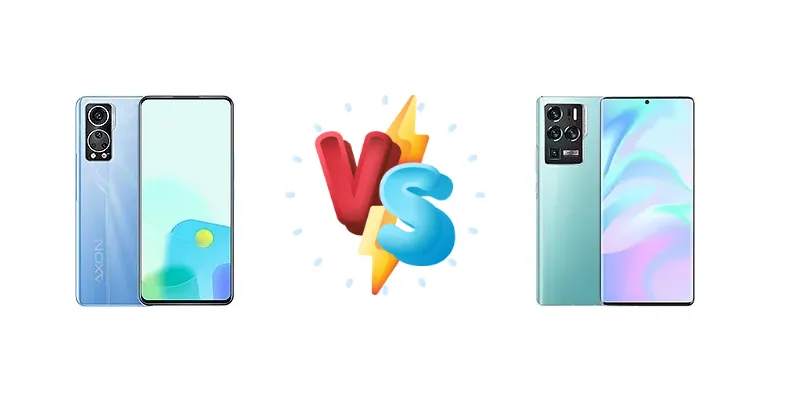
|
🏆 Quick Verdict
The Axon 30 Ultra 5G generally edges out the 30S thanks to its Snapdragon 888 chipset and potentially superior camera system. However, the 30S offers a compelling alternative with the Snapdragon 870, providing excellent performance at a potentially lower price point. It depends on your budget and priorities.
| PHONES | ||
|---|---|---|
| Phone Names | ZTE Axon 30S | ZTE Axon 30 Ultra 5G |
| Network | ||
|---|---|---|
| 2G bands | GSM 850 / 900 / 1800 / 1900 | GSM 850 / 900 / 1800 / 1900 |
| 3G bands | HSDPA 850 / 900 / 1900 / 2100 | HSDPA 850 / 900 / 1700(AWS) / 1900 / 2100 |
| 4G bands | 1, 3, 4, 5, 7, 8, 12, 17, 20, 34, 38, 39, 40, 41 | 1, 2, 3, 4, 5, 7, 8, 12, 17, 18, 19, 20, 26, 28, 34, 38, 39, 40, 41 |
| 5G bands | 1, 3, 28, 38, 41, 78 SA/NSA | 1, 3, 28, 41, 78, 79 SA/NSA |
| Speed | HSPA, LTE, 5G | HSPA, LTE, 5G |
| Technology | GSM / CDMA / HSPA / LTE / 5G | GSM / CDMA / HSPA / LTE / 5G |
| - | CDMA 800 | |
| Launch | ||
|---|---|---|
| Announced | 2022, September 26 | 2021, April 15 |
| Status | Available. Released 2022, September 26 | Available. Released 2021, April 19 |
| Body | ||
|---|---|---|
| Build | Glass front, plastic back, plastic frame | Glass front (Gorilla Glass 5), glass back (Gorilla Glass 5), aluminum frame |
| Dimensions | 170.2 x 77.8 x 7.8 mm (6.70 x 3.06 x 0.31 in) | 161.5 x 73 x 8 mm (6.36 x 2.87 x 0.31 in) |
| SIM | Nano-SIM + Nano-SIM | Nano-SIM + Nano-SIM |
| Weight | 189 g (6.67 oz) | 188 g (6.63 oz) |
| Display | ||
|---|---|---|
| Protection | Corning Gorilla Glass | Corning Gorilla Glass 5 |
| Resolution | 1080 x 2460 pixels (~400 ppi density) | 1080 x 2400 pixels, 20:9 ratio (~395 ppi density) |
| Size | 6.92 inches, 107.0 cm2 (~80.8% screen-to-body ratio) | 6.67 inches, 107.4 cm2 (~91.1% screen-to-body ratio) |
| Type | AMOLED, 1B colors, 120Hz | AMOLED, 1B colors, 144Hz, HDR10+ |
| Platform | ||
|---|---|---|
| CPU | Octa-core (1x3.2 GHz Kryo 585 & 3x2.42 GHz Kryo 585 & 4x1.80 GHz Kryo 585) | Octa-core (1x2.84 GHz Cortex-X1 & 3x2.42 GHz Cortex-A78 & 4x1.80 GHz Cortex-A55) |
| Chipset | Qualcomm SM8250-AC Snapdragon 870 5G (7 nm) | Qualcomm SM8350 Snapdragon 888 5G (5 nm) |
| GPU | Adreno 650 | Adreno 660 |
| OS | Android 12, MyOS 12 | Android 11, MyOS 11 |
| Memory | ||
|---|---|---|
| Card slot | microSDXC (uses shared SIM slot) | No |
| Internal | 128GB 8GB RAM, 256GB 12GB RAM | 128GB 8GB RAM, 256GB 8GB RAM, 256GB 12GB RAM, 1TB 16GB RAM, 1TB 18GB RAM |
| - | UFS 3.1 | |
| Main Camera | ||
|---|---|---|
| Features | Dual-LED flash, HDR, panorama | Laser AF, Dual-LED flash, panorama, HDR |
| Quad | 64 MP, f/1.8, 25mm (wide), 1/1.73", 0.8µm, PDAF 8 MP, f/2.2, 120˚, 16mm (ultrawide) 5 MP (macro) Auxiliary lens | 64 MP, f/1.6, 26mm (wide), 1/1.72", 0.8µm, PDAF, OIS 64 MP, f/1.9, 35mm (standard), 1/1.97", 0.7µm, PDAF 8 MP, f/3.4, 123mm (periscope telephoto), 1/4.0", PDAF, OIS, 5x optical zoom 64 MP, f/2.2, 13mm, 120˚ (ultrawide), 1/1.97", 0.7µm |
| Single | - | 16 MP, (wide) |
| Video | 4K@30/60fps, 1080p@30fps, gyro-EIS, HDR, 10‑bit video | 8K@30fps, 4K@30/60fps, 1080p@30fps, gyro-EIS, HDR10, 10‑bit video |
| Selfie camera | ||
|---|---|---|
| Features | HDR | HDR |
| Single | 16 MP, f/2.5, (wide), under display | 16 MP, (wide) |
| Video | 1080p@30fps | 4K@30fps, 1080p@30fps |
| Sound | ||
|---|---|---|
| 3.5mm jack | No | No |
| 35mm jack | No | No |
| Loudspeaker | Yes | Yes, with stereo speakers |
| - | 24-bit/192kHz audio | |
| Comms | ||
|---|---|---|
| Bluetooth | 5.1, A2DP, LE | 5.2, A2DP, LE |
| NFC | Yes | Yes |
| Positioning | GPS, GLONASS, GALILEO, BDS | GPS, GLONASS, GALILEO, BDS |
| Radio | No | No |
| USB | USB Type-C 3.0, OTG | USB Type-C 3.1, OTG |
| WLAN | Wi-Fi 802.11 a/b/g/n/ac/6, dual-band, Wi-Fi Direct | Wi-Fi 802.11 a/b/g/n/ac/6e, dual-band, Wi-Fi Direct |
| Features | ||
|---|---|---|
| Sensors | Fingerprint (under display, optical), accelerometer, gyro, proximity, compass | Fingerprint (under display, optical), accelerometer, gyro, proximity, compass |
| Battery | ||
|---|---|---|
| Charging | 55W wired, PD, QC4 | 65W wired, PD3.0, QC4 |
| Type | Li-Ion 4200 mAh | Li-Po 4600 mAh |
| Misc | ||
|---|---|---|
| Colors | Black, Blue | Black, White, Blue, Light Brown, Aerospace Edition |
| Models | A2322 | A2022P, A2022PG |
| Price | About 250 EUR | About 550 EUR |
| Tests | ||
|---|---|---|
| Battery life | - | Endurance rating 91h |
| Camera | - | Photo / Video |
| Display | - | Contrast ratio: Infinite (nominal) |
| Loudspeaker | - | -24.6 LUFS (Very good) |
| Performance | - | AnTuTu: 703270 (v8) GeekBench: 3582 (v5.1) GFXBench: 54fps (ES 3.1 onscreen) |
ZTE Axon 30S
- Excellent performance with Snapdragon 870
- Fast 55W charging
- Likely more affordable
- Smooth 120Hz display
- Potentially less impressive camera than Ultra
- Lower peak brightness display
- Slightly older chipset
ZTE Axon 30 Ultra 5G
- Top-tier performance with Snapdragon 888
- Potentially superior camera system
- Faster 65W charging
- High brightness display with infinite contrast
- Likely more expensive
- Slightly older chipset (compared to newer releases)
- Battery life endurance rating is a theoretical maximum
Display Comparison
Both phones feature AMOLED displays, but the Axon 30 Ultra 5G boasts a higher measured brightness (698 nits vs. likely lower on the 30S) and an impressive 'infinite' contrast ratio, suggesting deeper blacks and more vibrant colors. The 30S likely has a slightly smaller display size, but both offer a smooth 120Hz refresh rate.
Camera Comparison
The Axon 30 Ultra 5G is expected to have a more advanced camera system. While specific megapixel counts are not explicitly stated, the Ultra's chipset and likely larger sensor(s) suggest improved image quality, especially in low light. The 30S still offers a capable camera, but the Ultra is likely the winner here.
Performance
The Axon 30 Ultra 5G's Snapdragon 888 offers a performance advantage over the Axon 30S's Snapdragon 870. While the 870 is still a very capable chip, the 888 generally handles demanding tasks and games with slightly better efficiency and speed. Expect smoother multitasking and faster app loading times on the Ultra.
Battery Life
Both phones boast an impressive endurance rating of 91h, indicating excellent battery life. The Axon 30 Ultra 5G has a slightly faster charging speed (65W vs 55W) which could shave off a few minutes when topping up.
Buying Guide
The ZTE Axon 30S is ideal for users seeking a high-performing phone without breaking the bank. It's great for gaming and everyday tasks. The ZTE Axon 30 Ultra 5G is for those who prioritize top-tier performance, a potentially better camera experience, and are willing to spend a bit more.