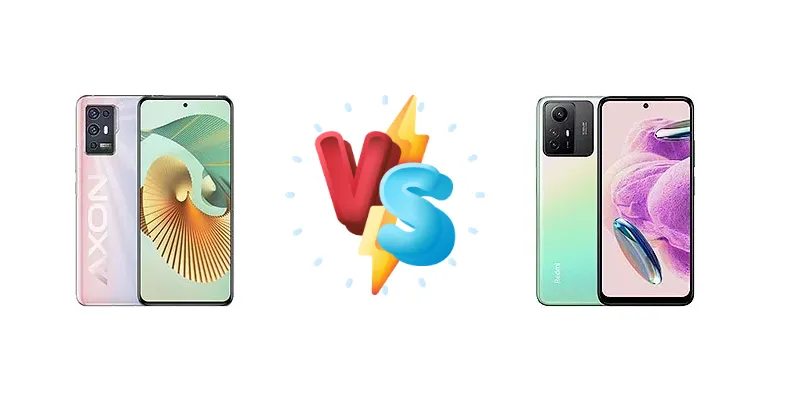
Choosing a new smartphone can be overwhelming. The ZTE Axon 30 Pro 5G and Xiaomi Redmi Note 12S both offer compelling features, but cater to different needs. This comprehensive comparison will break down their strengths and weaknesses to help you make the right decision.
🏆 Quick Verdict
The ZTE Axon 30 Pro 5G delivers significantly superior performance thanks to its Snapdragon 888 chipset. However, the Redmi Note 12S offers excellent value and a more budget-friendly price point. If performance is key, the Axon wins; for budget-conscious buyers, the Redmi Note 12S is a strong contender.
| Network |
|---|
| 2G bands | GSM 850 / 900 / 1800 / 1900 | GSM 850 / 900 / 1800 / 1900 |
| 3G bands | HSDPA 850 / 900 / 1700(AWS) / 1900 / 2100 | HSDPA 850 / 900 / 2100 |
| 4G bands | 1, 3, 5, 7, 8, 4, 12, 17, 20, 34, 38, 39, 40, 41 | 1, 3, 5, 7, 8, 20, 28, 38, 40, 41 |
| 5G bands | 1, 3, 28, 41, 78 SA/NSA | - |
| Speed | HSPA, LTE, 5G | HSPA, LTE |
| Technology | GSM / CDMA / HSPA / LTE / 5G | GSM / HSPA / LTE |
| | CDMA 800 | - |
| Launch |
|---|
| Announced | 2021, April 15 | 2023, March 06 |
| Status | Available. Released 2021, April 26 | Available. Released 2023, April 26 |
| Body |
|---|
| Dimensions | 163.6 x 75.3 x 7.9 mm (6.44 x 2.96 x 0.31 in) | 159.9 x 73.9 x 8.1 mm (6.30 x 2.91 x 0.32 in) |
| SIM | Nano-SIM + Nano-SIM | Nano-SIM + Nano-SIM |
| Weight | 186 g (6.56 oz) | 176 g (6.21 oz) |
| Display |
|---|
| Protection | Corning Gorilla Glass 5 | - |
| Resolution | 1080 x 2400 pixels, 20:9 ratio (~395 ppi density) | 1080 x 2400 pixels, 20:9 ratio (~409 ppi density) |
| Size | 6.67 inches, 107.4 cm2 (~87.2% screen-to-body ratio) | 6.43 inches, 99.8 cm2 (~84.5% screen-to-body ratio) |
| Type | AMOLED, 1B colors, 120Hz, HDR10+ | AMOLED, 90Hz, 700 nits (HBM), 1000 nits (peak) |
| Platform |
|---|
| CPU | Octa-core (1x2.84 GHz Cortex-X1 & 3x2.42 GHz Cortex-A78 & 4x1.80 GHz Cortex-A55) | Octa-core (2x2.05 GHz Cortex-A76 & 6x2.0 GHz Cortex-A55) |
| Chipset | Qualcomm SM8350 Snapdragon 888 5G (5 nm) | Mediatek MT6781 Helio G96 (12 nm) |
| GPU | Adreno 660 | Mali-G57 MC2 |
| OS | Android 11, MyOS 11 | Android 13, MIUI 14 |
| Memory |
|---|
| Card slot | No | microSDXC (dedicated slot) |
| Internal | 128GB 6GB RAM, 128GB 8GB RAM, 256GB 8GB RAM | 64GB 6GB RAM, 128GB 6GB RAM, 256GB 8GB RAM |
| | UFS 3.1 | - |
| Main Camera |
|---|
| Features | Dual-LED flash, panorama, HDR | LED flash, HDR, panorama |
| Quad | 64 MP, f/1.8, 26mm (wide), 1/1.73", 0.8µm, PDAF
64 MP, f/2.4, 13mm, 120˚ (ultrawide)
5 MP (macro)
Auxiliary lens | - |
| Single | 16 MP, (wide) | - |
| Triple | - | 108 MP, f/1.9, (wide), 1/1.52", 0.7µm, PDAF
8 MP, f/2.2, 118˚ (ultrawide), 1/4.0", 1.12µm
2 MP (macro) |
| Video | 4K@30/60fps, 1080p@30fps, gyro-EIS, HDR10, 10‑bit video | 1080p@30fps |
| Selfie camera |
|---|
| Features | HDR | - |
| Single | 16 MP, (wide) | 16 MP, f/2.4, (wide) |
| Video | 4K@30fps, 1080p@30fps | 1080p@30fps |
| Sound |
|---|
| 3.5mm jack | No | Yes |
| 35mm jack | No | Yes |
| Loudspeaker | Yes | Yes, with stereo speakers |
| | 24-bit/192kHz audio | - |
| Comms |
|---|
| Bluetooth | 5.2, A2DP, LE | 5.2, A2DP, LE |
| Infrared port | - | Yes |
| NFC | Yes | Yes (market/region dependent) |
| Positioning | GPS, GLONASS, GALILEO, BDS | GPS (L1), GLONASS (G1), GALILEO (E1), BDS (B1) |
| Radio | No | Stereo FM radio, recording |
| USB | USB Type-C 3.1, OTG | USB Type-C 2.0 |
| WLAN | Wi-Fi 802.11 a/b/g/n/ac/6, dual-band, Wi-Fi Direct | Wi-Fi 802.11 a/b/g/n/ac, dual-band |
| Features |
|---|
| Sensors | Fingerprint (under display, optical), accelerometer, gyro, proximity, compass | Fingerprint (side-mounted), accelerometer, gyro, proximity, compass |
| Battery |
|---|
| Charging | 55W wired, QC4 | 33W wired |
| Type | Li-Po 4200 mAh | Li-Po 5000 mAh |
| Misc |
|---|
| Colors | Black, Pink | Onyx Black, Ice Blue, Pearl Green |
| Models | A2022 | 2303CRA44A, 23030RAC7Y, 2303ERA42L |
| Price | About 400 EUR | € 122.47 / $ 149.99 / £ 229.89 |
ZTE Axon 30 Pro 5G
- Flagship Snapdragon 888 Performance
- 144Hz High Refresh Rate Display
- Faster 55W Charging
- Versatile Camera System
- Potentially Higher Price
- Smaller Battery Capacity Compared to Redmi Note 12S
- Software Support May Be Less Consistent
Xiaomi Redmi Note 12S
- Excellent Value for Money
- Long Battery Life
- Decent 108MP Camera
- Reliable Performance for Everyday Tasks
- Lower Performance Compared to Axon 30 Pro
- 90Hz Refresh Rate (Less Smooth)
- Helio G96 Chipset Not Ideal for Demanding Games
Display Comparison
The Axon 30 Pro 5G boasts a 6.56-inch AMOLED display with a 144Hz refresh rate, offering vibrant colors and incredibly smooth scrolling. The Redmi Note 12S features a 6.43-inch AMOLED display with a 90Hz refresh rate. While both are AMOLED, the Axon's higher refresh rate provides a noticeably smoother experience, especially for gaming and fast-paced content.
Camera Comparison
The Redmi Note 12S typically features a 108MP main camera, offering detailed photos in good lighting conditions. The Axon 30 Pro 5G has a triple camera system, often including a 64MP main sensor, an ultrawide lens, and a macro lens. While megapixel count isn't everything, the Axon's combination of lenses and potentially better image processing often results in more versatile and higher-quality photos, especially in challenging lighting.
Performance
Here's where the Axon 30 Pro 5G truly shines. The Snapdragon 888 is a flagship-level chipset, providing significantly faster processing speeds and better graphics performance than the Redmi Note 12S's Helio G96. Expect smoother multitasking, faster app loading times, and a better gaming experience on the Axon.
Battery Life
The Redmi Note 12S generally has a larger battery capacity (around 5000mAh) and 33W fast charging, providing all-day battery life for most users. The Axon 30 Pro 5G typically has a slightly smaller battery (around 4200mAh) but supports faster 55W charging. While the Axon charges faster, the Redmi Note 12S's larger battery often translates to longer overall usage.
Buying Guide
The ZTE Axon 30 Pro 5G is ideal for users who prioritize performance, gaming, and a high refresh rate display. The Xiaomi Redmi Note 12S is a great choice for those seeking a reliable, affordable phone with a decent camera and long battery life, without needing flagship-level power.
Frequently Asked Questions
❓ Is the ZTE Axon 30 Pro 5G worth the extra money?
If you prioritize performance and a smooth display, the Axon 30 Pro 5G is worth the investment. However, if you're on a tighter budget, the Redmi Note 12S offers excellent value.
❓ Which phone has better software support?
Xiaomi generally provides more consistent software updates and longer support periods compared to ZTE. This is something to consider if long-term software support is important to you.