
ZTE Axon 30 Pro 5G vs Sony Xperia 1 III: Which Snapdragon 888 Flagship Reigns Supreme?
| Phones Images | |||||
|---|---|---|---|---|---|
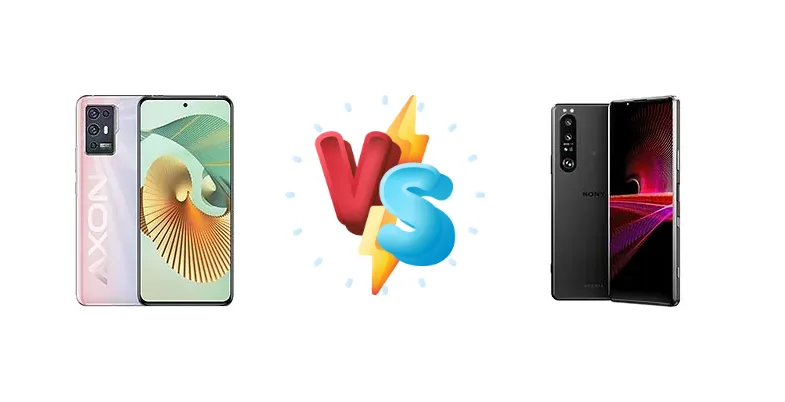
|
🏆 Quick Verdict
For the average user prioritizing value and rapid charging, the ZTE Axon 30 Pro 5G emerges as the winner. Its 55W charging significantly outperforms the Xperia 1 III’s 30W, and it delivers comparable performance at a potentially lower price point. However, Sony’s focus on multimedia and camera control will appeal to a niche audience.
| PHONES | ||
|---|---|---|
| Phone Names | ZTE Axon 30 Pro 5G | Sony Xperia 1 III |
| Network | ||
|---|---|---|
| 2G bands | GSM 850 / 900 / 1800 / 1900 | GSM 850 / 900 / 1800 / 1900 |
| 3G bands | HSDPA 850 / 900 / 1700(AWS) / 1900 / 2100 | HSDPA 800 / 850 / 900 / 1700(AWS) / 1900 / 2100 |
| 4G bands | 1, 3, 5, 7, 8, 4, 12, 17, 20, 34, 38, 39, 40, 41 | 1, 2, 3, 4, 5, 7, 8, 12, 13, 17, 19, 20, 25, 26, 28, 29, 32, 34, 38, 39, 40, 41, 46, 66 - Europe |
| 5G bands | 1, 3, 28, 41, 78 SA/NSA | 1, 3, 5, 7, 8, 20, 28, 38, 40, 41, 77, 78 SA/NSA/Sub6 - Europe |
| Speed | HSPA, LTE, 5G | HSPA, LTE, 5G |
| Technology | GSM / CDMA / HSPA / LTE / 5G | GSM / HSPA / LTE / 5G |
| CDMA 800 | SA/NSA/Sub6/mmWave - USA (specific) | |
| Launch | ||
|---|---|---|
| Announced | 2021, April 15 | 2021, April 14 |
| Status | Available. Released 2021, April 26 | Available. Released 2021, August 25 |
| Body | ||
|---|---|---|
| Build | - | Glass front (Gorilla Glass Victus), glass back (Gorilla Glass 6), aluminum frame |
| Dimensions | 163.6 x 75.3 x 7.9 mm (6.44 x 2.96 x 0.31 in) | 165 x 71 x 8.2 mm (6.50 x 2.80 x 0.32 in) |
| SIM | Nano-SIM + Nano-SIM | Nano-SIM + Nano-SIM |
| Weight | 186 g (6.56 oz) | 186 g / 187.1 g (mmWave) (6.56 oz) |
| - | IP65/IP68 dust/water resistant (up to 1.5m for 30 min) | |
| Display | ||
|---|---|---|
| Protection | Corning Gorilla Glass 5 | Corning Gorilla Glass Victus |
| Resolution | 1080 x 2400 pixels, 20:9 ratio (~395 ppi density) | 1644 x 3840 pixels, 21:9 ratio (~643 ppi density) |
| Size | 6.67 inches, 107.4 cm2 (~87.2% screen-to-body ratio) | 6.5 inches, 98.6 cm2 (~84.2% screen-to-body ratio) |
| Type | AMOLED, 1B colors, 120Hz, HDR10+ | OLED, 1B colors, 120Hz, HDR BT.2020 |
| - | Runs at 1096 x 2560 pixels except for select use cases | |
| Platform | ||
|---|---|---|
| CPU | Octa-core (1x2.84 GHz Cortex-X1 & 3x2.42 GHz Cortex-A78 & 4x1.80 GHz Cortex-A55) | Octa-core (1x2.84 GHz Cortex-X1 & 3x2.42 GHz Cortex-A78 & 4x1.80 GHz Cortex-A55) |
| Chipset | Qualcomm SM8350 Snapdragon 888 5G (5 nm) | Qualcomm SM8350 Snapdragon 888 5G (5 nm) |
| GPU | Adreno 660 | Adreno 660 |
| OS | Android 11, MyOS 11 | Android 11, upgradable to Android 13 |
| Memory | ||
|---|---|---|
| Card slot | No | microSDXC (uses shared SIM slot) |
| Internal | 128GB 6GB RAM, 128GB 8GB RAM, 256GB 8GB RAM | 256GB 12GB RAM, 512GB 12GB RAM |
| UFS 3.1 | UFS 3.X | |
| Main Camera | ||
|---|---|---|
| Features | Dual-LED flash, panorama, HDR | Zeiss optics, Zeiss T* lens coating, color spectrum sensor, LED flash, panorama, HDR, eye tracking |
| Quad | 64 MP, f/1.8, 26mm (wide), 1/1.73", 0.8µm, PDAF 64 MP, f/2.4, 13mm, 120˚ (ultrawide) 5 MP (macro) Auxiliary lens | - |
| Single | 16 MP, (wide) | 8 MP, f/2.0, 24mm (wide), 1/4", 1.12µm |
| Triple | - | 12 MP, f/1.7, 24mm (wide), 1/1.7", 1.8µm, dual pixel PDAF, OIS 12 MP, f/2.3, 70mm (telephoto), f/2.8, 105mm (telephoto), 1/2.9", dual pixel PDAF, 3x/4.4x optical zoom, OIS 12 MP, f/2.2, 124˚, 16mm (ultrawide), 1/2.6", dual pixel PDAF 0.3 MP, TOF 3D, (depth) |
| Video | 4K@30/60fps, 1080p@30fps, gyro-EIS, HDR10, 10‑bit video | 4K@24/25/30/60/120fps HDR, 1080p@30/60/120fps; 5-axis gyro-EIS, OIS |
| Selfie camera | ||
|---|---|---|
| Features | HDR | HDR |
| Single | 16 MP, (wide) | 8 MP, f/2.0, 24mm (wide), 1/4.0", 1.12µm |
| Video | 4K@30fps, 1080p@30fps | 1080p@30fps, 5-axis gyro-EIS |
| Sound | ||
|---|---|---|
| 3.5mm jack | No | Yes |
| 35mm jack | No | Yes |
| Loudspeaker | Yes | Yes, with stereo speakers |
| 24-bit/192kHz audio | 24-bit/192kHz audio Dynamic vibration system | |
| Comms | ||
|---|---|---|
| Bluetooth | 5.2, A2DP, LE | 5.2, A2DP, LE, aptX HD, aptX Adaptive |
| NFC | Yes | Yes |
| Positioning | GPS, GLONASS, GALILEO, BDS | GPS, GLONASS, BDS, GALILEO, QZSS |
| Radio | No | No |
| USB | USB Type-C 3.1, OTG | USB Type-C 3.1, OTG, video output |
| WLAN | Wi-Fi 802.11 a/b/g/n/ac/6, dual-band, Wi-Fi Direct | Wi-Fi 802.11 a/b/g/n/ac/6, dual-band, Wi-Fi Direct, DLNA |
| Features | ||
|---|---|---|
| Sensors | Fingerprint (under display, optical), accelerometer, gyro, proximity, compass | Fingerprint (side-mounted), accelerometer, gyro, proximity, barometer, compass |
| - | Native Sony Alpha camera support | |
| Battery | ||
|---|---|---|
| Charging | 55W wired, QC4 | 30W wired, PD, 50% in 30 min Wireless Reverse wireless |
| Type | Li-Po 4200 mAh | Li-Po 4500 mAh |
| Misc | ||
|---|---|---|
| Colors | Black, Pink | Frosted Black, Frosted Gray, Frosted Purple |
| Models | A2022 | XQBC62/V, XQBC52V.UKCX, SO-51B, SOG03, A101SO, XQ-BC62, XQ-BC72, XQ-BC52, XQ-BC01, XQ-BC11, XQ-BC21, XQ-BC72 |
| Price | About 400 EUR | € 505.26 / $ 903.43 |
| Tests | ||
|---|---|---|
| Battery life | - | Endurance rating 82h |
| Camera | - | Photo / Video |
| Display | - | Contrast ratio: Infinite (nominal) |
| Loudspeaker | - | -26.5 LUFS (Good) |
| Performance | - | AnTuTu: 607423 (v8) GeekBench: 3515 (v5.1) GFXBench: 54fps (ES 3.1 onscreen) |
ZTE Axon 30 Pro 5G
- Significantly faster 55W charging
- Potentially better thermal management due to larger size
- Likely more affordable price point
- Missing display brightness data
- Less emphasis on multimedia features
Sony Xperia 1 III
- Higher peak display brightness (620 nits)
- Wireless and reverse wireless charging
- Sony’s renowned camera software and manual controls
- Slower 30W charging
- Higher price point
- Snapdragon 888 throttling potential
Display Comparison
The Sony Xperia 1 III boasts a 620 nit peak brightness, a figure that suggests superior visibility in direct sunlight compared to the Axon 30 Pro 5G (brightness data unavailable). While both likely utilize high-quality OLED panels, Sony’s emphasis on color accuracy and its 'Creator Mode' caters to content creators. The Xperia 1 III’s infinite contrast ratio (nominal) is standard for OLED, but the lack of specific refresh rate data for the Axon 30 Pro 5G leaves a question mark regarding smoothness. The Xperia 1 III’s 21:9 aspect ratio is geared towards video consumption, while the Axon 30 Pro 5G likely adopts a more conventional ratio.
Camera Comparison
Both phones are advertised as having strong photo and video capabilities, but the specifics are lacking. Without sensor size or aperture data, a direct comparison is difficult. Sony’s history suggests a focus on natural color reproduction and extensive manual controls, appealing to photography enthusiasts. The Axon 30 Pro 5G may lean towards more processed images, aiming for wider appeal. The absence of detail regarding OIS (Optical Image Stabilization) on either device makes it impossible to assess low-light performance differences.
Performance
Both devices are equipped with the Qualcomm SM8350 Snapdragon 888 5G (5 nm) chipset, featuring an Octa-core CPU configuration (1x2.84 GHz Cortex-X1, 3x2.42 GHz Cortex-A78, 4x1.80 GHz Cortex-A55). This means raw processing power will be largely identical. However, thermal management could differentiate the experience. The Axon 30 Pro 5G’s larger size *potentially* allows for a more robust cooling solution, mitigating the Snapdragon 888’s known tendency to throttle under sustained load. RAM specifications are missing for both, but LPDDR5 is expected, with the Xperia 1 III potentially benefitting from faster LPDDR5X.
Battery Life
Both the ZTE Axon 30 Pro 5G and the Sony Xperia 1 III share an endurance rating of 82h, suggesting similar overall battery life. However, the charging capabilities are drastically different. The Axon 30 Pro 5G supports 55W wired charging with QC4, promising significantly faster top-ups than the Xperia 1 III’s 30W wired charging with PD, which achieves 50% charge in 30 minutes. The Xperia 1 III also offers wireless and reverse wireless charging, features absent on the Axon 30 Pro 5G, providing added convenience.
Buying Guide
Buy the ZTE Axon 30 Pro 5G if you need a fast-charging, high-performance phone that doesn’t break the bank. It’s ideal for power users who demand quick top-ups and don’t want to compromise on processing power. Buy the Sony Xperia 1 III if you prioritize a premium multimedia experience, manual camera controls, and a more refined software experience, and are willing to pay a premium for those features.