
ZTE Axon 30 Pro 5G vs Oppo Find X3 Pro: A Deep Dive into Snapdragon 888 Flagships
| Phones Images | |||||
|---|---|---|---|---|---|
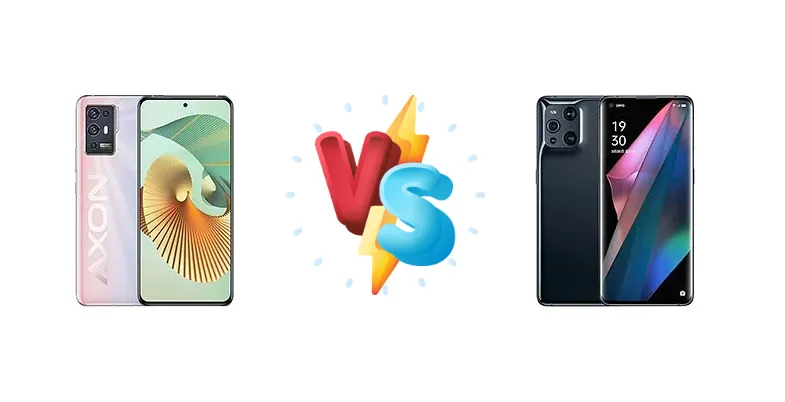
|
🏆 Quick Verdict
For most users, the Oppo Find X3 Pro emerges as the superior choice. While both phones share the Snapdragon 888 chipset, the Find X3 Pro’s faster 65W wired and 30W wireless charging, coupled with its brighter 774 nit display, provide a more refined and convenient daily experience. The Axon 30 Pro remains a compelling option for budget-conscious buyers.
| PHONES | ||
|---|---|---|
| Phone Names | ZTE Axon 30 Pro 5G | Oppo Find X3 Pro |
| Network | ||
|---|---|---|
| 2G bands | GSM 850 / 900 / 1800 / 1900 | GSM 850 / 900 / 1800 / 1900 |
| 3G bands | HSDPA 850 / 900 / 1700(AWS) / 1900 / 2100 | HSDPA 800 / 850 / 900 / 1700(AWS) / 1900 / 2100 |
| 4G bands | 1, 3, 5, 7, 8, 4, 12, 17, 20, 34, 38, 39, 40, 41 | 1, 2, 3, 4, 5, 7, 8, 12, 13, 17, 18, 19, 20, 25, 26, 28, 32, 34, 38, 39, 40, 41, 42, 66 - International |
| 5G bands | 1, 3, 28, 41, 78 SA/NSA | 1, 3, 5, 7, 8, 20, 28, 38, 40, 41, 77, 78, 79 SA/NSA - International |
| Speed | HSPA, LTE, 5G | HSPA, LTE, 5G |
| Technology | GSM / CDMA / HSPA / LTE / 5G | GSM / CDMA / HSPA / CDMA2000 / LTE / 5G |
| CDMA 800 | 1, 2, 3, 5, 7, 8, 12, 20, 28, 38, 40, 41, 66, 77, 78, 79 SA/NSA - China | |
| Launch | ||
|---|---|---|
| Announced | 2021, April 15 | 2021, March 11 |
| Status | Available. Released 2021, April 26 | Available. Released 2021, March 19 |
| Body | ||
|---|---|---|
| Build | - | Glass front (Gorilla Glass 5), glass back (Gorilla Glass 5), aluminum frame |
| Dimensions | 163.6 x 75.3 x 7.9 mm (6.44 x 2.96 x 0.31 in) | 163.6 x 74 x 8.3 mm (6.44 x 2.91 x 0.33 in) |
| SIM | Nano-SIM + Nano-SIM | Nano-SIM + eSIM |
| Weight | 186 g (6.56 oz) | 193 g (6.81 oz) |
| - | IP68 dust/water resistant (up to 1.5m for 30 min) | |
| Display | ||
|---|---|---|
| Protection | Corning Gorilla Glass 5 | Corning Gorilla Glass 5 |
| Resolution | 1080 x 2400 pixels, 20:9 ratio (~395 ppi density) | 1440 x 3216 pixels, 20:9 ratio (~525 ppi density) |
| Size | 6.67 inches, 107.4 cm2 (~87.2% screen-to-body ratio) | 6.7 inches, 108.4 cm2 (~89.6% screen-to-body ratio) |
| Type | AMOLED, 1B colors, 120Hz, HDR10+ | LTPO AMOLED, 1B colors, 120Hz, HDR10+, BT.2020, 500 nits (typ), 1300 nits (peak) |
| Platform | ||
|---|---|---|
| CPU | Octa-core (1x2.84 GHz Cortex-X1 & 3x2.42 GHz Cortex-A78 & 4x1.80 GHz Cortex-A55) | Octa-core (1x2.84 GHz Cortex-X1 & 3x2.42 GHz Cortex-A78 & 4x1.80 GHz Cortex-A55) |
| Chipset | Qualcomm SM8350 Snapdragon 888 5G (5 nm) | Qualcomm SM8350 Snapdragon 888 5G (5 nm) |
| GPU | Adreno 660 | Adreno 660 |
| OS | Android 11, MyOS 11 | Android 11, upgradable to Android 14, ColorOS 14 |
| Memory | ||
|---|---|---|
| Card slot | No | No |
| Internal | 128GB 6GB RAM, 128GB 8GB RAM, 256GB 8GB RAM | 256GB 8GB RAM, 256GB 12GB RAM, 512GB 16GB RAM |
| UFS 3.1 | UFS 3.1 | |
| Main Camera | ||
|---|---|---|
| Features | Dual-LED flash, panorama, HDR | Color spectrum sensor, LED flash, HDR, panorama |
| Quad | 64 MP, f/1.8, 26mm (wide), 1/1.73", 0.8µm, PDAF 64 MP, f/2.4, 13mm, 120˚ (ultrawide) 5 MP (macro) Auxiliary lens | 50 MP, f/1.8, 26mm (wide), 1/1.56", 1.0µm, multi-directional PDAF, OIS 13 MP, f/2.4, 52mm (telephoto), 1/3.4", 1.0µm, 2x optical zoom, PDAF 50 MP, f/2.2, 16mm, 110˚ (ultrawide), 1/1.56", 1.0µm, multi-directional PDAF 3 MP, f/3.0, (microscope), AF, ring flash, 60x magnification |
| Single | 16 MP, (wide) | - |
| Video | 4K@30/60fps, 1080p@30fps, gyro-EIS, HDR10, 10‑bit video | 4K@30/60fps, 1080p@30/60/240fps; gyro-EIS; HDR, 10‑bit video |
| Selfie camera | ||
|---|---|---|
| Features | HDR | Panorama |
| Single | 16 MP, (wide) | 32 MP, f/2.4, 26mm (wide), 1/2.8", 0.8µm |
| Video | 4K@30fps, 1080p@30fps | 1080p@30fps |
| Sound | ||
|---|---|---|
| 3.5mm jack | No | No |
| 35mm jack | No | No |
| Loudspeaker | Yes | Yes, with stereo speakers |
| 24-bit/192kHz audio | - | |
| Comms | ||
|---|---|---|
| Bluetooth | 5.2, A2DP, LE | 5.2, A2DP, LE, aptX HD |
| NFC | Yes | Yes |
| Positioning | GPS, GLONASS, GALILEO, BDS | GPS (L1+L5), GLONASS (L1), BDS (B1I+B1c+B2a), GALILEO (E1+E5a), QZSS (L1+L5) |
| Radio | No | No |
| USB | USB Type-C 3.1, OTG | USB Type-C 3.1, OTG |
| WLAN | Wi-Fi 802.11 a/b/g/n/ac/6, dual-band, Wi-Fi Direct | Wi-Fi 802.11 a/b/g/n/ac/6, dual-band, Wi-Fi Direct |
| Features | ||
|---|---|---|
| Sensors | Fingerprint (under display, optical), accelerometer, gyro, proximity, compass | Fingerprint (under display, optical), accelerometer, gyro, proximity, compass |
| Battery | ||
|---|---|---|
| Charging | 55W wired, QC4 | 65W wired, PD, 40% in 10 min 30W wireless, 100% in 80 min 10W reverse wireless |
| Type | Li-Po 4200 mAh | Li-Po 4500 mAh |
| Misc | ||
|---|---|---|
| Colors | Black, Pink | Gloss Black, Blue, White, Cosmic Mocha, Mars Edition, Photographer Edition |
| Models | A2022 | CPH2173, PEEM00, OPG03 |
| Price | About 400 EUR | About 200 EUR |
| Tests | ||
|---|---|---|
| Battery life | - | Endurance rating 81h |
| Camera | - | Photo / Video |
| Display | - | Contrast ratio: Infinite (nominal) |
| Loudspeaker | - | -25.4 LUFS (Very good) |
| Performance | - | AnTuTu: 656467 (v8) GeekBench: 3316 (v5.1) GFXBench: 33fps (ES 3.1 onscreen) |
ZTE Axon 30 Pro 5G
- Potentially lower price point
- Snapdragon 888 performance
- 55W fast charging
- Slower charging than Oppo Find X3 Pro
- Display brightness likely lower
- Camera specs unknown, potentially less advanced
Oppo Find X3 Pro
- 65W wired and 30W wireless charging
- Brighter 774 nit display
- Potentially superior camera system
- Higher price point
- Snapdragon 888 performance (shared with Axon 30 Pro)
- No specified thermal management details
Display Comparison
The Oppo Find X3 Pro boasts a significantly brighter display, reaching a measured 774 nits. While the Axon 30 Pro’s display specs aren’t provided, the Find X3 Pro’s higher peak brightness translates to better outdoor visibility. Both likely utilize high refresh rate panels, but the Find X3 Pro’s contrast ratio is listed as infinite (nominal), suggesting a superior panel technology. The lack of PWM frequency data for the Axon 30 Pro makes it difficult to assess its suitability for users sensitive to flicker, a potential advantage for the Find X3 Pro if it employs a higher PWM rate.
Camera Comparison
Both devices are listed as having Photo/Video capabilities, but detailed camera specifications are absent. The absence of sensor size or aperture information makes a direct comparison impossible. The Find X3 Pro’s marketing emphasized its camera system, suggesting a more sophisticated implementation. The Axon 30 Pro, while capable, likely prioritizes affordability over cutting-edge camera technology. We can assume both phones offer a versatile camera experience, but the Find X3 Pro likely holds an edge in image quality and features.
Performance
Both the ZTE Axon 30 Pro 5G and the Oppo Find X3 Pro are equipped with the Qualcomm SM8350 Snapdragon 888 5G (5 nm) chipset, featuring the same Octa-core CPU configuration (1x2.84 GHz Cortex-X1, 3x2.42 GHz Cortex-A78, and 4x1.80 GHz Cortex-A55). This means raw processing power will be nearly identical. However, thermal management – not specified for either device – will be the deciding factor in sustained performance. The Find X3 Pro’s more robust build quality *suggests* potentially better heat dissipation, but without concrete data, this remains speculative. Both phones likely utilize LPDDR5 RAM, but the speed isn’t specified.
Battery Life
The Oppo Find X3 Pro’s charging capabilities are a clear advantage. It supports 65W wired charging, achieving 40% charge in just 10 minutes, and 30W wireless charging, fully charging in 80 minutes. It also offers 10W reverse wireless charging. The ZTE Axon 30 Pro offers 55W wired charging with QC4 support, a respectable speed, but significantly slower than the Oppo. Both phones share an endurance rating of 81 hours, suggesting similar battery life despite potential differences in battery capacity (not specified for either device). The Find X3 Pro’s faster charging mitigates any potential capacity disadvantage.
Buying Guide
Buy the ZTE Axon 30 Pro 5G if you prioritize maximizing value and are comfortable with slightly slower charging speeds. It’s ideal for users who spend less time tethered to a charger and appreciate a capable flagship experience without the premium price tag. Buy the Oppo Find X3 Pro if you demand the fastest possible charging – both wired and wireless – and appreciate a brighter, more vibrant display. This phone is geared towards power users who need a device that can keep up with their demanding lifestyles.