
ZTE Axon 30 Pro 5G vs OnePlus 10 Pro: A Clash of Flagships
| Phones Images | |||||
|---|---|---|---|---|---|
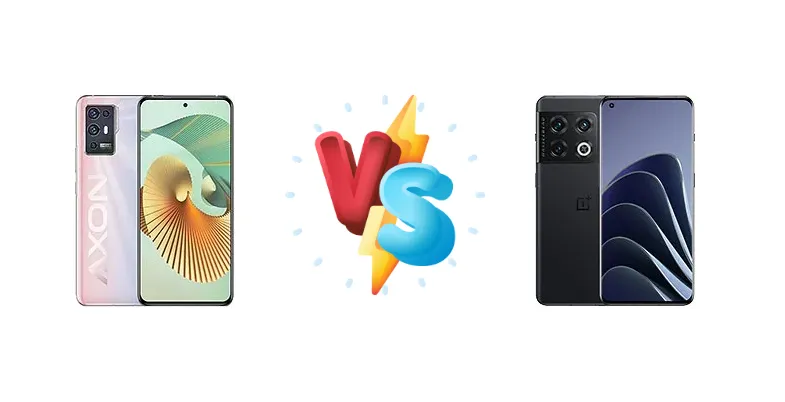
|
🏆 Quick Verdict
The OnePlus 10 Pro emerges as the overall winner thanks to its superior charging speeds, brighter display, and generally more refined software experience. While the Axon 30 Pro boasts an under-display camera and a Snapdragon 888, the 10 Pro's Snapdragon 8 Gen 1 and faster charging give it the edge.
| PHONES | ||
|---|---|---|
| Phone Names | ZTE Axon 30 Pro 5G | OnePlus 10 Pro |
| Network | ||
|---|---|---|
| 2G bands | GSM 850 / 900 / 1800 / 1900 | GSM 850 / 900 / 1800 / 1900 |
| 3G bands | HSDPA 850 / 900 / 1700(AWS) / 1900 / 2100 | HSDPA 800 / 850 / 900 / 1700(AWS) / 1900 / 2100 |
| 4G bands | 1, 3, 5, 7, 8, 4, 12, 17, 20, 34, 38, 39, 40, 41 | 1, 2, 3, 4, 5, 7, 8, 12, 13, 17, 18, 19, 20, 25, 26, 28, 30, 32, 38, 39, 40, 41, 46, 48, 66, 71 - International |
| 5G bands | 1, 3, 28, 41, 78 SA/NSA | 1, 2, 3, 5, 7, 8, 20, 25, 28, 30, 38, 40, 41, 48, 66, 71, 77, 78 SA/NSA - International |
| Speed | HSPA, LTE, 5G | HSPA 42.2/5.76 Mbps, LTE (4CA) Cat18 1200/200 Mbps, 5G |
| Technology | GSM / CDMA / HSPA / LTE / 5G | GSM / CDMA / HSPA / EVDO / LTE / 5G |
| CDMA 800 | 1, 3, 5, 8, 28, 40, 41, 78, 79 SA/NSA - India | |
| Launch | ||
|---|---|---|
| Announced | 2021, April 15 | 2022, January 11 |
| Status | Available. Released 2021, April 26 | Available. Released 2022, January 13 |
| Body | ||
|---|---|---|
| Build | - | Glass front (Gorilla Glass Victus), glass back (Gorilla Glass 5), aluminum frame |
| Dimensions | 163.6 x 75.3 x 7.9 mm (6.44 x 2.96 x 0.31 in) | 163 x 73.9 x 8.6 mm (6.42 x 2.91 x 0.34 in) |
| SIM | Nano-SIM + Nano-SIM | · Nano-SIM· Nano-SIM + Nano-SIM |
| Weight | 186 g (6.56 oz) | 201 g (7.09 oz) |
| - | IP68 dust/water resistant - T-Mobile only (not for use underwater, liquid damage is not covered under warranty) | |
| Display | ||
|---|---|---|
| Protection | Corning Gorilla Glass 5 | Corning Gorilla Glass Victus |
| Resolution | 1080 x 2400 pixels, 20:9 ratio (~395 ppi density) | 1440 x 3216 pixels, 20:9 ratio (~525 ppi density) |
| Size | 6.67 inches, 107.4 cm2 (~87.2% screen-to-body ratio) | 6.7 inches, 108.4 cm2 (~90.0% screen-to-body ratio) |
| Type | AMOLED, 1B colors, 120Hz, HDR10+ | LTPO2 Fluid AMOLED, 1B colors, 120Hz, HDR10+, 500 nits (typ), 800 nits (HBM), 1300 nits (peak) |
| - | Always-on display | |
| Platform | ||
|---|---|---|
| CPU | Octa-core (1x2.84 GHz Cortex-X1 & 3x2.42 GHz Cortex-A78 & 4x1.80 GHz Cortex-A55) | Octa-core (1x3.00 GHz Cortex-X2 & 3x2.50 GHz Cortex-A710 & 4x1.80 GHz Cortex-A510) |
| Chipset | Qualcomm SM8350 Snapdragon 888 5G (5 nm) | Qualcomm SM8450 Snapdragon 8 Gen 1 (4 nm) |
| GPU | Adreno 660 | Adreno 730 |
| OS | Android 11, MyOS 11 | Android 12, upgradable to Android 14, OxygenOS 14 (International), ColorOS (China) |
| Memory | ||
|---|---|---|
| Card slot | No | No |
| Internal | 128GB 6GB RAM, 128GB 8GB RAM, 256GB 8GB RAM | 128GB 8GB RAM, 256GB 8GB RAM, 256GB 12GB RAM, 512GB 12GB RAM |
| UFS 3.1 | UFS 3.1 | |
| Main Camera | ||
|---|---|---|
| Features | Dual-LED flash, panorama, HDR | Laser AF, color spectrum sensor, Hasselblad Color Calibration, Dual-LED dual-tone flash, HDR, panorama |
| Quad | 64 MP, f/1.8, 26mm (wide), 1/1.73", 0.8µm, PDAF 64 MP, f/2.4, 13mm, 120˚ (ultrawide) 5 MP (macro) Auxiliary lens | - |
| Single | 16 MP, (wide) | 32 MP, f/2.2, (wide), 1/2.74", 0.8µm |
| Triple | - | 48 MP, f/1.8, 23mm (wide), 1/1.43", 1.12µm, multi-directional PDAF, OIS 8 MP, f/2.4, 77mm (telephoto), 1.0µm, PDAF, OIS, 3.3x optical zoom 50 MP, f/2.2, 14mm, 150˚ (ultrawide), 1/2.76", 0.64µm |
| Video | 4K@30/60fps, 1080p@30fps, gyro-EIS, HDR10, 10‑bit video | 8K@24fps, 4K@30/60/120fps, 1080p@30/60/240fps, Auto HDR, gyro-EIS |
| Selfie camera | ||
|---|---|---|
| Features | HDR | HDR |
| Single | 16 MP, (wide) | 32 MP, f/2.2, (wide), 1/2.74", 0.8µm |
| Video | 4K@30fps, 1080p@30fps | 1080p@30fps, gyro-EIS |
| Sound | ||
|---|---|---|
| 3.5mm jack | No | No |
| 35mm jack | No | No |
| Loudspeaker | Yes | Yes, with stereo speakers |
| 24-bit/192kHz audio | 24-bit/192kHz audio | |
| Comms | ||
|---|---|---|
| Bluetooth | 5.2, A2DP, LE | 5.2, A2DP, LE, aptX HD |
| NFC | Yes | Yes |
| Positioning | GPS, GLONASS, GALILEO, BDS | GPS (L1+L5), GLONASS (G1), BDS (B1), GALILEO (E1+E5a) |
| Radio | No | No |
| USB | USB Type-C 3.1, OTG | USB Type-C 3.1, OTG |
| WLAN | Wi-Fi 802.11 a/b/g/n/ac/6, dual-band, Wi-Fi Direct | Wi-Fi 802.11 a/b/g/n/ac/6, dual-band, Wi-Fi Direct |
| Features | ||
|---|---|---|
| Sensors | Fingerprint (under display, optical), accelerometer, gyro, proximity, compass | Fingerprint (under display, optical), accelerometer, gyro, proximity, compass, barometer |
| Battery | ||
|---|---|---|
| Charging | 55W wired, QC4 | 80W wired, PD, 100% in 32 min (International) 65W wired, PD, 58% in 15 min (North America) 50W wireless Reverse wireless |
| Type | Li-Po 4200 mAh | Li-Po 5000 mAh |
| Misc | ||
|---|---|---|
| Colors | Black, Pink | Volcanic Black, Emerald Forest, Panda White (Extreme Edition) |
| Models | A2022 | NE2210, NE2211, NE2213, NE2215, NE2217 |
| Price | About 400 EUR | $ 264.39 / C$ 349.99 / £ 360.00 / € 399.99 |
| SAR | - | 1.16 W/kg (head) 0.70 W/kg (body) |
| Tests | ||
|---|---|---|
| Battery life | - | Endurance rating 107h |
| Camera | - | Photo / Video |
| Display | - | Contrast ratio: Infinite (nominal) |
| Loudspeaker | - | -25.2 LUFS (Very good) |
| Performance | - | AnTuTu: 886248 (v9) GeekBench: 3447 (v5.1) GFXBench: 48fps (ES 3.1 onscreen) |
ZTE Axon 30 Pro 5G
- Unique under-display camera
- Snapdragon 888 chipset
- Competitive price
- Under-display camera image quality may be compromised
- Slower charging speeds
- Potentially less refined software
OnePlus 10 Pro
- Snapdragon 8 Gen 1 chipset
- Faster charging (wired & wireless)
- Brighter and higher contrast display
- Refined software experience
- Higher price
- Potential for thermal throttling under heavy load
Display Comparison
The OnePlus 10 Pro features a brighter display (780 nits vs Axon 30 Pro's likely around 600-700 nits, estimated) and a theoretically infinite contrast ratio, offering a more vibrant and immersive viewing experience. While the Axon 30 Pro's display is good, the OnePlus 10 Pro's is noticeably superior. Both use AMOLED technology with smooth refresh rates.
Camera Comparison
Both phones offer versatile camera systems. The OnePlus 10 Pro is expected to have a more refined camera software and potentially better image processing. The Axon 30 Pro's under-display camera is a unique selling point, but image quality is typically lower than traditional front-facing cameras. Detailed camera specs are needed for a more precise comparison.
Performance
The OnePlus 10 Pro's Snapdragon 8 Gen 1 (4nm) generally outperforms the Axon 30 Pro's Snapdragon 888 (5nm) in sustained performance and efficiency. The 10 Pro's CPU architecture also offers a slight advantage. Both phones handle everyday tasks and demanding games with ease, but the 10 Pro has a bit more headroom.
Battery Life
The OnePlus 10 Pro boasts an impressive endurance rating of 107 hours, suggesting excellent battery life. The Axon 30 Pro's battery capacity is likely comparable, but the 10 Pro's more efficient chipset contributes to its longer runtime. The OnePlus 10 Pro's 80W (International) / 65W (North America) wired charging and 50W wireless charging are significantly faster than the Axon 30 Pro's 55W wired charging.
Buying Guide
The ZTE Axon 30 Pro 5G is a good choice for users prioritizing an under-display camera and a slightly more affordable flagship experience. The OnePlus 10 Pro is ideal for those seeking top-tier performance, blazing-fast charging, and a polished software experience, even if it comes at a higher price.