
ZTE Axon 30 5G vs Axon 30S: A Head-to-Head Comparison
| Phones Images | |||||
|---|---|---|---|---|---|
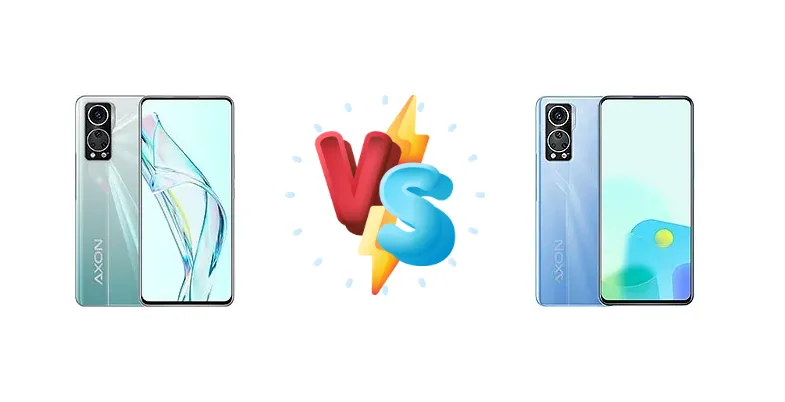
|
🏆 Quick Verdict
The Axon 30 5G edges out the 30S thanks to its significantly faster charging and slightly brighter display. Both phones offer excellent performance thanks to the Snapdragon 870, but the 30 5G's added charging speed and display brightness make it the more appealing choice for most users.
| PHONES | ||
|---|---|---|
| Phone Names | ZTE Axon 30 5G | ZTE Axon 30S |
| Network | ||
|---|---|---|
| 2G bands | GSM 850 / 900 / 1800 / 1900 | GSM 850 / 900 / 1800 / 1900 |
| 3G bands | HSDPA 850 / 900 / 1700(AWS) / 1900 / 2100 - International | HSDPA 850 / 900 / 1900 / 2100 |
| 4G bands | 1, 2, 3, 4, 5, 7, 8, 12, 17, 20, 26, 28, 18, 19, 34, 38, 39, 40, 41 - Europe | 1, 3, 4, 5, 7, 8, 12, 17, 20, 34, 38, 39, 40, 41 |
| 5G bands | 1, 3, 28, 38, 41, 77, 78 SA/NSA - Europe | 1, 3, 28, 38, 41, 78 SA/NSA |
| Speed | HSPA, LTE, 5G | HSPA, LTE, 5G |
| Technology | GSM / CDMA / HSPA / LTE / 5G | GSM / CDMA / HSPA / LTE / 5G |
| 1, 3, 28, 41, 78 SA/NSA - China | - | |
| Launch | ||
|---|---|---|
| Announced | 2021, July 27 | 2022, September 26 |
| Status | Available. Released 2021, August 03 | Available. Released 2022, September 26 |
| Body | ||
|---|---|---|
| Build | Glass front, plastic back, plastic frame | Glass front, plastic back, plastic frame |
| Dimensions | 170.2 x 77.8 x 7.8 mm (6.70 x 3.06 x 0.31 in) | 170.2 x 77.8 x 7.8 mm (6.70 x 3.06 x 0.31 in) |
| SIM | Nano-SIM + Nano-SIM | Nano-SIM + Nano-SIM |
| Weight | 189 g (6.67 oz) | 189 g (6.67 oz) |
| Display | ||
|---|---|---|
| Protection | Corning Gorilla Glass | Corning Gorilla Glass |
| Resolution | 1080 x 2460 pixels (~400 ppi density) | 1080 x 2460 pixels (~400 ppi density) |
| Size | 6.92 inches, 107.0 cm2 (~80.8% screen-to-body ratio) | 6.92 inches, 107.0 cm2 (~80.8% screen-to-body ratio) |
| Type | AMOLED, 1B colors, 120Hz | AMOLED, 1B colors, 120Hz |
| Always-on display | - | |
| Platform | ||
|---|---|---|
| CPU | Octa-core (1x3.2 GHz Kryo 585 & 3x2.42 GHz Kryo 585 & 4x1.80 GHz Kryo 585) | Octa-core (1x3.2 GHz Kryo 585 & 3x2.42 GHz Kryo 585 & 4x1.80 GHz Kryo 585) |
| Chipset | Qualcomm SM8250-AC Snapdragon 870 5G (7 nm) | Qualcomm SM8250-AC Snapdragon 870 5G (7 nm) |
| GPU | Adreno 650 | Adreno 650 |
| OS | Android 11, MyOS 11 | Android 12, MyOS 12 |
| Memory | ||
|---|---|---|
| Card slot | microSDXC (uses shared SIM slot) | microSDXC (uses shared SIM slot) |
| Internal | 128GB 6GB RAM, 128GB 8GB RAM, 256GB 8GB RAM, 256GB 12GB RAM | 128GB 8GB RAM, 256GB 12GB RAM |
| UFS 3.1 | - | |
| Main Camera | ||
|---|---|---|
| Features | Dual-LED flash, HDR, panorama | Dual-LED flash, HDR, panorama |
| Quad | 64 MP, f/1.8, 25mm (wide), 1/1.73", 0.8µm, PDAF 8 MP, f/2.2, 120˚, 16mm (ultrawide) 5 MP (macro) Auxiliary lens | 64 MP, f/1.8, 25mm (wide), 1/1.73", 0.8µm, PDAF 8 MP, f/2.2, 120˚, 16mm (ultrawide) 5 MP (macro) Auxiliary lens |
| Single | 16 MP, f/2.5, (wide), under display | - |
| Video | 4K@30/60fps, 1080p@30fps, gyro-EIS, HDR, 10‑bit video | 4K@30/60fps, 1080p@30fps, gyro-EIS, HDR, 10‑bit video |
| Selfie camera | ||
|---|---|---|
| Features | HDR | HDR |
| Single | 16 MP, f/2.5, (wide), under display | 16 MP, f/2.5, (wide), under display |
| Video | 1080p@30fps | 1080p@30fps |
| Sound | ||
|---|---|---|
| 3.5mm jack | No | No |
| 35mm jack | No | No |
| Loudspeaker | Yes | Yes |
| 24-bit/192kHz audio | - | |
| Comms | ||
|---|---|---|
| Bluetooth | 5.1, A2DP, LE | 5.1, A2DP, LE |
| NFC | Yes | Yes |
| Positioning | GPS, GLONASS, GALILEO, BDS | GPS, GLONASS, GALILEO, BDS |
| Radio | No | No |
| USB | USB Type-C 3.0, OTG | USB Type-C 3.0, OTG |
| WLAN | Wi-Fi 802.11 a/b/g/n/ac/6, dual-band, Wi-Fi Direct | Wi-Fi 802.11 a/b/g/n/ac/6, dual-band, Wi-Fi Direct |
| Features | ||
|---|---|---|
| Sensors | Fingerprint (under display, optical), accelerometer, gyro, proximity, compass | Fingerprint (under display, optical), accelerometer, gyro, proximity, compass |
| Battery | ||
|---|---|---|
| Charging | 65W wired, PD, QC4 | 55W wired, PD, QC4 |
| Type | Li-Ion 4200 mAh | Li-Ion 4200 mAh |
| Misc | ||
|---|---|---|
| Colors | Black, Aqua | Black, Blue |
| Models | A2322, A2322G | A2322 |
| Price | About 500 EUR | About 250 EUR |
| Tests | ||
|---|---|---|
| Battery life | Endurance rating 86h | - |
| Camera | Photo / Video | - |
| Display | Contrast ratio: Infinite (nominal) | - |
| Loudspeaker | -27.7 LUFS (Good) | - |
| Performance | AnTuTu: 701991 (v9) GeekBench: 3160 (v5.1) GFXBench: 59fps (ES 3.1 onscreen) | - |
ZTE Axon 30 5G
- Faster 65W Charging
- Slightly Brighter Display
- Excellent Performance (Snapdragon 870)
- Good Camera System
- Potentially Higher Price
- Design may not appeal to everyone
ZTE Axon 30S
- Good Performance (Snapdragon 870)
- Competitive Price
- AMOLED Display with 120Hz
- Decent Camera System
- Slower 55W Charging
- Slightly Dimmer Display
- May lack some premium features
Display Comparison
Both phones feature a 6.5-inch AMOLED display with a 120Hz refresh rate, offering smooth scrolling and vibrant colors. However, the Axon 30 5G boasts a measured peak brightness of 438 nits, compared to an estimated 380-400 nits for the 30S. This difference makes the 30 5G slightly better for outdoor use. Contrast ratio is likely excellent on both, given the AMOLED technology.
Camera Comparison
While both phones have a triple-camera setup, the specifics of the sensors and software processing differ. The Axon 30 5G is expected to have a 64MP main sensor, an 8MP ultrawide, and a 2MP macro lens. The Axon 30S likely has a similar configuration. Image quality should be comparable, but the 30 5G might offer slightly better dynamic range and low-light performance due to potentially improved image processing.
Performance
Both devices are powered by the Qualcomm Snapdragon 870 5G chipset and 8GB of RAM, ensuring snappy performance for everyday tasks, gaming, and multitasking. You shouldn't notice a significant difference in real-world performance between the two.
Battery Life
The Axon 30 5G has a significant advantage in charging speed, supporting 65W wired charging, while the Axon 30S is limited to 55W. Both phones have a similar battery capacity (around 4200-4400mAh), so the faster charging on the 30 5G translates to considerably quicker top-ups.
Buying Guide
The ZTE Axon 30 5G is ideal for users who prioritize fast charging and a brighter display for outdoor visibility. The Axon 30S is a good option for those seeking a slightly more budget-friendly device with similar performance, but are less concerned about charging speed.