
ZTE Axon 30 5G vs Samsung Galaxy A52 5G: A Performance and Battery Showdown
| Phones Images | |||||
|---|---|---|---|---|---|
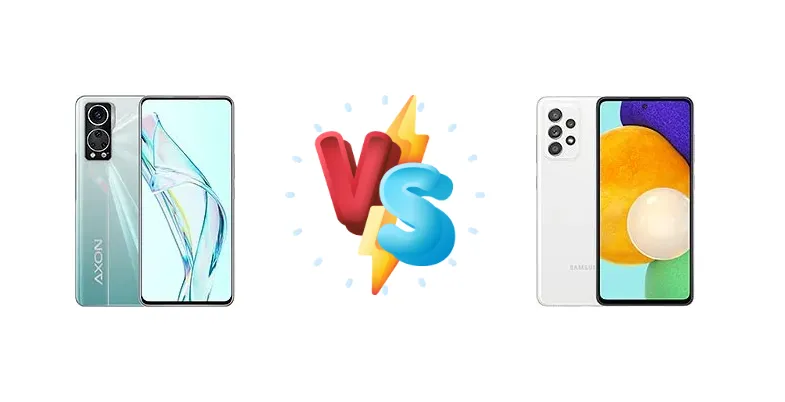
|
🏆 Quick Verdict
For users prioritizing raw performance and faster charging, the ZTE Axon 30 5G is the clear winner. Its Snapdragon 870 delivers a noticeable speed advantage. However, the Samsung Galaxy A52 5G excels in battery endurance and offers a brighter display, making it ideal for media consumption and users who value longevity over peak power.
| PHONES | ||
|---|---|---|
| Phone Names | ZTE Axon 30 5G | Samsung Galaxy A52 5G |
| Network | ||
|---|---|---|
| 2G bands | GSM 850 / 900 / 1800 / 1900 | GSM 850 / 900 / 1800 / 1900 |
| 3G bands | HSDPA 850 / 900 / 1700(AWS) / 1900 / 2100 - International | HSDPA 850 / 900 / 1700(AWS) / 1900 / 2100 |
| 4G bands | 1, 2, 3, 4, 5, 7, 8, 12, 17, 20, 26, 28, 18, 19, 34, 38, 39, 40, 41 - Europe | 1, 2, 3, 4, 5, 7, 8, 12, 17, 20, 26, 28, 32, 38, 40, 41, 66 |
| 5G bands | 1, 3, 28, 38, 41, 77, 78 SA/NSA - Europe | 1, 3, 5, 7, 8, 20, 28, 38, 40, 41, 66, 78 SA/NSA/Sub6 |
| Speed | HSPA, LTE, 5G | HSPA, LTE, 5G |
| Technology | GSM / CDMA / HSPA / LTE / 5G | GSM / HSPA / LTE / 5G |
| 1, 3, 28, 41, 78 SA/NSA - China | - | |
| Launch | ||
|---|---|---|
| Announced | 2021, July 27 | 2021, March 17 |
| Status | Available. Released 2021, August 03 | Available. Released 2021, March 19 |
| Body | ||
|---|---|---|
| Build | Glass front, plastic back, plastic frame | Glass front (Gorilla Glass 5), plastic back |
| Dimensions | 170.2 x 77.8 x 7.8 mm (6.70 x 3.06 x 0.31 in) | 159.9 x 75.1 x 8.4 mm (6.30 x 2.96 x 0.33 in) |
| SIM | Nano-SIM + Nano-SIM | · Nano-SIM· Nano-SIM + Nano-SIM |
| Weight | 189 g (6.67 oz) | 189 g (6.67 oz) |
| - | IP67 dust/water resistant (up to 1m for 30 min) | |
| Display | ||
|---|---|---|
| Protection | Corning Gorilla Glass | Corning Gorilla Glass 5 |
| Resolution | 1080 x 2460 pixels (~400 ppi density) | 1080 x 2400 pixels, 20:9 ratio (~407 ppi density) |
| Size | 6.92 inches, 107.0 cm2 (~80.8% screen-to-body ratio) | 6.5 inches, 101.0 cm2 (~84.1% screen-to-body ratio) |
| Type | AMOLED, 1B colors, 120Hz | Super AMOLED, 120Hz, HDR10+, 800 nits (HBM) |
| Always-on display | Always-on display | |
| Platform | ||
|---|---|---|
| CPU | Octa-core (1x3.2 GHz Kryo 585 & 3x2.42 GHz Kryo 585 & 4x1.80 GHz Kryo 585) | Octa-core (2x2.2 GHz Kryo 570 & 6x1.8 GHz Kryo 570) |
| Chipset | Qualcomm SM8250-AC Snapdragon 870 5G (7 nm) | Qualcomm SM7225 Snapdragon 750G 5G (8 nm) |
| GPU | Adreno 650 | Adreno 619 |
| OS | Android 11, MyOS 11 | Android 11, upgradable to Android 14, One UI 6.1 |
| Memory | ||
|---|---|---|
| Card slot | microSDXC (uses shared SIM slot) | microSDXC (uses shared SIM slot) |
| Internal | 128GB 6GB RAM, 128GB 8GB RAM, 256GB 8GB RAM, 256GB 12GB RAM | 128GB 4GB RAM, 128GB 6GB RAM, 128GB 8GB RAM, 256GB 4GB RAM, 256GB 8GB RAM |
| UFS 3.1 | - | |
| Main Camera | ||
|---|---|---|
| Features | Dual-LED flash, HDR, panorama | LED flash, panorama, HDR |
| Quad | 64 MP, f/1.8, 25mm (wide), 1/1.73", 0.8µm, PDAF 8 MP, f/2.2, 120˚, 16mm (ultrawide) 5 MP (macro) Auxiliary lens | 64 MP, f/1.8, 26mm (wide), 1/1.7X", 0.8µm, PDAF, OIS 12 MP, f/2.2, 123˚ (ultrawide), 1.12µm 5 MP (macro) Auxiliary lens |
| Single | 16 MP, f/2.5, (wide), under display | - |
| Video | 4K@30/60fps, 1080p@30fps, gyro-EIS, HDR, 10‑bit video | 4K@30fps, 1080p@30/60fps; gyro-EIS |
| Selfie camera | ||
|---|---|---|
| Features | HDR | HDR |
| Single | 16 MP, f/2.5, (wide), under display | 32 MP, f/2.2, 26mm (wide), 1/2.8", 0.8µm |
| Video | 1080p@30fps | 4K@30fps, 1080p@30fps |
| Sound | ||
|---|---|---|
| 3.5mm jack | No | Yes |
| 35mm jack | No | Yes |
| Loudspeaker | Yes | Yes, with stereo speakers |
| 24-bit/192kHz audio | - | |
| Comms | ||
|---|---|---|
| Bluetooth | 5.1, A2DP, LE | 5.0, A2DP, LE |
| NFC | Yes | Yes (market/region dependent) |
| Positioning | GPS, GLONASS, GALILEO, BDS | GPS, GLONASS, GALILEO, BDS |
| Radio | No | FM radio (market/region dependent) |
| USB | USB Type-C 3.0, OTG | USB Type-C 2.0, OTG |
| WLAN | Wi-Fi 802.11 a/b/g/n/ac/6, dual-band, Wi-Fi Direct | Wi-Fi 802.11 a/b/g/n/ac, dual-band, Wi-Fi Direct |
| Features | ||
|---|---|---|
| Sensors | Fingerprint (under display, optical), accelerometer, gyro, proximity, compass | Fingerprint (under display, optical), accelerometer, gyro, compass |
| - | Virtual proximity sensing | |
| Battery | ||
|---|---|---|
| Charging | 65W wired, PD, QC4 | 25W wired, 50% in 30 min |
| Type | Li-Ion 4200 mAh | Li-Po 4500 mAh |
| Misc | ||
|---|---|---|
| Colors | Black, Aqua | Awesome Black, Awesome White, Awesome Violet, Awesome Blue |
| Models | A2322, A2322G | SM-A526B, SM-A526B/DS, SM-A5260, SM-A526W, SM-A526U, SM-A526U1 |
| Price | About 500 EUR | $ 137.39 / £ 280.00 / € 115.49 |
| SAR | - | 0.74 W/kg (head) 0.53 W/kg (body) |
| SAR EU | - | 1.05 W/kg (head) 1.42 W/kg (body) |
| Tests | ||
|---|---|---|
| Battery life | Endurance rating 86h | Endurance rating 111h |
| Camera | Photo / Video | Photo / Video |
| Display | Contrast ratio: Infinite (nominal) | Contrast ratio: Infinite (nominal) |
| Loudspeaker | -27.7 LUFS (Good) | -27.5 LUFS (Good) |
| Performance | AnTuTu: 701991 (v9) GeekBench: 3160 (v5.1) GFXBench: 59fps (ES 3.1 onscreen) | AnTuTu: 334981 (v8), 386474 (v9) GeekBench: 1820 (v5.1) GFXBench: 16fps (ES 3.1 onscreen) |
ZTE Axon 30 5G
- Significantly faster processor (Snapdragon 870)
- 65W fast charging for quick top-ups
- Potentially better low-light camera performance
- Shorter battery life
- Less bright display
Samsung Galaxy A52 5G
- Exceptional battery life (111-hour endurance)
- Much brighter display for outdoor visibility
- Established brand and software support
- Slower processor (Snapdragon 750G)
- Slower charging speed
Display Comparison
The Samsung Galaxy A52 5G boasts a substantially brighter display, reaching 787 nits compared to the Axon 30 5G’s 438 nits. This difference is immediately noticeable outdoors, where the A52 5G remains easily readable in direct sunlight. Both displays share an 'Infinite' (nominal) contrast ratio, suggesting similar black levels, but the A52’s higher peak brightness provides a more vibrant and dynamic image. While neither specification details refresh rate, the A52 5G is known to have a 120Hz display, a feature not mentioned for the Axon 30 5G, further enhancing its visual experience.
Camera Comparison
Both phones feature capable camera systems, but detailed sensor information is lacking in the provided data. However, the chipset difference suggests the Axon 30 5G’s image signal processor (ISP) will offer faster processing and potentially better low-light performance. The A52 5G likely benefits from Samsung’s well-tuned image processing algorithms, known for producing vibrant and shareable photos. Without specific sensor size or aperture details, it’s difficult to definitively declare a winner, but the Axon 30 5G’s superior processing power gives it an edge.
Performance
The core difference lies in the chipsets. The ZTE Axon 30 5G utilizes the Qualcomm Snapdragon 870 5G (7nm), a processor found in many higher-end devices, featuring an octa-core configuration with a prime core clocked at 3.2 GHz. The Samsung Galaxy A52 5G, conversely, employs the Snapdragon 750G 5G (8nm). The 870’s more powerful CPU and GPU translate to significantly faster app loading times, smoother multitasking, and superior gaming performance. The 8nm process of the 750G offers better efficiency, but cannot match the raw power of the 7nm 870. The Axon 30 5G will demonstrably outperform the A52 5G in CPU and GPU-intensive tasks.
Battery Life
The Samsung Galaxy A52 5G takes a clear lead in battery endurance, achieving an impressive 111-hour rating compared to the Axon 30 5G’s 86 hours. This suggests the Snapdragon 750G’s 8nm process is more efficient. While the Axon 30 5G compensates with significantly faster 65W wired charging (including PD and QC4 support), allowing for a quicker top-up, the A52 5G’s longer runtime is more valuable for users who frequently spend extended periods away from a power outlet. The A52 5G’s 25W charging, while slower, still offers a 50% charge in 30 minutes.
Buying Guide
Buy the ZTE Axon 30 5G if you need a phone capable of handling demanding games and applications without throttling, and if 65W fast charging is a priority. Buy the Samsung Galaxy A52 5G if you prefer a phone with exceptional battery life, a significantly brighter screen for outdoor visibility, and a more established brand reputation with a longer software support commitment.