
ZTE Axon 30 5G vs Motorola Edge 20 Pro: A Deep Dive into Snapdragon 870 Performance and Battery Life
| Phones Images | |||||
|---|---|---|---|---|---|
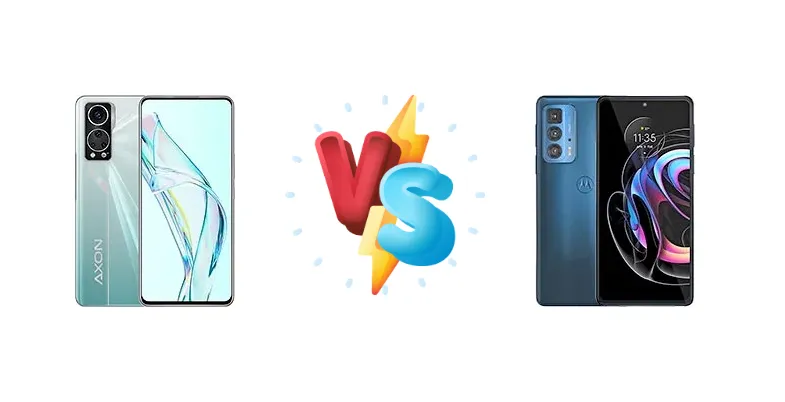
|
🏆 Quick Verdict
For the average user prioritizing longevity, the Motorola Edge 20 Pro emerges as the winner. Its significantly superior 112-hour endurance rating, stemming from a more efficient power profile, outweighs the Axon 30 5G’s faster 65W charging. While both offer excellent performance, the Edge 20 Pro delivers peace of mind for all-day use.
| PHONES | ||
|---|---|---|
| Phone Names | ZTE Axon 30 5G | Motorola Edge 20 Pro |
| Network | ||
|---|---|---|
| 2G bands | GSM 850 / 900 / 1800 / 1900 | GSM 850 / 900 / 1800 / 1900 |
| 3G bands | HSDPA 850 / 900 / 1700(AWS) / 1900 / 2100 - International | HSDPA 850 / 900 / 1700(AWS) / 1900 / 2100 |
| 4G bands | 1, 2, 3, 4, 5, 7, 8, 12, 17, 20, 26, 28, 18, 19, 34, 38, 39, 40, 41 - Europe | 1, 2, 3, 4, 5, 7, 8, 12, 13, 17, 20, 26, 28, 32, 34, 38, 39, 40, 41, 42, 43, 66 |
| 5G bands | 1, 3, 28, 38, 41, 77, 78 SA/NSA - Europe | 1, 3, 5, 7, 8, 28, 38, 41, 66, 77, 78 SA/NSA/Sub6 |
| Speed | HSPA, LTE, 5G | HSPA 42.2/5.76 Mbps, LTE Cat18 1200/150 Mbps, 5G |
| Technology | GSM / CDMA / HSPA / LTE / 5G | GSM / HSPA / LTE / 5G |
| 1, 3, 28, 41, 78 SA/NSA - China | - | |
| Launch | ||
|---|---|---|
| Announced | 2021, July 27 | 2021, July 29 |
| Status | Available. Released 2021, August 03 | Available. Released 2021, August 16 |
| Body | ||
|---|---|---|
| Build | Glass front, plastic back, plastic frame | Glass front (Gorilla Glass 5), aluminum frame, glass back (Gorilla Glass 5) or eco leather back |
| Dimensions | 170.2 x 77.8 x 7.8 mm (6.70 x 3.06 x 0.31 in) | 163 x 76 x 8 mm (6.42 x 2.99 x 0.31 in) |
| SIM | Nano-SIM + Nano-SIM | Nano-SIM + Nano-SIM |
| Weight | 189 g (6.67 oz) | 185/190 g (depending on color) (6.53 oz) |
| - | Water-repellent design | |
| Display | ||
|---|---|---|
| Protection | Corning Gorilla Glass | Corning Gorilla Glass 5 |
| Resolution | 1080 x 2460 pixels (~400 ppi density) | 1080 x 2400 pixels, 19.5:9 ratio (~385 ppi density) |
| Size | 6.92 inches, 107.0 cm2 (~80.8% screen-to-body ratio) | 6.7 inches, 110.2 cm2 (~89.0% screen-to-body ratio) |
| Type | AMOLED, 1B colors, 120Hz | OLED, 1B colors, 144Hz, HDR10+ |
| Always-on display | - | |
| Platform | ||
|---|---|---|
| CPU | Octa-core (1x3.2 GHz Kryo 585 & 3x2.42 GHz Kryo 585 & 4x1.80 GHz Kryo 585) | Octa-core (1x3.2 GHz Kryo 585 & 3x2.42 GHz Kryo 585 & 4x1.80 GHz Kryo 585) |
| Chipset | Qualcomm SM8250-AC Snapdragon 870 5G (7 nm) | Qualcomm SM8250-AC Snapdragon 870 5G (7 nm) |
| GPU | Adreno 650 | Adreno 650 |
| OS | Android 11, MyOS 11 | Android 11, planned upgrade to Android 13 |
| Memory | ||
|---|---|---|
| Card slot | microSDXC (uses shared SIM slot) | No |
| Internal | 128GB 6GB RAM, 128GB 8GB RAM, 256GB 8GB RAM, 256GB 12GB RAM | 128GB 6GB RAM, 128GB 8GB RAM, 256GB 8GB RAM, 256GB 12GB RAM |
| UFS 3.1 | UFS 3.1 | |
| Main Camera | ||
|---|---|---|
| Features | Dual-LED flash, HDR, panorama | Dual-LED flash, panorama, HDR |
| Quad | 64 MP, f/1.8, 25mm (wide), 1/1.73", 0.8µm, PDAF 8 MP, f/2.2, 120˚, 16mm (ultrawide) 5 MP (macro) Auxiliary lens | - |
| Single | 16 MP, f/2.5, (wide), under display | - |
| Triple | - | 108 MP, f/1.9, (wide), 1/1.52", 0.7µm, PDAF 8 MP, f/3.4, 126mm (periscope telephoto), 1.0µm, 5x optical zoom, PDAF, OIS 16 MP, f/2.2, 13mm, 119˚ (ultrawide), 1.0µm |
| Video | 4K@30/60fps, 1080p@30fps, gyro-EIS, HDR, 10‑bit video | 8K@24fps, 4K@30/60fps, 1080p@30/60/240/960fps, gyro-EIS |
| Selfie camera | ||
|---|---|---|
| Features | HDR | HDR |
| Single | 16 MP, f/2.5, (wide), under display | 32 MP, f/2.3, (wide), 0.7µm |
| Video | 1080p@30fps | 4K@30fps, 1080p@30/120fps |
| Sound | ||
|---|---|---|
| 3.5mm jack | No | No |
| 35mm jack | No | No |
| Loudspeaker | Yes | Yes |
| 24-bit/192kHz audio | - | |
| Comms | ||
|---|---|---|
| Bluetooth | 5.1, A2DP, LE | 5.1, A2DP, LE |
| NFC | Yes | Yes |
| Positioning | GPS, GLONASS, GALILEO, BDS | GPS (L1+L5), GLONASS, BDS, GALILEO |
| Radio | No | No |
| USB | USB Type-C 3.0, OTG | USB Type-C 3.1, DisplayPort 1.4 |
| WLAN | Wi-Fi 802.11 a/b/g/n/ac/6, dual-band, Wi-Fi Direct | Wi-Fi 802.11 a/b/g/n/ac/6, dual-band, Wi-Fi Direct |
| Features | ||
|---|---|---|
| Sensors | Fingerprint (under display, optical), accelerometer, gyro, proximity, compass | Fingerprint (side-mounted), accelerometer, gyro, proximity, compass |
| Battery | ||
|---|---|---|
| Charging | 65W wired, PD, QC4 | 30W wired |
| Type | Li-Ion 4200 mAh | Li-Po 4500 mAh |
| Misc | ||
|---|---|---|
| Colors | Black, Aqua | Midnight Blue, Blue Vegan Leather, Iridescent Cloud |
| Models | A2322, A2322G | XT2153-1 |
| Price | About 500 EUR | About 330 EUR |
| Tests | ||
|---|---|---|
| Battery life | Endurance rating 86h | Endurance rating 112h |
| Camera | Photo / Video | Photo / Video |
| Display | Contrast ratio: Infinite (nominal) | Contrast ratio: Infinite (nominal) |
| Loudspeaker | -27.7 LUFS (Good) | -29.2 LUFS (Average) |
| Performance | AnTuTu: 701991 (v9) GeekBench: 3160 (v5.1) GFXBench: 59fps (ES 3.1 onscreen) | AnTuTu: 711090 (v9) GeekBench: 3140 (v5.1) GFXBench: 49fps (ES 3.1 onscreen) |
ZTE Axon 30 5G
- Faster 65W charging for quick top-ups
- Supports PD and QC4 charging standards
- Potentially more affordable (market dependent)
- Significantly lower battery endurance (86h)
- Dimmer display impacts outdoor visibility
- Camera specifications are unknown
Motorola Edge 20 Pro
- Superior battery life (112h endurance)
- Brighter display for better outdoor readability
- Efficient power management
- Slower 30W charging
- Camera specifications are unknown
- May be priced higher than the Axon 30 5G
Display Comparison
The Motorola Edge 20 Pro boasts a considerably brighter display, reaching a measured 673 nits compared to the ZTE Axon 30 5G’s 438 nits. This difference is immediately noticeable in outdoor visibility, where the Edge 20 Pro will remain far more readable under direct sunlight. Both displays share an 'Infinite' (nominal) contrast ratio, suggesting deep blacks typical of OLED panels, but the brightness disparity is the defining factor. While neither specification details refresh rate or panel technology (LTPO), the brightness advantage clearly favors the Motorola.
Camera Comparison
Both phones are listed as having 'Photo / Video' capabilities, offering minimal insight into their camera systems. Without sensor size, aperture, or OIS details, a meaningful comparison is impossible. It’s reasonable to assume both will offer competent image capture, but the lack of specifics prevents identifying a clear winner. The omission of details regarding features like computational photography or video recording resolutions further limits analysis. We can safely assume both will include standard features, but the quality will depend on the unseen hardware and software processing.
Performance
Both devices are equipped with the Qualcomm Snapdragon 870 5G (7nm) chipset, featuring an octa-core CPU configuration (1x3.2 GHz Kryo 585, 3x2.42 GHz Kryo 585, and 4x1.80 GHz Kryo 585). This means CPU performance will be virtually identical across both phones. The absence of information regarding RAM type (LPDDR4x vs LPDDR5) or speed prevents a deeper analysis of multitasking capabilities, but the shared chipset ensures a smooth experience for demanding applications and gaming. Thermal management, however, could differ based on chassis design and cooling solutions, a factor not detailed in the provided data.
Battery Life
The Motorola Edge 20 Pro’s 112-hour endurance rating significantly surpasses the ZTE Axon 30 5G’s 86-hour rating. This indicates a more efficient power management system or a larger battery capacity (though the capacity isn't specified). While the Axon 30 5G compensates with 65W wired charging (supporting PD and QC4), enabling faster top-ups, the Edge 20 Pro’s longer runtime reduces the need for frequent charging. The Edge 20 Pro’s 30W charging is slower, but the superior battery life mitigates this disadvantage.
Buying Guide
Buy the ZTE Axon 30 5G if you prioritize rapid charging and frequently find yourself needing to top up your battery throughout the day. Its 65W charging capability is a significant advantage. Buy the Motorola Edge 20 Pro if you value extended battery life and prefer a phone that can comfortably last a full day – and beyond – on a single charge, even with moderate to heavy usage.