
ZTE Axon 30 5G vs Google Pixel 6a: A Detailed Comparison of Performance, Battery, and Display
| Phones Images | |||||
|---|---|---|---|---|---|
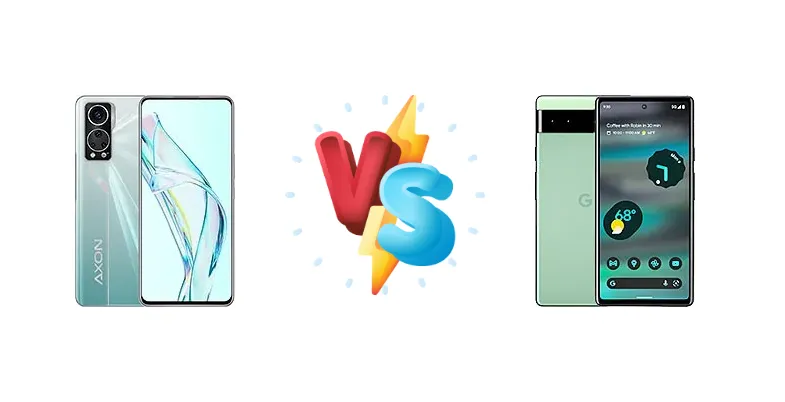
|
🏆 Quick Verdict
For the average user prioritizing camera quality and software experience, the Google Pixel 6a is the better choice. However, the ZTE Axon 30 5G delivers superior charging speeds and a strong performance profile for those who value responsiveness and gaming, making it a strong contender for power users.
| PHONES | ||
|---|---|---|
| Phone Names | ZTE Axon 30 5G | Google Pixel 6a |
| Network | ||
|---|---|---|
| 2G bands | GSM 850 / 900 / 1800 / 1900 | GSM 850 / 900 / 1800 / 1900 |
| 3G bands | HSDPA 850 / 900 / 1700(AWS) / 1900 / 2100 - International | HSDPA 800 / 850 / 900 / 1700(AWS) / 1900 / 2100 |
| 4G bands | 1, 2, 3, 4, 5, 7, 8, 12, 17, 20, 26, 28, 18, 19, 34, 38, 39, 40, 41 - Europe | 1, 2, 3, 4, 5, 7, 8, 12, 13, 14, 17, 18, 19, 20, 25, 26, 28, 29, 30, 38, 39, 40, 41, 42, 48, 66, 71 - GX7AS, GB62Z (USA/Canada) |
| 5G bands | 1, 3, 28, 38, 41, 77, 78 SA/NSA - Europe | 1, 2, 3, 5, 7, 8, 12, 20, 25, 28, 30, 38, 40, 41, 48, 66, 71, 77, 78 SA/NSA/Sub6 - GX7AS (USA/Canada) |
| Speed | HSPA, LTE, 5G | HSPA, LTE, 5G |
| Technology | GSM / CDMA / HSPA / LTE / 5G | GSM / HSPA / LTE / 5G |
| 1, 3, 28, 41, 78 SA/NSA - China | 1, 2, 3, 5, 7, 8, 12, 20, 25, 28, 30, 40, 48, 66, 71, 77, 78 SA/NSA/Sub6 - G1AZG (International) | |
| Launch | ||
|---|---|---|
| Announced | 2021, July 27 | 2022, May 11 |
| Status | Available. Released 2021, August 03 | Available. Released 2022, July 21 |
| Body | ||
|---|---|---|
| Build | Glass front, plastic back, plastic frame | Glass front (Gorilla Glass 3), aluminum frame, plastic back |
| Dimensions | 170.2 x 77.8 x 7.8 mm (6.70 x 3.06 x 0.31 in) | 152.2 x 71.8 x 8.9 mm (5.99 x 2.83 x 0.35 in) |
| SIM | Nano-SIM + Nano-SIM | Nano-SIM + eSIM |
| Weight | 189 g (6.67 oz) | 178 g (6.28 oz) |
| - | IP67 dust/water resistant (up to 1m for 30 min) | |
| Display | ||
|---|---|---|
| Protection | Corning Gorilla Glass | Corning Gorilla Glass 3 |
| Resolution | 1080 x 2460 pixels (~400 ppi density) | 1080 x 2400 pixels, 20:9 ratio (~429 ppi density) |
| Size | 6.92 inches, 107.0 cm2 (~80.8% screen-to-body ratio) | 6.1 inches, 90.7 cm2 (~83.0% screen-to-body ratio) |
| Type | AMOLED, 1B colors, 120Hz | OLED, HDR |
| Always-on display | Always-on display | |
| Platform | ||
|---|---|---|
| CPU | Octa-core (1x3.2 GHz Kryo 585 & 3x2.42 GHz Kryo 585 & 4x1.80 GHz Kryo 585) | Octa-core (2x2.80 GHz Cortex-X1 & 2x2.25 GHz Cortex-A76 & 4x1.80 GHz Cortex-A55) |
| Chipset | Qualcomm SM8250-AC Snapdragon 870 5G (7 nm) | Google Tensor (5 nm) |
| GPU | Adreno 650 | Mali-G78 MP20 |
| OS | Android 11, MyOS 11 | Android 12, upgradable to Android 15, up to 5 major Android upgrades |
| Memory | ||
|---|---|---|
| Card slot | microSDXC (uses shared SIM slot) | No |
| Internal | 128GB 6GB RAM, 128GB 8GB RAM, 256GB 8GB RAM, 256GB 12GB RAM | 128GB 6GB RAM |
| UFS 3.1 | UFS 3.1 | |
| Main Camera | ||
|---|---|---|
| Dual | - | 12.2 MP, f/1.7, 27mm, (wide), 1/2.55", 1.4µm, dual pixel PDAF, OIS 12 MP, f/2.2, 17mm, 114˚ (ultrawide), 1.25µm |
| Features | Dual-LED flash, HDR, panorama | Dual-LED flash, Pixel Shift, Auto-HDR, panorama |
| Quad | 64 MP, f/1.8, 25mm (wide), 1/1.73", 0.8µm, PDAF 8 MP, f/2.2, 120˚, 16mm (ultrawide) 5 MP (macro) Auxiliary lens | - |
| Single | 16 MP, f/2.5, (wide), under display | 8 MP, f/2.0, 24mm (wide), 1.12µm |
| Video | 4K@30/60fps, 1080p@30fps, gyro-EIS, HDR, 10‑bit video | 4K@30/60fps, 1080p@30/60/120/240fps; gyro-EIS, OIS |
| Selfie camera | ||
|---|---|---|
| Features | HDR | HDR, panorama |
| Single | 16 MP, f/2.5, (wide), under display | 8 MP, f/2.0, 24mm (wide), 1.12µm |
| Video | 1080p@30fps | 1080p@30fps |
| Sound | ||
|---|---|---|
| 3.5mm jack | No | No |
| 35mm jack | No | No |
| Loudspeaker | Yes | Yes, with stereo speakers |
| 24-bit/192kHz audio | - | |
| Comms | ||
|---|---|---|
| Bluetooth | 5.1, A2DP, LE | 5.2, A2DP, LE |
| NFC | Yes | Yes |
| Positioning | GPS, GLONASS, GALILEO, BDS | GPS, GLONASS, GALILEO, QZSS |
| Radio | No | No |
| USB | USB Type-C 3.0, OTG | USB Type-C 3.1 |
| WLAN | Wi-Fi 802.11 a/b/g/n/ac/6, dual-band, Wi-Fi Direct | Wi-Fi 802.11 a/b/g/n/ac/6e, dual-band, Wi-Fi Direct |
| Features | ||
|---|---|---|
| Sensors | Fingerprint (under display, optical), accelerometer, gyro, proximity, compass | Fingerprint (under display, optical), accelerometer, gyro, proximity, compass, barometer |
| Battery | ||
|---|---|---|
| Charging | 65W wired, PD, QC4 | 18W wired, PD3.0 |
| Type | Li-Ion 4200 mAh | Li-Po 4410 mAh |
| Misc | ||
|---|---|---|
| Colors | Black, Aqua | Chalk, Charcoal, Sage |
| Models | A2322, A2322G | GX7AS, GB62Z, G1AZG, GB17L |
| Price | About 500 EUR | $ 138.99 / C$ 228.74 / ₹ 23,999 |
| Tests | ||
|---|---|---|
| Battery life | Endurance rating 86h | Endurance rating 94h |
| Camera | Photo / Video | - |
| Display | Contrast ratio: Infinite (nominal) | Contrast ratio: Infinite (nominal) |
| Loudspeaker | -27.7 LUFS (Good) | - |
| Performance | AnTuTu: 701991 (v9) GeekBench: 3160 (v5.1) GFXBench: 59fps (ES 3.1 onscreen) | - |
ZTE Axon 30 5G
- Significantly faster 65W charging
- Strong Snapdragon 870 performance
- Potentially lower price point
- Lower display brightness
- Less advanced camera processing
- Shorter battery endurance
Google Pixel 6a
- Brighter, more visible display
- Superior camera image processing
- Longer battery life
- Slower 18W charging
- Google Tensor chip may throttle under sustained load
- Potentially higher price point
Display Comparison
The Pixel 6a boasts a significantly brighter display, reaching 876 nits compared to the Axon 30 5G’s 438 nits. This translates to vastly improved visibility outdoors under direct sunlight. Both displays share an 'Infinite' (nominal) contrast ratio, suggesting deep blacks, but the Pixel 6a’s higher brightness is a clear advantage for everyday usability. While neither specifies refresh rate, the brightness difference is the dominant factor for visual experience.
Camera Comparison
Both phones are listed as having 'Photo / Video' capabilities, lacking specific details. However, Google’s Tensor chip is renowned for its computational photography prowess, suggesting the Pixel 6a will deliver superior image quality, particularly in challenging lighting conditions. The Pixel 6a’s image processing algorithms are likely to provide better dynamic range and noise reduction. Without sensor size or aperture information, it’s difficult to make a definitive judgment, but Google’s software advantage is a significant factor. The Axon 30 5G likely relies more on hardware capabilities, which are currently unknown.
Performance
The chipset choice defines the performance character of each phone. The ZTE Axon 30 5G utilizes the Qualcomm Snapdragon 870 5G (7nm), an octa-core processor with a Kryo 585 architecture. The Google Pixel 6a, however, is powered by Google’s in-house Tensor chip (5nm). The 5nm process node of the Tensor chip generally offers better power efficiency and thermal performance compared to the 7nm Snapdragon 870. While the Snapdragon 870 excels in sustained CPU performance, the Tensor chip’s strength lies in its AI and machine learning capabilities, enhancing features like voice recognition and image processing. Both CPUs feature a similar core configuration with high-performance and efficiency cores, but the Tensor’s architecture is optimized for Google’s specific software.
Battery Life
The Pixel 6a edges out the Axon 30 5G in endurance, achieving a rating of 94 hours versus 86 hours for the Axon 30 5G. This suggests the Tensor chip’s efficiency contributes to longer battery life despite the Axon 30 5G’s faster 65W charging. The Axon 30 5G supports 65W wired charging with PD and QC4, enabling significantly faster charging times – likely a full charge in under 40 minutes – compared to the Pixel 6a’s 18W wired charging with PD3.0. This difference is crucial for users who prioritize minimizing downtime.
Buying Guide
Buy the ZTE Axon 30 5G if you need a phone that charges incredibly fast (65W) and offers excellent performance for demanding tasks like gaming, and aren't heavily invested in the Google ecosystem. Buy the Google Pixel 6a if you prioritize a clean Android experience, exceptional camera capabilities powered by Google’s image processing, and longer-term software support.