
ZTE Axon 20 5G vs Sony Xperia 5 III: A Detailed Comparison of Performance and Battery Life
| Phones Images | |||||
|---|---|---|---|---|---|
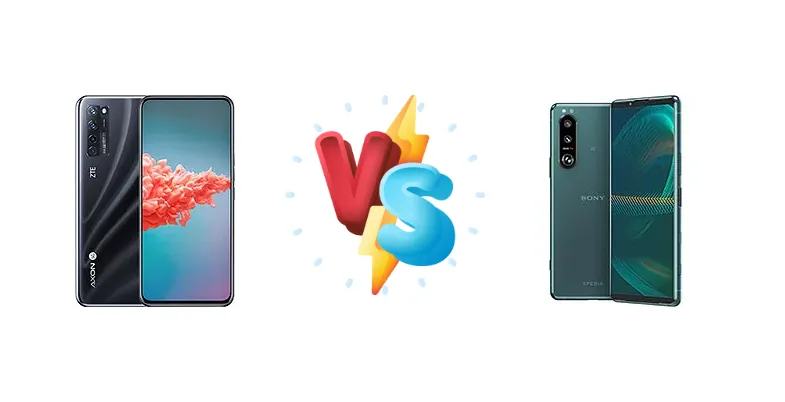
|
🏆 Quick Verdict
For the average user prioritizing raw performance and longevity, the Sony Xperia 5 III is the clear winner. Its Snapdragon 888 chipset and 100-hour endurance rating significantly outperform the Axon 20 5G’s Snapdragon 765G and 82-hour rating. However, the Axon 20 5G remains a compelling option for budget-conscious buyers.
| PHONES | ||
|---|---|---|
| Phone Names | ZTE Axon 20 5G | Sony Xperia 5 III |
| Network | ||
|---|---|---|
| 2G bands | GSM 850 / 900 / 1800 / 1900 | GSM 850 / 900 / 1800 / 1900 |
| 3G bands | HSDPA 850 / 900 / 1700(AWS) / 1900 / 2100 | HSDPA 800 / 850 / 900 / 1700(AWS) / 1900 / 2100 |
| 4G bands | 1, 3, 5, 7, 8, 20, 38, 40, 41 - Europe | 1, 2, 3, 4, 5, 7, 8, 12, 13, 17, 19, 20, 25, 26, 28, 29, 32, 34, 38, 39, 40, 41, 46, 48, 66, 71 - USA |
| 5G bands | 78 SA/NSA - Europe | 1, 2, 3, 5, 7, 8, 20, 28, 38, 40, 41, 66, 71, 77, 78 SA/NSA/Sub6 - USA |
| Speed | HSPA, LTE, 5G | HSPA, LTE, 5G |
| Technology | GSM / CDMA / HSPA / LTE / 5G | GSM / HSPA / LTE / 5G |
| 1, 3, 28, 41, 78, 79 SA/NSA - China | 1, 3, 5, 7, 8, 28, 38, 40, 41, 77, 78, 79 SA/NSA/Sub6 - Asia | |
| Launch | ||
|---|---|---|
| Announced | 2020, September 01. Released 2020, September 10 | 2021, April 14 |
| Status | Discontinued | Available. Released 2021, October 08 |
| Body | ||
|---|---|---|
| Build | Glass front, glass back or eco leather back, plastic frame | Glass front (Gorilla Glass 6), glass back (Gorilla Glass 6), aluminum frame |
| Dimensions | 172.1 x 77.9 x 8 mm (6.78 x 3.07 x 0.31 in) | 157 x 68 x 8.2 mm (6.18 x 2.68 x 0.32 in) |
| SIM | · Nano-SIM· Nano-SIM + Nano-SIM | · Nano-SIM· Nano-SIM + Nano-SIM |
| Weight | 198 g (6.98 oz) | 168 g (5.93 oz) |
| - | IP65/IP68 dust/water resistant (up to 1.5m for 30 min) | |
| Display | ||
|---|---|---|
| Protection | - | Corning Gorilla Glass 6 |
| Resolution | 1080 x 2460 pixels (~400 ppi density) | 1080 x 2520 pixels, 21:9 ratio (~449 ppi density) |
| Size | 6.92 inches, 107.0 cm2 (~79.8% screen-to-body ratio) | 6.1 inches, 86.9 cm2 (~81.4% screen-to-body ratio) |
| Type | OLED, 1B colors, 90Hz | OLED, 1B colors, 120Hz, HDR BT.2020 |
| Always-on display | - | |
| Platform | ||
|---|---|---|
| CPU | Octa-core (1x2.4 GHz Kryo 475 Prime & 1x2.2 GHz Kryo 475 Gold & 6x1.8 GHz Kryo 475 Silver) | Octa-core (1x2.84 GHz Cortex-X1 & 3x2.42 GHz Cortex-A78 & 4x1.80 GHz Cortex-A55) |
| Chipset | Qualcomm SM7250 Snapdragon 765G 5G (7 nm) | Qualcomm SM8350 Snapdragon 888 5G (5 nm) |
| GPU | Adreno 620 | Adreno 660 |
| OS | Android 10, MiFavor 10.5 | Android 11, upgradable to Android 13 |
| Memory | ||
|---|---|---|
| Card slot | microSDXC (uses shared SIM slot) | microSDXC (uses shared SIM slot) |
| Internal | 128GB 6GB RAM, 128GB 8GB RAM, 256GB 8GB RAM | 128GB 8GB RAM, 256GB 8GB RAM |
| - | UFS 3.X | |
| Main Camera | ||
|---|---|---|
| Features | Dual-LED dual-tone flash, HDR, panorama | Zeiss optics, Zeiss T* lens coating, color spectrum sensor, LED flash, panorama, HDR, eye tracking |
| Quad | 64 MP, f/1.8, 25mm (wide), 1/1.72", 0.8µm, PDAF 8 MP, f/2.2, 120˚, 16mm (ultrawide) 2 MP (macro) Auxiliary lens | - |
| Single | - | 8 MP, f/2.0, 24mm (wide), 1/4", 1.12µm |
| Triple | - | 12 MP, f/1.7, 24mm (wide), 1/1.7", 1.8µm, dual pixel PDAF, OIS 12 MP, f/2.3, 70mm (telephoto), f/2.8, 105mm (telephoto), 1/2.9", dual pixel PDAF, 3x/4.4x optical zoom, OIS 12 MP, f/2.2, 124˚, 16mm (ultrawide), 1/2.6", dual pixel PDAF |
| Video | 4K@30/60fps, 1080p@30fps, gyro-EIS, HDR, 10‑bit video | 4K@24/25/30/60/120fps HDR, 1080p@30/60/120fps; 5-axis gyro-EIS, OIS |
| Selfie camera | ||
|---|---|---|
| Features | HDR | HDR |
| Single | 32 MP, f/2.0, (wide), under display | 8 MP, f/2.0, 24mm (wide), 1/4.0", 1.12µm |
| Video | 1080p@30fps | 1080p@30fps, 5-axis gyro-EIS |
| Sound | ||
|---|---|---|
| 3.5mm jack | No | Yes |
| 35mm jack | No | Yes |
| Loudspeaker | Yes | Yes, with stereo speakers |
| 24-bit/192kHz audio | 24-bit/192kHz audio Dynamic vibration system | |
| Comms | ||
|---|---|---|
| Bluetooth | 5.1, A2DP, LE | 5.2, A2DP, LE, aptX HD, aptX Adaptive |
| NFC | Yes | Yes |
| Positioning | GPS, GLONASS, GALILEO, BDS | GPS, GLONASS, BDS, GALILEO, QZSS |
| Radio | No | No |
| USB | USB Type-C 3.1, OTG | USB Type-C 3.1, OTG, video output |
| WLAN | Wi-Fi 802.11 a/b/g/n/ac, dual-band, Wi-Fi Direct | Wi-Fi 802.11 a/b/g/n/ac/6, dual-band, Wi-Fi Direct, DLNA |
| Features | ||
|---|---|---|
| Sensors | Fingerprint (under display, optical), accelerometer, gyro, proximity, compass | Fingerprint (side-mounted), accelerometer, gyro, proximity, barometer, compass |
| - | Native Sony Alpha camera support | |
| Battery | ||
|---|---|---|
| Charging | 30W wired, QC4, 60% in 30 min | Wired, PD, 50% in 30 min |
| Type | Li-Ion 4220 mAh | Li-Po 4500 mAh |
| Misc | ||
|---|---|---|
| Colors | Black, Gold, Blue, Purple, Sunrise Yellow | Black, Green, Pink |
| Models | A2121, A2121E, A2121G | XQBQ62/G, XQBQ52G.UKCX, XQBQ52B.UKCX, XQ-BQ52, XQ-BQ72, XQ-BQ42, XQ-BQ62, SO-53B |
| Price | About 720 EUR | € 431.90 / £ 199.99 |
| Tests | ||
|---|---|---|
| Battery life | Endurance rating 82h | Endurance rating 100h |
| Camera | Photo / Video | Photo / Video |
| Display | Contrast ratio: Infinite (nominal) | Contrast ratio: Infinite (nominal) |
| Loudspeaker | -27.3 LUFS (Good) | -26.7 LUFS (Good) |
| Performance | AnTuTu: 320399 (v8) GeekBench: 1957 (v5.1) GFXBench: 18fps (ES 3.1 onscreen) | AnTuTu: 708394 (v9) GeekBench: 3549 (v5.1) GFXBench: 53fps (ES 3.1 onscreen) |
ZTE Axon 20 5G
- More affordable price point
- Functional 5G connectivity
- Under-display camera (novelty factor)
- Significantly weaker processor
- Lower display brightness
- Shorter battery life
Sony Xperia 5 III
- Flagship-level performance with Snapdragon 888
- Brighter and potentially smoother display
- Longer battery life and endurance
- Higher price tag
- May lack expandable storage
- Compact size may not suit all users
Display Comparison
The Sony Xperia 5 III boasts a significantly brighter display at 590 nits compared to the ZTE Axon 20 5G’s 406 nits. This translates to better visibility outdoors and a more vibrant viewing experience. Both displays share an 'Infinite' (nominal) contrast ratio, suggesting standard OLED performance. While neither specification details refresh rates, Sony’s history with the Xperia line suggests a 120Hz panel, a feature likely absent on the Axon 20 5G, impacting smoothness during scrolling and gaming.
Camera Comparison
Both phones feature 'Photo / Video' capabilities, but the context data lacks specifics. Given Sony’s expertise in imaging, the Xperia 5 III likely benefits from more advanced image processing algorithms and potentially larger sensor sizes. The Snapdragon 888’s image signal processor (ISP) is also more capable than the 765G’s, leading to better low-light performance and dynamic range. Without detailed sensor information, it’s reasonable to assume the Xperia 5 III offers a more refined and versatile camera experience.
Performance
The core difference lies in the chipsets: the ZTE Axon 20 5G utilizes the Qualcomm Snapdragon 765G (7nm), while the Sony Xperia 5 III is powered by the Snapdragon 888 5G (5nm). The 5nm process node of the 888 offers superior power efficiency and transistor density, resulting in substantially higher performance. The Xperia 5 III’s CPU, featuring a Cortex-X1 prime core, further enhances its processing capabilities compared to the Axon 20 5G’s Kryo 475 setup. This gap is particularly noticeable in demanding tasks like video editing and graphically intensive games.
Battery Life
The Sony Xperia 5 III’s endurance rating of 100 hours surpasses the ZTE Axon 20 5G’s 82 hours. While battery capacity isn’t specified, the combination of the more efficient Snapdragon 888 (5nm) and optimized software likely contributes to this advantage. Charging speeds differ as well; the Axon 20 5G supports 30W wired charging with QC4, reaching 60% in 30 minutes, while the Xperia 5 III utilizes PD, achieving 50% charge in the same timeframe. The Xperia 5 III’s superior endurance means less frequent charging, despite a potentially similar charging speed.
Buying Guide
Buy the ZTE Axon 20 5G if you need a functional 5G phone on a tight budget and are willing to compromise on processing power and camera quality. Buy the Sony Xperia 5 III if you prioritize a flagship-level experience, demanding performance for gaming and content creation, and value a longer-lasting battery and brighter display.