
OnePlus 8T vs ZTE Axon 20 5G: A Detailed Comparison
| Phones Images | |||||
|---|---|---|---|---|---|
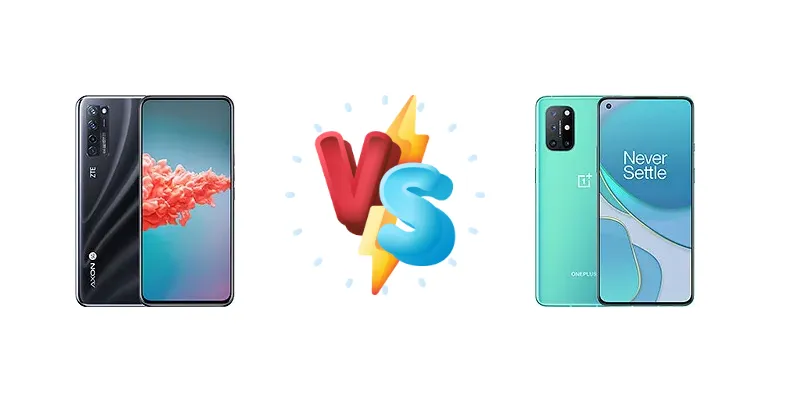
|
🏆 Quick Verdict
For most users, the OnePlus 8T is the superior choice. Its significantly faster Snapdragon 865 chipset, coupled with 65W charging and a brighter display, provides a smoother, more responsive experience. While the Axon 20 5G offers a unique under-display camera, the performance trade-offs aren't worth it for the average user.
| PHONES | ||
|---|---|---|
| Phone Names | ZTE Axon 20 5G | OnePlus 8T |
| Network | ||
|---|---|---|
| 2G bands | GSM 850 / 900 / 1800 / 1900 | GSM 850 / 900 / 1800 / 1900 |
| 3G bands | HSDPA 850 / 900 / 1700(AWS) / 1900 / 2100 | HSDPA 800 / 850 / 900 / 1700(AWS) / 1800 / 1900 / 2100 |
| 4G bands | 1, 3, 5, 7, 8, 20, 38, 40, 41 - Europe | 1, 2, 3, 4, 5, 7, 8, 12, 13, 17, 18, 19, 20, 25, 26, 28, 32, 34, 38, 39, 40, 41, 42, 66 - EU |
| 5G bands | 78 SA/NSA - Europe | 1, 3, 7, 28, 41, 78 SA/NSA - EU |
| Speed | HSPA, LTE, 5G | HSPA 42.2/5.76 Mbps, LTE (5CA) Cat18 1200/200 Mbps, 5G 7.5 Gbps DL |
| Technology | GSM / CDMA / HSPA / LTE / 5G | GSM / CDMA / HSPA / LTE / 5G |
| 1, 3, 28, 41, 78, 79 SA/NSA - China | 41, 78, 79 SA/NSA - CN | |
| Launch | ||
|---|---|---|
| Announced | 2020, September 01. Released 2020, September 10 | 2020, October 14 |
| Status | Discontinued | Available. Released 2020, October 16 |
| Body | ||
|---|---|---|
| Build | Glass front, glass back or eco leather back, plastic frame | Glass front (Gorilla Glass 5), glass back (Gorilla Glass 5), aluminum frame |
| Dimensions | 172.1 x 77.9 x 8 mm (6.78 x 3.07 x 0.31 in) | 160.7 x 74.1 x 8.4 mm (6.33 x 2.92 x 0.33 in) |
| SIM | · Nano-SIM· Nano-SIM + Nano-SIM | Nano-SIM + Nano-SIM |
| Weight | 198 g (6.98 oz) | 188 g (6.63 oz) |
| Display | ||
|---|---|---|
| Protection | - | Corning Gorilla Glass 5 |
| Resolution | 1080 x 2460 pixels (~400 ppi density) | 1080 x 2400 pixels, 20:9 ratio (~402 ppi density) |
| Size | 6.92 inches, 107.0 cm2 (~79.8% screen-to-body ratio) | 6.55 inches, 103.6 cm2 (~87.0% screen-to-body ratio) |
| Type | OLED, 1B colors, 90Hz | Fluid AMOLED, 120Hz, HDR10+ |
| Always-on display | Always-on display | |
| Platform | ||
|---|---|---|
| CPU | Octa-core (1x2.4 GHz Kryo 475 Prime & 1x2.2 GHz Kryo 475 Gold & 6x1.8 GHz Kryo 475 Silver) | Octa-core (1x2.84 GHz Cortex-A77 & 3x2.42 GHz Cortex-A77 & 4x1.80 GHz Cortex-A55) |
| Chipset | Qualcomm SM7250 Snapdragon 765G 5G (7 nm) | Qualcomm SM8250 Snapdragon 865 5G (7 nm+) |
| GPU | Adreno 620 | Adreno 650 |
| OS | Android 10, MiFavor 10.5 | Android 11, upgradable to Android 14, OxygenOS 14 |
| Memory | ||
|---|---|---|
| Card slot | microSDXC (uses shared SIM slot) | No |
| Internal | 128GB 6GB RAM, 128GB 8GB RAM, 256GB 8GB RAM | 128GB 8GB RAM, 256GB 12GB RAM |
| - | UFS 3.1 | |
| Main Camera | ||
|---|---|---|
| Features | Dual-LED dual-tone flash, HDR, panorama | Dual-LED flash, HDR, panorama |
| Quad | 64 MP, f/1.8, 25mm (wide), 1/1.72", 0.8µm, PDAF 8 MP, f/2.2, 120˚, 16mm (ultrawide) 2 MP (macro) Auxiliary lens | 48 MP, f/1.7, 26mm (wide), 1/2.0", 0.8µm, PDAF, OIS 16 MP, f/2.2, 14mm, 123˚ (ultrawide), 1/3.6", 1.0µm 5 MP (macro) 2 MP, f/2.4, (monochrome) |
| Video | 4K@30/60fps, 1080p@30fps, gyro-EIS, HDR, 10‑bit video | 4K@30/60fps, 1080p@30/60/240fps, Auto HDR, gyro-EIS |
| Selfie camera | ||
|---|---|---|
| Features | HDR | HDR |
| Single | 32 MP, f/2.0, (wide), under display | 16 MP, f/2.4, (wide), 1/3.06", 1.0µm |
| Video | 1080p@30fps | 1080p@30fps, gyro-EIS |
| Sound | ||
|---|---|---|
| 3.5mm jack | No | No |
| 35mm jack | No | No |
| Loudspeaker | Yes | Yes, with stereo speakers |
| 24-bit/192kHz audio | - | |
| Comms | ||
|---|---|---|
| Bluetooth | 5.1, A2DP, LE | 5.1, A2DP, LE, aptX HD |
| NFC | Yes | Yes |
| Positioning | GPS, GLONASS, GALILEO, BDS | GPS (L1+L5), GLONASS (G1), BDS (B1), GALILEO (E1+E5a) |
| Radio | No | No |
| USB | USB Type-C 3.1, OTG | USB Type-C 3.1, OTG |
| WLAN | Wi-Fi 802.11 a/b/g/n/ac, dual-band, Wi-Fi Direct | Wi-Fi 802.11 a/b/g/n/ac/6, dual-band, Wi-Fi Direct, DLNA |
| Features | ||
|---|---|---|
| Sensors | Fingerprint (under display, optical), accelerometer, gyro, proximity, compass | Fingerprint (under display, optical), accelerometer, gyro, proximity, compass, barometer (market dependant) |
| Battery | ||
|---|---|---|
| Charging | 30W wired, QC4, 60% in 30 min | 65W wired, 100% in 39 min |
| Type | Li-Ion 4220 mAh | Li-Po 4500 mAh |
| Misc | ||
|---|---|---|
| Colors | Black, Gold, Blue, Purple, Sunrise Yellow | Aquamarine Green, Lunar Silver, Cyberpunk 2077 Edition |
| Models | A2121, A2121E, A2121G | KB2001, KB2000, KB2003, KB2005 |
| Price | About 720 EUR | € 130.75 |
| Tests | ||
|---|---|---|
| Battery life | Endurance rating 82h | Endurance rating 104h |
| Camera | Photo / Video | Photo / Video |
| Display | Contrast ratio: Infinite (nominal) | Contrast ratio: Infinite (nominal) |
| Loudspeaker | -27.3 LUFS (Good) | -24.0 LUFS (Very good) |
| Performance | AnTuTu: 320399 (v8) GeekBench: 1957 (v5.1) GFXBench: 18fps (ES 3.1 onscreen) | AnTuTu: 586000 (v8) GeekBench: 3126 (v5.1) GFXBench: 46fps (ES 3.1 onscreen) |
ZTE Axon 20 5G
- Innovative under-display camera
- More affordable price point
- Decent 5G connectivity
- Significantly slower processor
- Lower display brightness
- Slower charging speeds
OnePlus 8T
- Faster Snapdragon 865 processor
- Brighter and more vibrant display
- Ultra-fast 65W charging
- Higher price tag
- No under-display camera innovation
- May run hotter under heavy load
Display Comparison
The OnePlus 8T boasts a significantly brighter display, reaching 802 nits measured, compared to the ZTE Axon 20 5G’s 406 nits. This translates to far better visibility outdoors under direct sunlight. Both displays share an 'Infinite' (nominal) contrast ratio, typical of AMOLED panels, but the OnePlus 8T’s higher peak brightness provides a more dynamic and engaging viewing experience. While both utilize AMOLED technology, the OnePlus 8T’s superior brightness makes it the clear winner for media consumption and everyday use.
Camera Comparison
Both phones feature capable camera systems, but details beyond 'Photo/Video' are lacking in the provided data. However, the market positioning suggests the OnePlus 8T likely benefits from more advanced image processing algorithms and potentially larger sensor sizes. The ZTE Axon 20 5G’s under-display camera, while innovative, is known to suffer from image quality compromises compared to traditional front-facing cameras. Without specific sensor size or aperture information, it’s reasonable to assume the OnePlus 8T delivers more consistent and higher-quality photos and videos.
Performance
The core difference lies in the chipsets. The OnePlus 8T is powered by the Qualcomm SM8250 Snapdragon 865 5G (7nm+), featuring a Cortex-A77 prime core clocked at 2.84 GHz. The ZTE Axon 20 5G utilizes the Qualcomm SM7250 Snapdragon 765G 5G (7nm) with a Kryo 475 Prime core at 2.4 GHz. This architectural difference results in a substantial performance gap; the 865 offers significantly faster CPU and GPU performance, making the OnePlus 8T better suited for demanding tasks like gaming and video editing. The 7nm+ process node on the 865 also contributes to improved thermal efficiency, reducing the likelihood of throttling under sustained load.
Battery Life
The OnePlus 8T offers a superior endurance rating of 104 hours, compared to the ZTE Axon 20 5G’s 82 hours. While the Axon 20 5G’s battery capacity isn’t specified, the OnePlus 8T’s larger battery combined with the more efficient Snapdragon 865 chipset contributes to its longer runtime. Crucially, the OnePlus 8T supports 65W wired charging, achieving a full charge in just 39 minutes, while the Axon 20 5G’s 30W charging with QC4 takes considerably longer, reaching 60% in 30 minutes. This charging speed difference is a significant advantage for OnePlus 8T users.
Buying Guide
Buy the ZTE Axon 20 5G if you are intrigued by the under-display camera technology and prioritize a lower initial cost, accepting compromises in processing power and display quality. Buy the OnePlus 8T if you demand a consistently fast and fluid user experience, rapid charging, and a brighter, more vibrant display, even if it means a higher price tag.