
Motorola Edge+ (2023) vs. ZTE Axon 20 5G: A Generational Leap in Performance?
| Phones Images | |||||
|---|---|---|---|---|---|
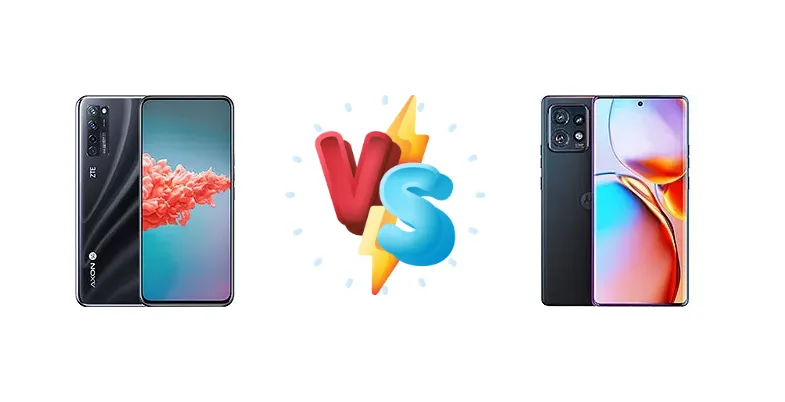
|
🏆 Quick Verdict
For most users, the Motorola Edge+ (2023) is the clear winner. Its Snapdragon 8 Gen 2 chipset delivers significantly faster performance and improved efficiency, making it ideal for demanding tasks and gaming. While the Axon 20 5G offers a unique under-display camera and respectable battery life, it can't compete with the Edge+'s raw power.
| PHONES | ||
|---|---|---|
| Phone Names | ZTE Axon 20 5G | Motorola Edge+ (2023) |
| Network | ||
|---|---|---|
| 2G bands | GSM 850 / 900 / 1800 / 1900 | GSM 850 / 900 / 1800 / 1900 |
| 3G bands | HSDPA 850 / 900 / 1700(AWS) / 1900 / 2100 | HSDPA 850 / 900 / 1700(AWS) / 1900 / 2100 |
| 4G bands | 1, 3, 5, 7, 8, 20, 38, 40, 41 - Europe | 1, 2, 3, 4, 5, 7, 8, 12, 13, 14, 17, 18, 20, 25, 26, 28, 29, 30, 38, 39, 40, 41, 41, 46, 48, 66, 71 |
| 5G bands | 78 SA/NSA - Europe | 1, 2, 3, 5, 7, 12, 14, 20, 25, 26, 28, 29, 30, 38, 41, 41, 48, 66, 70, 71, 77, 78 SA/NSA/Sub6/mmWave |
| Speed | HSPA, LTE, 5G | HSPA, LTE, 5G |
| Technology | GSM / CDMA / HSPA / LTE / 5G | GSM / HSPA / LTE / 5G |
| 1, 3, 28, 41, 78, 79 SA/NSA - China | - | |
| Launch | ||
|---|---|---|
| Announced | 2020, September 01. Released 2020, September 10 | 2023, May 02 |
| Status | Discontinued | Available. Released 2023, May 19 |
| Body | ||
|---|---|---|
| Build | Glass front, glass back or eco leather back, plastic frame | Glass front (Gorilla Glass Victus), glass back (Gorilla Glass Victus), aluminum frame |
| Dimensions | 172.1 x 77.9 x 8 mm (6.78 x 3.07 x 0.31 in) | 161.2 x 74 x 8.6 mm (6.35 x 2.91 x 0.34 in) |
| SIM | · Nano-SIM· Nano-SIM + Nano-SIM | Nano-SIM + eSIM |
| Weight | 198 g (6.98 oz) | 203 g (7.16 oz) |
| - | IP68 dust/water resistant (up to 1.5m for 30 min) | |
| Display | ||
|---|---|---|
| Protection | - | Corning Gorilla Glass Victus |
| Resolution | 1080 x 2460 pixels (~400 ppi density) | 1080 x 2400 pixels, 20:9 ratio (~395 ppi density) |
| Size | 6.92 inches, 107.0 cm2 (~79.8% screen-to-body ratio) | 6.67 inches, 107.4 cm2 (~90.0% screen-to-body ratio) |
| Type | OLED, 1B colors, 90Hz | OLED, 1B colors, 165Hz, HDR10+, Dolby Vision, 1300 nits (peak) |
| Always-on display | - | |
| Platform | ||
|---|---|---|
| CPU | Octa-core (1x2.4 GHz Kryo 475 Prime & 1x2.2 GHz Kryo 475 Gold & 6x1.8 GHz Kryo 475 Silver) | Octa-core (1x3.2 GHz Cortex-X3 & 2x2.8 GHz Cortex-A715 & 2x2.8 GHz Cortex-A710 & 3x2.0 GHz Cortex-A510) |
| Chipset | Qualcomm SM7250 Snapdragon 765G 5G (7 nm) | Qualcomm SM8550-AB Snapdragon 8 Gen 2 (4 nm) |
| GPU | Adreno 620 | Adreno 740 |
| OS | Android 10, MiFavor 10.5 | Android 13, upgradable to Android 14 |
| Memory | ||
|---|---|---|
| Card slot | microSDXC (uses shared SIM slot) | No |
| Internal | 128GB 6GB RAM, 128GB 8GB RAM, 256GB 8GB RAM | 512GB 8GB RAM |
| - | UFS 4.0 | |
| Main Camera | ||
|---|---|---|
| Features | Dual-LED dual-tone flash, HDR, panorama | Dual-LED flash, panorama, HDR |
| Quad | 64 MP, f/1.8, 25mm (wide), 1/1.72", 0.8µm, PDAF 8 MP, f/2.2, 120˚, 16mm (ultrawide) 2 MP (macro) Auxiliary lens | - |
| Triple | - | 50 MP, f/1.8, (wide), 1/1.55", 1.0µm, multi-directional PDAF, OIS 12 MP, f/1.6, (telephoto), 1/2.93", 1.22µm, PDAF, 2x optical zoom 50 MP, f/2.2, 114˚ (ultrawide), 1/2.76", 0.64µm, AF |
| Video | 4K@30/60fps, 1080p@30fps, gyro-EIS, HDR, 10‑bit video | 8K@30fps, 4K@30/60fps, 1080p@30/60/120/240/960fps, 10-bit HDR10+, gyro-EIS |
| Selfie camera | ||
|---|---|---|
| Features | HDR | HDR |
| Single | 32 MP, f/2.0, (wide), under display | 60 MP, f/2.2, (wide), 1/2.8", 0.61µm |
| Video | 1080p@30fps | 4K@30/60fps, 1080p@30/60/120/240fps |
| Sound | ||
|---|---|---|
| 3.5mm jack | No | No |
| 35mm jack | No | No |
| Loudspeaker | Yes | Yes, with stereo speakers |
| 24-bit/192kHz audio | - | |
| Comms | ||
|---|---|---|
| Bluetooth | 5.1, A2DP, LE | 5.3, A2DP, LE, aptX HD, aptX Adaptive |
| NFC | Yes | Yes |
| Positioning | GPS, GLONASS, GALILEO, BDS | GPS, GLONASS, GALILEO, BDS |
| Radio | No | No |
| USB | USB Type-C 3.1, OTG | USB Type-C 3.2, OTG, DisplayPort 1.4 |
| WLAN | Wi-Fi 802.11 a/b/g/n/ac, dual-band, Wi-Fi Direct | Wi-Fi 802.11 a/b/g/n/ac/6e/7, tri-band, Wi-Fi Direct |
| Features | ||
|---|---|---|
| Sensors | Fingerprint (under display, optical), accelerometer, gyro, proximity, compass | Fingerprint (under display, optical), accelerometer, gyro, proximity, compass, barometer |
| - | Ready For 3.5 support | |
| Battery | ||
|---|---|---|
| Charging | 30W wired, QC4, 60% in 30 min | 68W wired 15W wireless 5W reverse wired 5W reverse wireless |
| Type | Li-Ion 4220 mAh | Li-Po 5100 mAh |
| Misc | ||
|---|---|---|
| Colors | Black, Gold, Blue, Purple, Sunrise Yellow | Interstellar Black |
| Models | A2121, A2121E, A2121G | - |
| Price | About 720 EUR | $ 298.99 |
| Tests | ||
|---|---|---|
| Battery life | Endurance rating 82h | - |
| Camera | Photo / Video | - |
| Display | Contrast ratio: Infinite (nominal) | - |
| Loudspeaker | -27.3 LUFS (Good) | - |
| Performance | AnTuTu: 320399 (v8) GeekBench: 1957 (v5.1) GFXBench: 18fps (ES 3.1 onscreen) | - |
ZTE Axon 20 5G
- Unique under-display camera design
- Respectable battery endurance (82h)
- More affordable price point
- Significantly slower processor (Snapdragon 765G)
- Lower display brightness
- Potentially compromised front camera quality
Motorola Edge+ (2023)
- Flagship-level performance (Snapdragon 8 Gen 2)
- Faster charging speeds (68W wired, 15W wireless)
- Likely superior display quality
- Higher price tag
- No under-display camera
- Specifications not fully available
Display Comparison
The ZTE Axon 20 5G’s display achieves a maximum brightness of 406 nits, which is adequate for indoor use but may struggle in direct sunlight. The Motorola Edge+ (2023) display specifications are not provided, but given its flagship status, it likely boasts a significantly higher peak brightness and potentially features LTPO technology for adaptive refresh rates, improving battery efficiency. The Axon 20 5G’s ‘infinite’ contrast ratio is a nominal specification; real-world contrast performance will depend on the panel technology used. The Edge+ likely offers superior color accuracy and viewing angles due to its more advanced panel.
Camera Comparison
Both phones feature photo and video capabilities, but detailed camera specifications are limited for the Axon 20 5G. The Axon 20 5G’s primary innovation is its under-display camera, a novelty that likely compromises image quality compared to traditional front-facing cameras. The Motorola Edge+ (2023) camera specifications are not provided, but as a flagship, it likely features a larger main sensor with optical image stabilization (OIS) and advanced image processing algorithms, resulting in superior image quality in various lighting conditions. Focusing on the main sensors is crucial, as the Axon 20 5G’s inclusion of a 2MP macro camera is unlikely to provide significant value.
Performance
The core difference lies in the chipsets. The ZTE Axon 20 5G utilizes the Qualcomm Snapdragon 765G (7nm), a capable mid-range processor. The Motorola Edge+ (2023) is powered by the Snapdragon 8 Gen 2 (4nm). This represents a substantial leap in performance. The 4nm process node of the 8 Gen 2 offers significantly improved power efficiency and thermal management compared to the 7nm 765G, resulting in less throttling during sustained workloads. The Edge+'s CPU, with its Cortex-X3 prime core, will outperform the Kryo 475 Prime in the Axon 20 5G in single-core tasks, while the combination of A715, A710, and A510 cores provides a substantial multi-core advantage. The Edge+ also benefits from faster LPDDR5x RAM, further enhancing responsiveness.
Battery Life
The ZTE Axon 20 5G achieves an endurance rating of 82 hours, indicating good battery life. It supports 30W wired charging with Quick Charge 4, reaching 60% charge in 30 minutes. The Motorola Edge+ (2023) boasts significantly faster 68W wired charging, allowing for a full charge in a much shorter timeframe. It also includes 15W wireless charging and 5W reverse wired/wireless charging, offering greater versatility. While the Axon 20 5G’s endurance is respectable, the Edge+’s faster charging speeds and potentially larger battery capacity (specifications not provided) provide a more convenient user experience.
Buying Guide
Buy the ZTE Axon 20 5G if you prioritize a unique design with an under-display camera and are on a strict budget, accepting compromises in performance and long-term software support. Buy the Motorola Edge+ (2023) if you demand the fastest possible Android experience, excellent battery charging speeds, and a phone that will remain capable for years to come.