
ZTE Axon 20 5G Extreme vs. Axon 30 5G: A Head-to-Head Showdown
| Phones Images | |||||
|---|---|---|---|---|---|
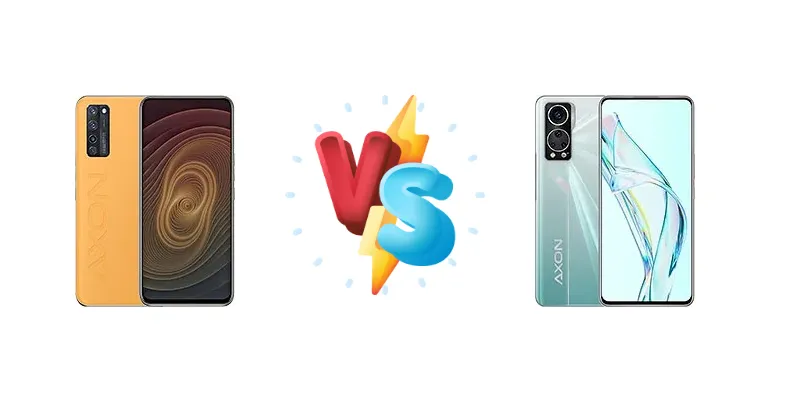
|
🏆 Quick Verdict
The ZTE Axon 30 5G is the clear winner. Its Snapdragon 870 chipset provides significantly better performance, faster charging, and a brighter display. While the Axon 20 offers a decent experience, the Axon 30's upgrades make it a more compelling choice for most users.
| PHONES | ||
|---|---|---|
| Phone Names | ZTE Axon 20 5G Extreme | ZTE Axon 30 5G |
| Network | ||
|---|---|---|
| 2G bands | GSM 850 / 900 / 1800 / 1900 | GSM 850 / 900 / 1800 / 1900 |
| 3G bands | HSDPA 850 / 900 / 1700(AWS) / 1900 / 2100 | HSDPA 850 / 900 / 1700(AWS) / 1900 / 2100 - International |
| 4G bands | 1, 3, 4, 5, 7, 8, 12, 17, 20, 34, 38, 39, 40, 41 | 1, 2, 3, 4, 5, 7, 8, 12, 17, 20, 26, 28, 18, 19, 34, 38, 39, 40, 41 - Europe |
| 5G bands | 1, 3, 28, 41, 78, 79 SA/NSA | 1, 3, 28, 38, 41, 77, 78 SA/NSA - Europe |
| Speed | HSPA, LTE, 5G | HSPA, LTE, 5G |
| Technology | GSM / CDMA / HSPA / LTE / 5G | GSM / CDMA / HSPA / LTE / 5G |
| CDMA 800 | 1, 3, 28, 41, 78 SA/NSA - China | |
| Launch | ||
|---|---|---|
| Announced | 2020, December 03. Released 2020, December 22 | 2021, July 27 |
| Status | Discontinued | Available. Released 2021, August 03 |
| Body | ||
|---|---|---|
| Build | Glass front, eco leather back, plastic frame | Glass front, plastic back, plastic frame |
| Dimensions | 172.1 x 77.9 x 8 mm (6.78 x 3.07 x 0.31 in) | 170.2 x 77.8 x 7.8 mm (6.70 x 3.06 x 0.31 in) |
| SIM | Nano-SIM + Nano-SIM | Nano-SIM + Nano-SIM |
| Weight | 198 g (6.98 oz) | 189 g (6.67 oz) |
| Display | ||
|---|---|---|
| Protection | - | Corning Gorilla Glass |
| Resolution | 1080 x 2460 pixels (~388 ppi density) | 1080 x 2460 pixels (~400 ppi density) |
| Size | 6.92 inches, 113.7 cm2 (~84.8% screen-to-body ratio) | 6.92 inches, 107.0 cm2 (~80.8% screen-to-body ratio) |
| Type | OLED, 1B colors, 90Hz | AMOLED, 1B colors, 120Hz |
| Always-on display | Always-on display | |
| Platform | ||
|---|---|---|
| CPU | Octa-core (1x2.4 GHz Kryo 475 Prime & 1x2.2 GHz Kryo 475 Gold & 6x1.8 GHz Kryo 475 Silver) | Octa-core (1x3.2 GHz Kryo 585 & 3x2.42 GHz Kryo 585 & 4x1.80 GHz Kryo 585) |
| Chipset | Qualcomm SM7250 Snapdragon 765G 5G (7 nm) | Qualcomm SM8250-AC Snapdragon 870 5G (7 nm) |
| GPU | Adreno 620 | Adreno 650 |
| OS | Android 10, MiFavor 10.5 | Android 11, MyOS 11 |
| Memory | ||
|---|---|---|
| Card slot | microSDXC (uses shared SIM slot) | microSDXC (uses shared SIM slot) |
| Internal | 256GB 12GB RAM | 128GB 6GB RAM, 128GB 8GB RAM, 256GB 8GB RAM, 256GB 12GB RAM |
| - | UFS 3.1 | |
| Main Camera | ||
|---|---|---|
| Features | Dual-LED dual-tone flash, HDR, panorama | Dual-LED flash, HDR, panorama |
| Quad | 64 MP, f/1.8, 25mm (wide), 1/1.72", 0.8µm, PDAF 8 MP, f/2.2, 120˚, 16mm (ultrawide) 2 MP (macro) Auxiliary lens | 64 MP, f/1.8, 25mm (wide), 1/1.73", 0.8µm, PDAF 8 MP, f/2.2, 120˚, 16mm (ultrawide) 5 MP (macro) Auxiliary lens |
| Single | - | 16 MP, f/2.5, (wide), under display |
| Video | 4K@30/60fps, 1080p@30fps, gyro-EIS, HDR, 10‑bit video | 4K@30/60fps, 1080p@30fps, gyro-EIS, HDR, 10‑bit video |
| Selfie camera | ||
|---|---|---|
| Features | HDR | HDR |
| Single | 32 MP, f/2.0, (wide), under display | 16 MP, f/2.5, (wide), under display |
| Video | 1080p@30fps | 1080p@30fps |
| Sound | ||
|---|---|---|
| 3.5mm jack | No | No |
| 35mm jack | No | No |
| Loudspeaker | Yes | Yes |
| 24-bit/192kHz audio | 24-bit/192kHz audio | |
| Comms | ||
|---|---|---|
| Bluetooth | 5.1, A2DP, LE | 5.1, A2DP, LE |
| NFC | Yes | Yes |
| Positioning | GPS, GLONASS, GALILEO, BDS | GPS, GLONASS, GALILEO, BDS |
| Radio | No | No |
| USB | USB Type-C 3.1, OTG | USB Type-C 3.0, OTG |
| WLAN | Wi-Fi 802.11 a/b/g/n/ac, dual-band, Wi-Fi Direct | Wi-Fi 802.11 a/b/g/n/ac/6, dual-band, Wi-Fi Direct |
| Features | ||
|---|---|---|
| Sensors | Fingerprint (under display, optical), accelerometer, gyro, proximity, compass | Fingerprint (under display, optical), accelerometer, gyro, proximity, compass |
| Battery | ||
|---|---|---|
| Charging | 30W wired, QC4, 60% in 30 min | 65W wired, PD, QC4 |
| Type | Li-Ion 4220 mAh | Li-Ion 4200 mAh |
| Misc | ||
|---|---|---|
| Colors | Sunrise Yellow | Black, Aqua |
| Models | A2121 | A2322, A2322G |
| Price | About 440 EUR | About 500 EUR |
| Tests | ||
|---|---|---|
| Battery life | - | Endurance rating 86h |
| Camera | - | Photo / Video |
| Display | - | Contrast ratio: Infinite (nominal) |
| Loudspeaker | - | -27.7 LUFS (Good) |
| Performance | - | AnTuTu: 701991 (v9) GeekBench: 3160 (v5.1) GFXBench: 59fps (ES 3.1 onscreen) |
ZTE Axon 20 5G Extreme
- Affordable
- Decent 5G connectivity
- Capable camera (for the price)
- 30W fast charging
- Older chipset
- Lower display brightness
- Slower charging compared to Axon 30
- Less powerful than Axon 30
ZTE Axon 30 5G
- Powerful Snapdragon 870 chipset
- Faster 65W charging
- Brighter and likely AMOLED display
- Excellent battery life
- Improved camera performance (likely)
- Potentially higher price
- No standout unique features beyond performance
Display Comparison
The Axon 30 5G features a noticeable upgrade in display technology. While the Axon 20's display is adequate, the Axon 30's higher brightness (438 nits vs. likely around 380-400 nits for the Axon 20) and 'infinite' contrast ratio (likely AMOLED) provide a more vibrant and immersive viewing experience. The Axon 30 likely has better color accuracy and deeper blacks.
Camera Comparison
Both phones offer capable cameras, but the Axon 30 5G likely has an edge. While specific camera specs are missing, the Snapdragon 870 generally supports more advanced image processing capabilities. The Axon 30's camera likely benefits from improved image stabilization and low-light performance. Both likely offer similar video recording capabilities.
Performance
The Snapdragon 870 in the Axon 30 5G is a significant leap over the Snapdragon 765G in the Axon 20 5G Extreme. Expect noticeably faster app loading times, smoother multitasking, and better performance in demanding games. The Axon 30's CPU configuration also offers a performance advantage.
Battery Life
Both phones boast impressive endurance ratings (86h), suggesting excellent battery life. However, the Axon 30 5G's 65W charging is a game-changer, allowing for significantly faster top-ups compared to the Axon 20's 30W charging.
Buying Guide
The ZTE Axon 20 5G Extreme is a good option for budget-conscious users who prioritize a decent camera and 5G connectivity without breaking the bank. The ZTE Axon 30 5G is ideal for those seeking a smoother, faster experience, better camera capabilities, and quicker charging, and are willing to spend a bit more.