
ZTE Axon 20 5G Extreme vs. Sony Xperia 5 III: A Detailed Comparison
| Phones Images | |||||
|---|---|---|---|---|---|
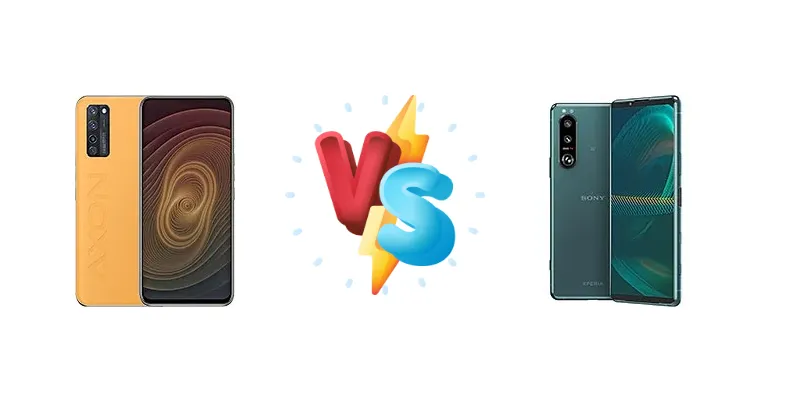
|
🏆 Quick Verdict
For the average user prioritizing value and a unique feature like the under-display camera, the ZTE Axon 20 5G Extreme is the more sensible choice. However, the Sony Xperia 5 III’s superior processing power and refined software experience justify its higher price tag for demanding users.
| PHONES | ||
|---|---|---|
| Phone Names | ZTE Axon 20 5G Extreme | Sony Xperia 5 III |
| Network | ||
|---|---|---|
| 2G bands | GSM 850 / 900 / 1800 / 1900 | GSM 850 / 900 / 1800 / 1900 |
| 3G bands | HSDPA 850 / 900 / 1700(AWS) / 1900 / 2100 | HSDPA 800 / 850 / 900 / 1700(AWS) / 1900 / 2100 |
| 4G bands | 1, 3, 4, 5, 7, 8, 12, 17, 20, 34, 38, 39, 40, 41 | 1, 2, 3, 4, 5, 7, 8, 12, 13, 17, 19, 20, 25, 26, 28, 29, 32, 34, 38, 39, 40, 41, 46, 48, 66, 71 - USA |
| 5G bands | 1, 3, 28, 41, 78, 79 SA/NSA | 1, 2, 3, 5, 7, 8, 20, 28, 38, 40, 41, 66, 71, 77, 78 SA/NSA/Sub6 - USA |
| Speed | HSPA, LTE, 5G | HSPA, LTE, 5G |
| Technology | GSM / CDMA / HSPA / LTE / 5G | GSM / HSPA / LTE / 5G |
| CDMA 800 | 1, 3, 5, 7, 8, 28, 38, 40, 41, 77, 78, 79 SA/NSA/Sub6 - Asia | |
| Launch | ||
|---|---|---|
| Announced | 2020, December 03. Released 2020, December 22 | 2021, April 14 |
| Status | Discontinued | Available. Released 2021, October 08 |
| Body | ||
|---|---|---|
| Build | Glass front, eco leather back, plastic frame | Glass front (Gorilla Glass 6), glass back (Gorilla Glass 6), aluminum frame |
| Dimensions | 172.1 x 77.9 x 8 mm (6.78 x 3.07 x 0.31 in) | 157 x 68 x 8.2 mm (6.18 x 2.68 x 0.32 in) |
| SIM | Nano-SIM + Nano-SIM | · Nano-SIM· Nano-SIM + Nano-SIM |
| Weight | 198 g (6.98 oz) | 168 g (5.93 oz) |
| - | IP65/IP68 dust/water resistant (up to 1.5m for 30 min) | |
| Display | ||
|---|---|---|
| Protection | - | Corning Gorilla Glass 6 |
| Resolution | 1080 x 2460 pixels (~388 ppi density) | 1080 x 2520 pixels, 21:9 ratio (~449 ppi density) |
| Size | 6.92 inches, 113.7 cm2 (~84.8% screen-to-body ratio) | 6.1 inches, 86.9 cm2 (~81.4% screen-to-body ratio) |
| Type | OLED, 1B colors, 90Hz | OLED, 1B colors, 120Hz, HDR BT.2020 |
| Always-on display | - | |
| Platform | ||
|---|---|---|
| CPU | Octa-core (1x2.4 GHz Kryo 475 Prime & 1x2.2 GHz Kryo 475 Gold & 6x1.8 GHz Kryo 475 Silver) | Octa-core (1x2.84 GHz Cortex-X1 & 3x2.42 GHz Cortex-A78 & 4x1.80 GHz Cortex-A55) |
| Chipset | Qualcomm SM7250 Snapdragon 765G 5G (7 nm) | Qualcomm SM8350 Snapdragon 888 5G (5 nm) |
| GPU | Adreno 620 | Adreno 660 |
| OS | Android 10, MiFavor 10.5 | Android 11, upgradable to Android 13 |
| Memory | ||
|---|---|---|
| Card slot | microSDXC (uses shared SIM slot) | microSDXC (uses shared SIM slot) |
| Internal | 256GB 12GB RAM | 128GB 8GB RAM, 256GB 8GB RAM |
| - | UFS 3.X | |
| Main Camera | ||
|---|---|---|
| Features | Dual-LED dual-tone flash, HDR, panorama | Zeiss optics, Zeiss T* lens coating, color spectrum sensor, LED flash, panorama, HDR, eye tracking |
| Quad | 64 MP, f/1.8, 25mm (wide), 1/1.72", 0.8µm, PDAF 8 MP, f/2.2, 120˚, 16mm (ultrawide) 2 MP (macro) Auxiliary lens | - |
| Single | - | 8 MP, f/2.0, 24mm (wide), 1/4", 1.12µm |
| Triple | - | 12 MP, f/1.7, 24mm (wide), 1/1.7", 1.8µm, dual pixel PDAF, OIS 12 MP, f/2.3, 70mm (telephoto), f/2.8, 105mm (telephoto), 1/2.9", dual pixel PDAF, 3x/4.4x optical zoom, OIS 12 MP, f/2.2, 124˚, 16mm (ultrawide), 1/2.6", dual pixel PDAF |
| Video | 4K@30/60fps, 1080p@30fps, gyro-EIS, HDR, 10‑bit video | 4K@24/25/30/60/120fps HDR, 1080p@30/60/120fps; 5-axis gyro-EIS, OIS |
| Selfie camera | ||
|---|---|---|
| Features | HDR | HDR |
| Single | 32 MP, f/2.0, (wide), under display | 8 MP, f/2.0, 24mm (wide), 1/4.0", 1.12µm |
| Video | 1080p@30fps | 1080p@30fps, 5-axis gyro-EIS |
| Sound | ||
|---|---|---|
| 3.5mm jack | No | Yes |
| 35mm jack | No | Yes |
| Loudspeaker | Yes | Yes, with stereo speakers |
| 24-bit/192kHz audio | 24-bit/192kHz audio Dynamic vibration system | |
| Comms | ||
|---|---|---|
| Bluetooth | 5.1, A2DP, LE | 5.2, A2DP, LE, aptX HD, aptX Adaptive |
| NFC | Yes | Yes |
| Positioning | GPS, GLONASS, GALILEO, BDS | GPS, GLONASS, BDS, GALILEO, QZSS |
| Radio | No | No |
| USB | USB Type-C 3.1, OTG | USB Type-C 3.1, OTG, video output |
| WLAN | Wi-Fi 802.11 a/b/g/n/ac, dual-band, Wi-Fi Direct | Wi-Fi 802.11 a/b/g/n/ac/6, dual-band, Wi-Fi Direct, DLNA |
| Features | ||
|---|---|---|
| Sensors | Fingerprint (under display, optical), accelerometer, gyro, proximity, compass | Fingerprint (side-mounted), accelerometer, gyro, proximity, barometer, compass |
| - | Native Sony Alpha camera support | |
| Battery | ||
|---|---|---|
| Charging | 30W wired, QC4, 60% in 30 min | Wired, PD, 50% in 30 min |
| Type | Li-Ion 4220 mAh | Li-Po 4500 mAh |
| Misc | ||
|---|---|---|
| Colors | Sunrise Yellow | Black, Green, Pink |
| Models | A2121 | XQBQ62/G, XQBQ52G.UKCX, XQBQ52B.UKCX, XQ-BQ52, XQ-BQ72, XQ-BQ42, XQ-BQ62, SO-53B |
| Price | About 440 EUR | € 431.90 / £ 199.99 |
| Tests | ||
|---|---|---|
| Battery life | - | Endurance rating 100h |
| Camera | - | Photo / Video |
| Display | - | Contrast ratio: Infinite (nominal) |
| Loudspeaker | - | -26.7 LUFS (Good) |
| Performance | - | AnTuTu: 708394 (v9) GeekBench: 3549 (v5.1) GFXBench: 53fps (ES 3.1 onscreen) |
ZTE Axon 20 5G Extreme
- Unique under-display camera technology
- More affordable price point
- Fast 30W charging with QC4 support
- Less powerful Snapdragon 765G chipset
- Potentially compromised front camera image quality
- Display uniformity may be affected by under-display camera
Sony Xperia 5 III
- Flagship Snapdragon 888 performance
- Bright and vibrant display
- Sony’s Alpha camera expertise and software optimizations
- Significantly higher price
- May experience thermal throttling under sustained load
- Slightly slower charging speed compared to Axon 20
Display Comparison
The Sony Xperia 5 III boasts a measured peak brightness of 590 nits, significantly brighter than what’s likely available on the Axon 20 5G Extreme (data unavailable, but typically lower in this price bracket). While both offer an 'infinite' contrast ratio, the Xperia 5 III’s display is likely to deliver a more vibrant and visible experience in direct sunlight. The Axon 20’s key differentiator is its under-display camera, sacrificing some display uniformity for a truly bezel-less front. The Xperia 5 III’s more traditional display offers a cleaner viewing experience, but lacks the novelty of the Axon 20’s implementation.
Camera Comparison
Both devices are advertised as capable photo and video devices, but the specifics differ. The Xperia 5 III benefits from Sony’s Alpha camera expertise, likely incorporating advanced image processing algorithms and potentially larger sensor sizes (data unavailable for both). The Axon 20’s under-display camera is a technological marvel, but image quality is inevitably compromised compared to a traditional front-facing camera. The Xperia 5 III’s rear camera system, while details are missing, will likely offer superior dynamic range, low-light performance, and video stabilization due to the more powerful ISP within the Snapdragon 888.
Performance
The core difference lies in the chipsets: the ZTE Axon 20 5G Extreme utilizes the Qualcomm SM7250 Snapdragon 765G (7nm), while the Sony Xperia 5 III is powered by the flagship Qualcomm SM8350 Snapdragon 888 (5nm). The 5nm process node of the 888 offers superior power efficiency and thermal performance compared to the 7nm 765G. The Xperia 5 III’s CPU, featuring a Cortex-X1 prime core, will demonstrably outperform the Axon 20’s Kryo 475 Prime in single-core tasks and overall responsiveness. While both phones likely utilize LPDDR4X RAM, the 888’s superior memory controller will further enhance the Xperia 5 III’s performance.
Battery Life
Both phones share a 100-hour endurance rating, suggesting similar real-world battery life despite the Xperia 5 III’s more power-hungry chipset. This is likely achieved through software optimizations and a relatively efficient display. However, charging speeds differ: the Axon 20 5G Extreme supports 30W QC4 charging, reaching 60% in 30 minutes, while the Xperia 5 III supports wired PD charging, achieving 50% in the same timeframe. While the difference isn’t massive, the Axon 20’s QC4 support may offer faster charging with compatible adapters.
Buying Guide
Buy the ZTE Axon 20 5G Extreme if you need a forward-thinking device with 5G and are intrigued by the under-display camera, all while staying within a tighter budget. Buy the Sony Xperia 5 III if you prioritize top-tier performance for gaming and content creation, demand a compact form factor, and value Sony’s dedicated camera features and software optimizations.