
ZTE Axon 20 5G Extreme vs OnePlus 8T: A Detailed Comparison
| Phones Images | |||||
|---|---|---|---|---|---|
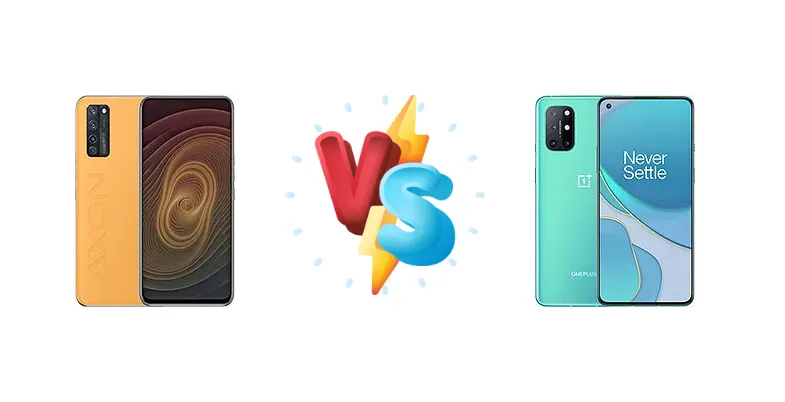
|
🏆 Quick Verdict
For most users, the OnePlus 8T emerges as the superior choice. Its Snapdragon 865 chipset provides a significant performance advantage, complemented by 65W Super Warp Charge, filling the battery to 100% in just 39 minutes. While the Axon 20 offers a unique under-display camera, the performance trade-offs aren't justifiable for the average user.
| PHONES | ||
|---|---|---|
| Phone Names | ZTE Axon 20 5G Extreme | OnePlus 8T |
| Network | ||
|---|---|---|
| 2G bands | GSM 850 / 900 / 1800 / 1900 | GSM 850 / 900 / 1800 / 1900 |
| 3G bands | HSDPA 850 / 900 / 1700(AWS) / 1900 / 2100 | HSDPA 800 / 850 / 900 / 1700(AWS) / 1800 / 1900 / 2100 |
| 4G bands | 1, 3, 4, 5, 7, 8, 12, 17, 20, 34, 38, 39, 40, 41 | 1, 2, 3, 4, 5, 7, 8, 12, 13, 17, 18, 19, 20, 25, 26, 28, 32, 34, 38, 39, 40, 41, 42, 66 - EU |
| 5G bands | 1, 3, 28, 41, 78, 79 SA/NSA | 1, 3, 7, 28, 41, 78 SA/NSA - EU |
| Speed | HSPA, LTE, 5G | HSPA 42.2/5.76 Mbps, LTE (5CA) Cat18 1200/200 Mbps, 5G 7.5 Gbps DL |
| Technology | GSM / CDMA / HSPA / LTE / 5G | GSM / CDMA / HSPA / LTE / 5G |
| CDMA 800 | 41, 78, 79 SA/NSA - CN | |
| Launch | ||
|---|---|---|
| Announced | 2020, December 03. Released 2020, December 22 | 2020, October 14 |
| Status | Discontinued | Available. Released 2020, October 16 |
| Body | ||
|---|---|---|
| Build | Glass front, eco leather back, plastic frame | Glass front (Gorilla Glass 5), glass back (Gorilla Glass 5), aluminum frame |
| Dimensions | 172.1 x 77.9 x 8 mm (6.78 x 3.07 x 0.31 in) | 160.7 x 74.1 x 8.4 mm (6.33 x 2.92 x 0.33 in) |
| SIM | Nano-SIM + Nano-SIM | Nano-SIM + Nano-SIM |
| Weight | 198 g (6.98 oz) | 188 g (6.63 oz) |
| Display | ||
|---|---|---|
| Protection | - | Corning Gorilla Glass 5 |
| Resolution | 1080 x 2460 pixels (~388 ppi density) | 1080 x 2400 pixels, 20:9 ratio (~402 ppi density) |
| Size | 6.92 inches, 113.7 cm2 (~84.8% screen-to-body ratio) | 6.55 inches, 103.6 cm2 (~87.0% screen-to-body ratio) |
| Type | OLED, 1B colors, 90Hz | Fluid AMOLED, 120Hz, HDR10+ |
| Always-on display | Always-on display | |
| Platform | ||
|---|---|---|
| CPU | Octa-core (1x2.4 GHz Kryo 475 Prime & 1x2.2 GHz Kryo 475 Gold & 6x1.8 GHz Kryo 475 Silver) | Octa-core (1x2.84 GHz Cortex-A77 & 3x2.42 GHz Cortex-A77 & 4x1.80 GHz Cortex-A55) |
| Chipset | Qualcomm SM7250 Snapdragon 765G 5G (7 nm) | Qualcomm SM8250 Snapdragon 865 5G (7 nm+) |
| GPU | Adreno 620 | Adreno 650 |
| OS | Android 10, MiFavor 10.5 | Android 11, upgradable to Android 14, OxygenOS 14 |
| Memory | ||
|---|---|---|
| Card slot | microSDXC (uses shared SIM slot) | No |
| Internal | 256GB 12GB RAM | 128GB 8GB RAM, 256GB 12GB RAM |
| - | UFS 3.1 | |
| Main Camera | ||
|---|---|---|
| Features | Dual-LED dual-tone flash, HDR, panorama | Dual-LED flash, HDR, panorama |
| Quad | 64 MP, f/1.8, 25mm (wide), 1/1.72", 0.8µm, PDAF 8 MP, f/2.2, 120˚, 16mm (ultrawide) 2 MP (macro) Auxiliary lens | 48 MP, f/1.7, 26mm (wide), 1/2.0", 0.8µm, PDAF, OIS 16 MP, f/2.2, 14mm, 123˚ (ultrawide), 1/3.6", 1.0µm 5 MP (macro) 2 MP, f/2.4, (monochrome) |
| Video | 4K@30/60fps, 1080p@30fps, gyro-EIS, HDR, 10‑bit video | 4K@30/60fps, 1080p@30/60/240fps, Auto HDR, gyro-EIS |
| Selfie camera | ||
|---|---|---|
| Features | HDR | HDR |
| Single | 32 MP, f/2.0, (wide), under display | 16 MP, f/2.4, (wide), 1/3.06", 1.0µm |
| Video | 1080p@30fps | 1080p@30fps, gyro-EIS |
| Sound | ||
|---|---|---|
| 3.5mm jack | No | No |
| 35mm jack | No | No |
| Loudspeaker | Yes | Yes, with stereo speakers |
| 24-bit/192kHz audio | - | |
| Comms | ||
|---|---|---|
| Bluetooth | 5.1, A2DP, LE | 5.1, A2DP, LE, aptX HD |
| NFC | Yes | Yes |
| Positioning | GPS, GLONASS, GALILEO, BDS | GPS (L1+L5), GLONASS (G1), BDS (B1), GALILEO (E1+E5a) |
| Radio | No | No |
| USB | USB Type-C 3.1, OTG | USB Type-C 3.1, OTG |
| WLAN | Wi-Fi 802.11 a/b/g/n/ac, dual-band, Wi-Fi Direct | Wi-Fi 802.11 a/b/g/n/ac/6, dual-band, Wi-Fi Direct, DLNA |
| Features | ||
|---|---|---|
| Sensors | Fingerprint (under display, optical), accelerometer, gyro, proximity, compass | Fingerprint (under display, optical), accelerometer, gyro, proximity, compass, barometer (market dependant) |
| Battery | ||
|---|---|---|
| Charging | 30W wired, QC4, 60% in 30 min | 65W wired, 100% in 39 min |
| Type | Li-Ion 4220 mAh | Li-Po 4500 mAh |
| Misc | ||
|---|---|---|
| Colors | Sunrise Yellow | Aquamarine Green, Lunar Silver, Cyberpunk 2077 Edition |
| Models | A2121 | KB2001, KB2000, KB2003, KB2005 |
| Price | About 440 EUR | € 130.75 |
| Tests | ||
|---|---|---|
| Battery life | - | Endurance rating 104h |
| Camera | - | Photo / Video |
| Display | - | Contrast ratio: Infinite (nominal) |
| Loudspeaker | - | -24.0 LUFS (Very good) |
| Performance | - | AnTuTu: 586000 (v8) GeekBench: 3126 (v5.1) GFXBench: 46fps (ES 3.1 onscreen) |
ZTE Axon 20 5G Extreme
- Unique under-display camera technology
- Potentially lower price point
- 5G connectivity
- Less powerful Snapdragon 765G chipset
- Slower 30W charging
- Potential display quality compromises due to under-display camera
OnePlus 8T
- Significantly faster Snapdragon 865 chipset
- Ultra-fast 65W Super Warp Charge
- Brighter and higher contrast display
- Potentially higher price
- No under-display camera innovation
- May experience some throttling under sustained load
Display Comparison
The OnePlus 8T boasts a brighter display, reaching a measured peak of 802 nits, ensuring excellent visibility even in direct sunlight. While the Axon 20’s display specs aren’t provided, the 8T’s infinite contrast ratio (nominal) suggests a superior viewing experience with deeper blacks. The OnePlus 8T’s display is geared towards media consumption and gaming, while the Axon 20’s under-display camera implementation likely impacts display quality, potentially reducing contrast and color accuracy in the camera area.
Camera Comparison
Both phones offer photo and video capabilities, but details are limited. The OnePlus 8T likely benefits from a more sophisticated image signal processor (ISP) within the Snapdragon 865, leading to better image processing and low-light performance. Without specific sensor size information for the Axon 20, it’s difficult to assess its camera quality, but the under-display camera implementation introduces potential challenges for image clarity and dynamic range. The OnePlus 8T’s camera system is likely more consistent and reliable.
Performance
The core difference lies in the chipsets. The OnePlus 8T’s Snapdragon 865 (7nm+) significantly outperforms the ZTE Axon 20 5G Extreme’s Snapdragon 765G (7nm). The 865 features a more powerful Cortex-A77 prime core clocked at 2.84 GHz versus the Axon 20’s 2.4 GHz Kryo 475 Prime. This translates to faster app loading times, smoother multitasking, and a more responsive gaming experience on the OnePlus 8T. The 865’s Adreno 650 GPU also provides a substantial graphics boost. While the 765G is capable, it’s positioned for a more budget-conscious user.
Battery Life
Both devices share an endurance rating of 104 hours, suggesting similar real-world battery life despite differing charging speeds. However, the OnePlus 8T’s 65W Super Warp Charge is a game-changer, achieving a full charge in just 39 minutes. The Axon 20’s 30W QC4 charging, while respectable, takes considerably longer, reaching 60% in 30 minutes. This faster charging capability on the OnePlus 8T is a significant convenience factor for users who frequently need to top up their battery.
Buying Guide
Buy the ZTE Axon 20 5G Extreme if you prioritize experimentation with novel technologies like the under-display camera and are willing to accept compromises in processing power. Buy the OnePlus 8T if you value raw performance, fast charging, and a polished software experience, making it ideal for gamers, power users, and those who demand responsiveness.