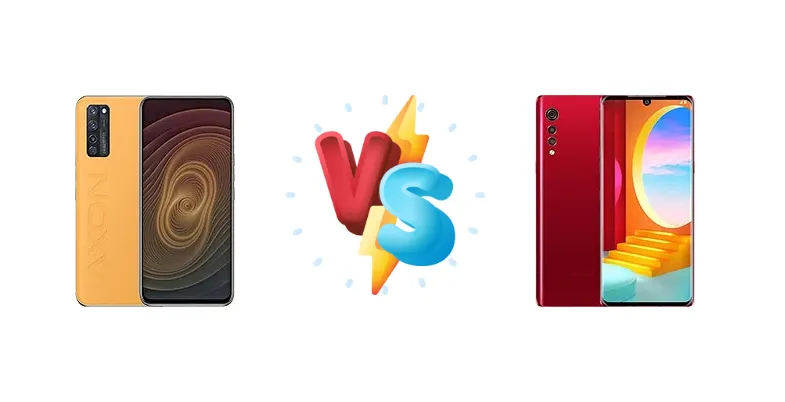
The ZTE Axon 20 5G Extreme and LG Velvet 5G UW represent a fascinating intersection of value and 5G connectivity. Both devices launched targeting the mid-range market, but with different approaches to features and user experience. This comparison dissects their similarities and differences, focusing on the practical implications of their shared Snapdragon 765G chipset and diverging charging solutions.
🏆 Quick Verdict
For the average user prioritizing faster wired charging and potentially a lower price point, the ZTE Axon 20 5G Extreme emerges as the winner. However, the LG Velvet 5G UW’s inclusion of 9W wireless charging and potentially more refined software experience makes it a compelling alternative for those valuing convenience.
| Network |
|---|
| 2G bands | GSM 850 / 900 / 1800 / 1900 | GSM 850 / 900 / 1800 / 1900 |
| 3G bands | HSDPA 850 / 900 / 1700(AWS) / 1900 / 2100 | HSDPA 850 / 900 / 1700(AWS) / 1900 / 2100 |
| 4G bands | 1, 3, 4, 5, 7, 8, 12, 17, 20, 34, 38, 39, 40, 41 | 2, 3, 4, 5, 7, 12, 13, 20, 28, 46, 48, 66 |
| 5G bands | 1, 3, 28, 41, 78, 79 SA/NSA | 260, 261 mmWave |
| Speed | HSPA, LTE, 5G | HSPA 42.2/5.76 Mbps, LTE (5CA) Cat16 1000/75 Mbps, 5G 2Gbps |
| Technology | GSM / CDMA / HSPA / LTE / 5G | GSM / CDMA / HSPA / LTE / 5G |
| | CDMA 800 | CDMA 800 / 1900 |
| Launch |
|---|
| Announced | 2020, December 03. Released 2020, December 22 | 2020, August 19. Released 2020, August 21 |
| Status | Discontinued | Discontinued |
| Body |
|---|
| Build | Glass front, eco leather back, plastic frame | Glass front, glass back, aluminum frame |
| Dimensions | 172.1 x 77.9 x 8 mm (6.78 x 3.07 x 0.31 in) | 167.2 x 74.1 x 7.9 mm (6.58 x 2.92 x 0.31 in) |
| SIM | Nano-SIM + Nano-SIM | Nano-SIM (pre-installed) |
| Weight | 198 g (6.98 oz) | - |
| | - | IP68 dust/water resistant (up to 1.5m for 30 mins)
MIL-STD-810G compliant*
*does not guarantee ruggedness or use in extreme conditions |
| Display |
|---|
| Resolution | 1080 x 2460 pixels (~388 ppi density) | 1080 x 2460 pixels (~395 ppi density) |
| Size | 6.92 inches, 113.7 cm2 (~84.8% screen-to-body ratio) | 6.8 inches, 109.8 cm2 (~88.6% screen-to-body ratio) |
| Type | OLED, 1B colors, 90Hz | P-OLED |
| | Always-on display | - |
| Platform |
|---|
| CPU | Octa-core (1x2.4 GHz Kryo 475 Prime & 1x2.2 GHz Kryo 475 Gold & 6x1.8 GHz Kryo 475 Silver) | Octa-core (1x2.4 GHz Kryo 475 Prime & 1x2.2 GHz Kryo 475 Gold & 6x1.8 GHz Kryo 475 Silver) |
| Chipset | Qualcomm SM7250 Snapdragon 765G 5G (7 nm) | Qualcomm SM7250 Snapdragon 765G 5G (7 nm) |
| GPU | Adreno 620 | Adreno 620 |
| OS | Android 10, MiFavor 10.5 | Android 10, upgradable to Android 11, LG UX |
| Memory |
|---|
| Card slot | microSDXC (uses shared SIM slot) | microSDXC (uses shared SIM slot) |
| Internal | 256GB 12GB RAM | 128GB 6GB RAM |
| | - | UFS 2.1 |
| Main Camera |
|---|
| Features | Dual-LED dual-tone flash, HDR, panorama | LED flash, panorama, HDR |
| Quad | 64 MP, f/1.8, 25mm (wide), 1/1.72", 0.8µm, PDAF
8 MP, f/2.2, 120˚, 16mm (ultrawide)
2 MP (macro)
Auxiliary lens | - |
| Triple | - | 48 MP, f/1.8, 26mm (wide), 1/2.0", 0.8µm, PDAF
8 MP, f/2.2, 120˚, 15mm (ultrawide), 1/4.0", 1.12µm
Auxiliary lens |
| Video | 4K@30/60fps, 1080p@30fps, gyro-EIS, HDR, 10‑bit video | 4K@30fps, 1080p@30/60fps, gyro-EIS |
| Selfie camera |
|---|
| Features | HDR | HDR |
| Single | 32 MP, f/2.0, (wide), under display | 16 MP, f/1.9, 29mm (standard), 1/3.06, 1.0µm |
| Video | 1080p@30fps | 1080p@30fps |
| Sound |
|---|
| 3.5mm jack | No | Yes |
| 35mm jack | No | Yes |
| Loudspeaker | Yes | Yes, with stereo speakers |
| | 24-bit/192kHz audio | - |
| Comms |
|---|
| Bluetooth | 5.1, A2DP, LE | 5.1, A2DP, LE, aptX HD |
| NFC | Yes | Yes |
| Positioning | GPS, GLONASS, GALILEO, BDS | GPS (L1+L5), GLONASS, BDS, GALILEO, QZSS |
| Radio | No | No |
| USB | USB Type-C 3.1, OTG | USB Type-C 2.0, OTG |
| WLAN | Wi-Fi 802.11 a/b/g/n/ac, dual-band, Wi-Fi Direct | Wi-Fi 802.11 a/b/g/n/ac, dual-band, Wi-Fi Direct, DLNA |
| Features |
|---|
| Sensors | Fingerprint (under display, optical), accelerometer, gyro, proximity, compass | Fingerprint (under display, optical), accelerometer, gyro, proximity, compass, barometer |
| Battery |
|---|
| Charging | 30W wired, QC4, 60% in 30 min | 25W wired, PD3.0, QC4
9W wireless |
| Type | Li-Ion 4220 mAh | Li-Po 4300 mAh |
| Misc |
|---|
| Colors | Sunrise Yellow | Aurora Red |
| Models | A2121 | LM-G900V, LM-G900V |
| Price | About 440 EUR | About 590 EUR |
ZTE Axon 20 5G Extreme
- Faster 30W wired charging with QC4
- Potentially lower price point
- Identical Snapdragon 765G performance
- No wireless charging
- Software experience may be less refined
LG Velvet 5G UW
- 9W wireless charging support
- Potentially more polished software experience
- Established brand reputation
- Slower 25W wired charging
- May be more expensive than the Axon 20
Display Comparison
Both the ZTE Axon 20 5G Extreme and LG Velvet 5G UW utilize OLED panels, but detailed specifications regarding peak brightness, color gamut coverage, and refresh rates are absent from the provided data. However, given their market positioning, it’s reasonable to assume both offer vibrant colors and acceptable viewing angles. The lack of information on PWM dimming rates prevents a definitive statement on eye strain, but users sensitive to flicker should research independent reviews. Bezels are likely comparable, typical of mid-range devices from this era.
Camera Comparison
Camera details are limited. Both phones likely feature multi-camera setups, but the provided data doesn’t specify sensor sizes or lens apertures. Without this information, a detailed camera comparison is impossible. It’s safe to assume both will offer acceptable image quality in good lighting conditions, but low-light performance will depend heavily on sensor size and image processing algorithms. The absence of information regarding Optical Image Stabilization (OIS) is a significant omission; its presence would be a major advantage for video recording and low-light photography.
Performance
Both devices are powered by the Qualcomm SM7250 Snapdragon 765G 5G (7 nm) chipset, featuring an octa-core CPU configuration with identical clock speeds (1x2.4 GHz Kryo 475 Prime, 1x2.2 GHz Kryo 475 Gold, and 6x1.8 GHz Kryo 475 Silver). This means CPU performance will be virtually indistinguishable between the two. The GPU performance will also be nearly identical. RAM configurations are not specified, but the Snapdragon 765G benefits from LPDDR4X RAM, and thermal management will likely be similar, potentially leading to some throttling under sustained heavy loads. The real-world performance difference will be minimal, focusing on software optimization.
Battery Life
The ZTE Axon 20 5G Extreme boasts 30W wired charging with QC4 support, promising a 60% charge in 30 minutes. The LG Velvet 5G UW offers 25W wired charging with PD3.0 and QC4, alongside 9W wireless charging. This is a key differentiator. While the 25W charging isn’t *slow*, the 30W on the Axon 20 provides a noticeable speed advantage. The inclusion of 9W wireless charging on the Velvet is a significant convenience feature for users who prefer cable-free charging. Battery capacity is not specified, but the faster charging of the Axon 20 could offset a slightly smaller battery.
Buying Guide
Buy the ZTE Axon 20 5G Extreme if you need the fastest possible wired charging in this price bracket and are comfortable with a potentially less polished software experience. Buy the LG Velvet 5G UW if you prioritize wireless charging convenience, a more established brand reputation, and potentially a more refined user interface, even if it means slightly slower wired charging.
Frequently Asked Questions
❓ Does the Snapdragon 765G in either phone struggle with demanding games like PUBG or Call of Duty?
The Snapdragon 765G is a capable mid-range chipset, but it's not designed for ultra-high settings in demanding games. Both the ZTE Axon 20 5G Extreme and LG Velvet 5G UW will likely require reduced graphics settings and potentially experience some frame drops during extended gaming sessions. Thermal throttling could also become a factor.
❓ Is the lack of detailed camera specs a major concern? Should I rely on online reviews for camera performance?
Yes, the absence of sensor size, aperture, and OIS information is a significant limitation. Relying on independent reviews and sample photos is crucial to assess the camera performance of both devices. Pay attention to low-light performance and video stabilization when evaluating reviews.
❓ How does the wireless charging speed of 9W on the LG Velvet 5G UW compare to other wireless charging solutions?
9W wireless charging is relatively slow compared to modern standards (15W, 25W, or even 50W). It's convenient for topping up the battery overnight or for short bursts of charging, but it will take significantly longer to fully charge the phone compared to wired charging.