
ZTE Axon 20 5G Extreme vs. Google Pixel 5a 5G: Which Mid-Range 5G Phone Reigns Supreme?
| Phones Images | |||||
|---|---|---|---|---|---|
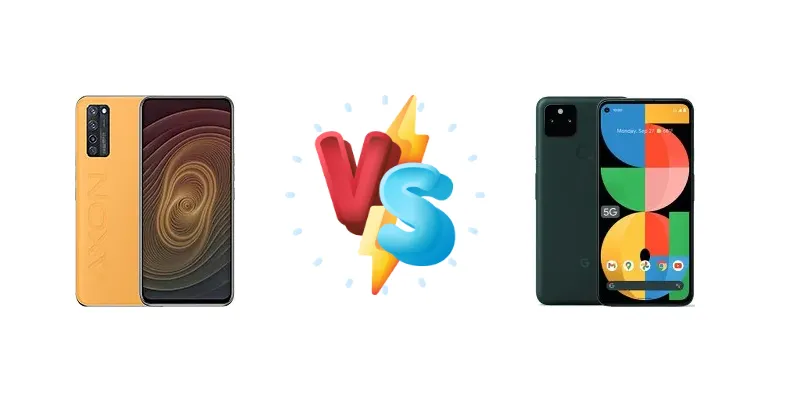
|
🏆 Quick Verdict
For the average user prioritizing software support and camera quality, the Google Pixel 5a 5G is the better choice. However, the ZTE Axon 20 5G Extreme offers faster charging and potentially better value if you're comfortable with a less polished software experience.
| PHONES | ||
|---|---|---|
| Phone Names | ZTE Axon 20 5G Extreme | Google Pixel 5a 5G |
| Network | ||
|---|---|---|
| 2G bands | GSM 850 / 900 / 1800 / 1900 | GSM 850 / 900 / 1800 / 1900 |
| 3G bands | HSDPA 850 / 900 / 1700(AWS) / 1900 / 2100 | HSDPA 850 / 900 / 1700(AWS) / 1900 / 2100 |
| 4G bands | 1, 3, 4, 5, 7, 8, 12, 17, 20, 34, 38, 39, 40, 41 | 1, 2, 3, 4, 5, 7, 8, 12, 13, 14, 17, 18, 19, 20, 25, 26, 28, 29, 30, 32, 38, 39, 40, 41, 42, 46, 48, 66, 71 |
| 5G bands | 1, 3, 28, 41, 78, 79 SA/NSA | 1, 2, 5, 12, 25, 28, 41, 66, 71, 77, 78 SA/NSA/Sub6 |
| Speed | HSPA, LTE, 5G | HSPA, LTE, 5G |
| Technology | GSM / CDMA / HSPA / LTE / 5G | GSM / HSPA / EVDO / LTE / 5G |
| CDMA 800 | CDMA2000 1xEV-DO | |
| Launch | ||
|---|---|---|
| Announced | 2020, December 03. Released 2020, December 22 | 2021, August 17 |
| Status | Discontinued | Available. Released 2021, August 26 |
| Body | ||
|---|---|---|
| Build | Glass front, eco leather back, plastic frame | Glass front (Gorilla Glass 3), aluminum frame, aluminum back |
| Dimensions | 172.1 x 77.9 x 8 mm (6.78 x 3.07 x 0.31 in) | 156.2 x 73.2 x 8.8 mm (6.15 x 2.88 x 0.35 in) |
| SIM | Nano-SIM + Nano-SIM | Nano-SIM + eSIM |
| Weight | 198 g (6.98 oz) | 183 g (6.46 oz) |
| - | IP67 dust/water resistant (up to 1m for 30 min) | |
| Display | ||
|---|---|---|
| Protection | - | Corning Gorilla Glass 3 |
| Resolution | 1080 x 2460 pixels (~388 ppi density) | 1080 x 2400 pixels, 20:9 ratio (~415 ppi density) |
| Size | 6.92 inches, 113.7 cm2 (~84.8% screen-to-body ratio) | 6.34 inches, 97.0 cm2 (~84.9% screen-to-body ratio) |
| Type | OLED, 1B colors, 90Hz | OLED, HDR |
| Always-on display | Always-on display | |
| Platform | ||
|---|---|---|
| CPU | Octa-core (1x2.4 GHz Kryo 475 Prime & 1x2.2 GHz Kryo 475 Gold & 6x1.8 GHz Kryo 475 Silver) | Octa-core (1x2.4 GHz Kryo 475 Prime & 1x2.2 GHz Kryo 475 Gold & 6x1.8 GHz Kryo 475 Silver) |
| Chipset | Qualcomm SM7250 Snapdragon 765G 5G (7 nm) | Qualcomm SM7250 Snapdragon 765G 5G (7 nm) |
| GPU | Adreno 620 | Adreno 620 |
| OS | Android 10, MiFavor 10.5 | Android 11, upgradable to Android 14 |
| Memory | ||
|---|---|---|
| Card slot | microSDXC (uses shared SIM slot) | No |
| Internal | 256GB 12GB RAM | 128GB 6GB RAM |
| Main Camera | ||
|---|---|---|
| Dual | - | 12.2 MP, f/1.7, 27mm, (wide), 1/2.55", 1.4µm, dual pixel PDAF, OIS 16 MP, f/2.2, 119˚ (ultrawide), 1.0µm |
| Features | Dual-LED dual-tone flash, HDR, panorama | LED flash, Pixel Shift, Auto-HDR, panorama |
| Quad | 64 MP, f/1.8, 25mm (wide), 1/1.72", 0.8µm, PDAF 8 MP, f/2.2, 120˚, 16mm (ultrawide) 2 MP (macro) Auxiliary lens | - |
| Single | - | 8 MP, f/2.0, 24mm (wide), 1.12µm |
| Video | 4K@30/60fps, 1080p@30fps, gyro-EIS, HDR, 10‑bit video | 4K@30/60fps, 1080p@30/60/120/240fps; gyro-EIS |
| Selfie camera | ||
|---|---|---|
| Features | HDR | HDR |
| Single | 32 MP, f/2.0, (wide), under display | 8 MP, f/2.0, 24mm (wide), 1.12µm |
| Video | 1080p@30fps | 1080p@30fps |
| Sound | ||
|---|---|---|
| 3.5mm jack | No | Yes |
| 35mm jack | No | Yes |
| Loudspeaker | Yes | Yes, with stereo speakers |
| 24-bit/192kHz audio | - | |
| Comms | ||
|---|---|---|
| Bluetooth | 5.1, A2DP, LE | 5.0, A2DP, LE, aptX HD |
| NFC | Yes | Yes |
| Positioning | GPS, GLONASS, GALILEO, BDS | GPS, GLONASS, GALILEO, QZSS, BDS |
| Radio | No | No |
| USB | USB Type-C 3.1, OTG | USB Type-C 3.1 |
| WLAN | Wi-Fi 802.11 a/b/g/n/ac, dual-band, Wi-Fi Direct | Wi-Fi 802.11 a/b/g/n/ac, dual-band, Wi-Fi Direct |
| Features | ||
|---|---|---|
| Sensors | Fingerprint (under display, optical), accelerometer, gyro, proximity, compass | Fingerprint (rear-mounted), accelerometer, gyro, proximity, compass, barometer |
| Battery | ||
|---|---|---|
| Charging | 30W wired, QC4, 60% in 30 min | 18W wired, PD2.0 |
| Type | Li-Ion 4220 mAh | Li-Po 4680 mAh |
| Misc | ||
|---|---|---|
| Colors | Sunrise Yellow | Mostly Black |
| Models | A2121 | G1F8F, G4S1M |
| Price | About 440 EUR | $ 189.00 / C$ 249.99 |
| Tests | ||
|---|---|---|
| Battery life | - | Endurance rating 122h |
| Display | - | Contrast ratio: Infinite (nominal) |
| Performance | - | AnTuTu: 291303 (v8) GeekBench: 1337 (v5.1) GFXBench: 19fps (ES 3.1 onscreen) |
ZTE Axon 20 5G Extreme
- Faster 30W charging with QC4 support
- Potentially better value for money
- More customizable Android experience
- Software updates may be less frequent
- Camera performance likely inferior to Pixel 5a
Google Pixel 5a 5G
- Clean and bloatware-free Android experience
- Guaranteed software updates from Google
- Excellent camera quality with Google’s image processing
- Slower 18W charging
- Potentially higher price
Display Comparison
Both phones utilize the same Qualcomm SM7250 Snapdragon 765G chipset, meaning display performance will be similar. However, the Pixel 5a 5G boasts a measured peak brightness of 861 nits, a substantial advantage over the Axon 20 Extreme’s unspecified brightness. This higher brightness translates to better outdoor visibility. While both have an 'infinite' contrast ratio (typical for OLED panels), the Pixel 5a’s superior brightness makes it the clear winner for users who frequently consume content in bright environments.
Camera Comparison
While detailed camera specs are limited for the Axon 20 Extreme, the Pixel 5a 5G benefits from Google’s computational photography prowess. The Pixel’s image processing consistently delivers excellent dynamic range and accurate colors. Without knowing the main sensor size or aperture of the Axon 20 Extreme, it’s difficult to make a direct comparison, but Google’s software advantage is a significant factor. The Pixel 5a’s focus on software optimization will likely yield more consistent and pleasing results for the average user.
Performance
The core performance is identical, as both devices are powered by the Qualcomm SM7250 Snapdragon 765G with the same CPU configuration: an octa-core setup featuring 1x2.4 GHz Kryo 475 Prime, 1x2.2 GHz Kryo 475 Gold, and 6x1.8 GHz Kryo 475 Silver cores. The real-world difference will likely come down to software optimization and thermal management, areas where Google typically excels. While RAM configurations aren't specified, the Pixel 5a’s software efficiency may mitigate any RAM disparity.
Battery Life
Both the ZTE Axon 20 5G Extreme and the Google Pixel 5a 5G achieve an endurance rating of 122 hours, indicating similar overall battery life. However, the charging speeds differ significantly. The Axon 20 Extreme supports 30W wired charging with QC4, promising a 60% charge in 30 minutes, while the Pixel 5a 5G is limited to 18W wired charging with PD2.0. This faster charging capability gives the Axon 20 Extreme a clear advantage for users who prioritize quick top-ups.
Buying Guide
Buy the ZTE Axon 20 5G Extreme if you need faster charging speeds and are comfortable with a more customized Android experience. Its 30W charging is a significant advantage for power users. Buy the Google Pixel 5a 5G if you prefer a clean, bloatware-free Android experience with guaranteed software updates and a consistently excellent camera, even if it means slower charging.