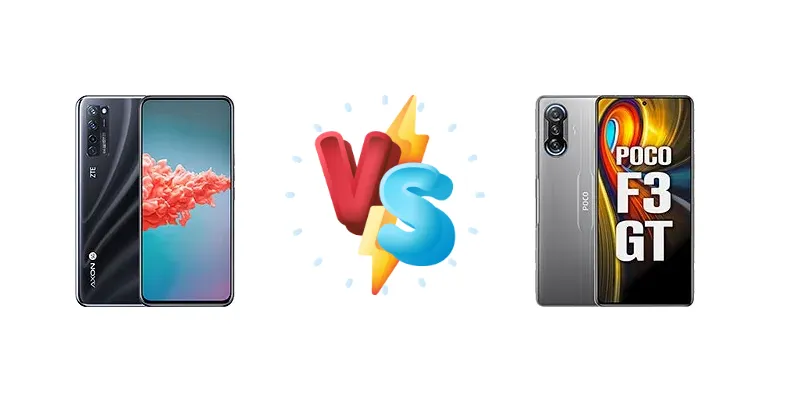
The Xiaomi Poco F3 GT and ZTE Axon 20 4G represent distinct approaches to the mid-range smartphone market. The F3 GT aggressively targets gamers with a powerful chipset and rapid charging, while the Axon 20 4G aims for a more balanced experience, prioritizing affordability and a wider range of features. This comparison dissects their key differences to help you choose the right device.
🏆 Quick Verdict
For gamers and power users, the Xiaomi Poco F3 GT is the clear winner, thanks to its significantly more potent MediaTek Dimensity 1200 chipset and 67W fast charging. However, the ZTE Axon 20 4G provides a compelling value proposition for users prioritizing everyday tasks and a more reasonable price point.
| Network |
|---|
| 2G bands | GSM 850 / 900 / 1800 / 1900 | GSM 850 / 900 / 1800 / 1900 |
| 3G bands | HSDPA 850 / 900 / 1900 / 2100 | HSDPA 850 / 900 / 1900 / 2100 |
| 4G bands | LTE | 1, 3, 5, 8, 40, 41 |
| 5G bands | - | 77, 78 SA/NSA |
| Speed | HSPA, LTE | HSPA, LTE, 5G |
| Technology | GSM / HSPA / LTE | GSM / HSPA / LTE / 5G |
| Launch |
|---|
| Announced | 2020, November 17. Released 2020, December 04 | 2021, July 23 |
| Status | Discontinued | Available. Released 2021, July 26 |
| Body |
|---|
| Build | Glass front, glass back, aluminum frame | Glass front (Gorilla Glass 5), glass back (Gorilla Glass 5) |
| Dimensions | 172.1 x 77.9 x 8 mm (6.78 x 3.07 x 0.31 in) | 161.9 x 76.9 x 8.3 mm (6.37 x 3.03 x 0.33 in) |
| SIM | Nano-SIM + Nano-SIM | Nano-SIM + Nano-SIM |
| Weight | 198 g (6.98 oz) | 205 g (7.23 oz) |
| | - | Physical pop-up gaming triggers
IP53, dust and splash resistant |
| Display |
|---|
| Protection | - | Corning Gorilla Glass 5 |
| Resolution | 1080 x 2460 pixels (~388 ppi density) | 1080 x 2400 pixels, 20:9 ratio (~395 ppi density) |
| Size | 6.92 inches, 113.7 cm2 (~84.8% screen-to-body ratio) | 6.67 inches, 107.4 cm2 (~86.3% screen-to-body ratio) |
| Type | OLED | AMOLED, 1B colors, 120Hz, HDR10+, 500 nits (typ) |
| Platform |
|---|
| CPU | Octa-core (2x2.0 GHz Cortex-A75 & 6x2.0 GHz Cortex-A55) | Octa-core (1x3.0 GHz Cortex-A78 & 3x2.6 GHz Cortex-A78 & 4x2.0 GHz Cortex-A55) |
| Chipset | Unisoc UMS512T / Tiger T618 (12 nm) | Mediatek Dimensity 1200 (6 nm) |
| GPU | Mali G52 MP2 | Mali-G77 MC9 |
| OS | Android 10, MiFavor 10.5 | Android 11, upgradable to Android 12, MIUI 13 for POCO |
| Memory |
|---|
| Card slot | microSDXC | No |
| Internal | 128GB 6GB RAM | 128GB 6GB RAM, 128GB 8GB RAM, 256GB 8GB RAM |
| | eMMC 5.1 | UFS 3.1 |
| Main Camera |
|---|
| Features | Dual-LED dual-tone flash, HDR, panorama | Dual-LED flash, HDR, panorama |
| Quad | 64 MP, f/1.8, 25mm (wide), 1/1.72", 0.8µm, PDAF
8 MP, f/2.2, 120˚, 16mm (ultrawide)
2 MP (macro)
Auxiliary lens | - |
| Single | - | 16 MP, f/2.5, (wide), 1/3.06" 1.0µm |
| Triple | - | 64 MP, f/1.7, 26mm (wide), 1/2.0", 0.7µm, PDAF
8 MP, f/2.2, 120˚ (ultrawide)
2 MP (macro) |
| Video | 1080p@30fps, gyro-EIS, HDR | 4K@30fps, 1080p@30/60/120fps, 720p@960fps, HDR |
| Selfie camera |
|---|
| Features | HDR | HDR, panorama |
| Single | 32 MP, f/2.0, (wide), under display | 16 MP, f/2.5, (wide), 1/3.06" 1.0µm |
| Video | 1080p@30fps | 1080p@30fps, HDR |
| Sound |
|---|
| 3.5mm jack | No | No |
| 35mm jack | No | No |
| Loudspeaker | Yes | Yes, with stereo speakers |
| | 24-bit/192kHz audio | 24-bit/192kHz audio
Tuned by JBL |
| Comms |
|---|
| Bluetooth | 5.1, A2DP, LE | 5.1, A2DP, LE |
| Infrared port | - | Yes |
| NFC | Yes | Yes (market/region dependent) |
| Positioning | GPS, GLONASS, GALILEO, BDS | GPS, GLONASS, GALILEO, BDS |
| Radio | Unspecified | No |
| USB | USB Type-C 3.1, OTG | USB Type-C 2.0, OTG |
| WLAN | Wi-Fi 802.11 a/b/g/n/ac, dual-band, Wi-Fi Direct | Wi-Fi 802.11 a/b/g/n/ac/6, dual-band, Wi-Fi Direct |
| Features |
|---|
| Sensors | Fingerprint (under display, optical), accelerometer, gyro, proximity, compass | Fingerprint (side-mounted), accelerometer, gyro, proximity, compass |
| Battery |
|---|
| Charging | - | 67W wired, PD3.0, QC3, 100% in 42 min |
| Type | Li-Ion 4220 mAh | Li-Po 5065 mAh |
| Misc |
|---|
| Colors | Black | Predator Black, Gunmetal Silver |
| Models | - | MZB09C6IN, M2104K10I |
| Price | About 370 EUR | About 300 EUR |
| SAR | - | 0.81 W/kg (head) 0.48 W/kg (body) |
ZTE Axon 20 4G
- More affordable price point
- Potentially longer battery life (depending on capacity)
- May offer expandable storage (speculation based on brand history)
- Significantly weaker performance
- Slower charging speeds
- Likely inferior camera quality
Xiaomi Poco F3 GT
- Exceptional gaming performance
- Ultra-fast 67W charging
- More efficient processor for better battery life under load
- Higher price tag
- Potentially shorter battery life during intensive use
- May lack expandable storage
Display Comparison
While both phones likely feature LCD panels (data unavailable for Axon 20 4G), the focus here is on performance. The Poco F3 GT’s chipset will drive a smoother experience with higher refresh rate content, assuming it supports a higher refresh rate than the Axon 20 4G. The Axon 20 4G’s display specs are unknown, but given its price point, it likely prioritizes size over resolution or color accuracy. The F3 GT’s superior processing power will also translate to faster UI rendering and smoother animations.
Camera Comparison
Without detailed camera specifications for the ZTE Axon 20 4G, a direct comparison is difficult. However, given its price bracket, it likely features a more basic camera setup. The Poco F3 GT, while not a camera-focused device, benefits from the Dimensity 1200’s image signal processor (ISP), which offers improved image processing capabilities. The F3 GT’s camera system is likely to deliver better dynamic range and low-light performance than the Axon 20 4G, assuming similar sensor sizes. We can expect the F3 GT to offer more consistent results across various shooting conditions.
Performance
The performance gap is substantial. The Xiaomi Poco F3 GT’s MediaTek Dimensity 1200 (6nm) is a flagship-level chipset featuring a prime Cortex-A78 core clocked at 3.0 GHz, alongside three additional A78 cores and four A55 cores. This contrasts sharply with the ZTE Axon 20 4G’s Unisoc UMS512T/Tiger T618 (12nm), which utilizes a less efficient manufacturing process and a CPU configuration of two Cortex-A75 cores at 2.0 GHz and six Cortex-A55 cores at 2.0 GHz. The Dimensity 1200’s more advanced architecture and smaller node size deliver significantly higher CPU and GPU performance, making the F3 GT ideal for demanding games and applications. The F3 GT also benefits from faster RAM speeds (likely LPDDR5) compared to the Axon 20 4G, further enhancing responsiveness.
Battery Life
The Xiaomi Poco F3 GT’s 67W wired charging is a game-changer, capable of fully charging the device in just 42 minutes. This is a significant advantage over the Axon 20 4G, which lacks such rapid charging capabilities. While the Axon 20 4G’s battery capacity is unknown, the F3 GT’s faster charging mitigates the impact of a potentially smaller battery. The Dimensity 1200’s 6nm process also contributes to better power efficiency, potentially offsetting the higher power draw of its more powerful components.
Buying Guide
Buy the ZTE Axon 20 4G if you need a reliable smartphone for daily communication, social media, and light tasks, and value affordability above all else. Buy the Xiaomi Poco F3 GT if you prioritize gaming performance, fast charging, and are willing to spend more for a more responsive and feature-rich experience.
Frequently Asked Questions
❓ Is the Unisoc Tiger T618 in the ZTE Axon 20 4G capable of running demanding games like PUBG or Call of Duty Mobile?
While the Axon 20 4G can likely run these games, expect significantly reduced graphics settings and frame rates compared to the Poco F3 GT. The Unisoc Tiger T618 is a budget-focused chipset and will struggle with sustained high performance.
❓ Does the Poco F3 GT get excessively hot during prolonged gaming sessions?
The Dimensity 1200 is a powerful chip, and some heat generation is expected. However, the Poco F3 GT incorporates cooling solutions to mitigate throttling. While it may get warm, it's unlikely to reach uncomfortable temperatures during typical gaming sessions.
❓ What type of charging protocol does the ZTE Axon 20 4G support?
Unfortunately, specific charging protocol details for the Axon 20 4G are unavailable. Given its price point, it likely supports standard USB Power Delivery (PD) but lacks the rapid charging capabilities of the Poco F3 GT.
❓ Is the 67W charging on the Poco F3 GT compatible with all USB-C chargers?
While the Poco F3 GT supports PD3.0 and QC3, to achieve the full 67W charging speed, you'll need a charger that specifically supports these protocols and delivers sufficient wattage. Using a standard USB-C charger will still charge the phone, but at a slower rate.