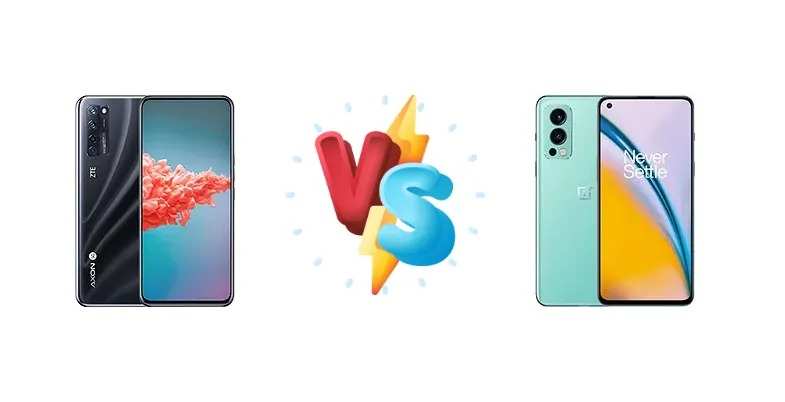
The OnePlus Nord 2 5G and ZTE Axon 20 4G represent different approaches to the mid-range smartphone market. The Nord 2, a successor to a popular line, aims for a balanced experience with 5G connectivity and fast charging. The Axon 20 4G, while older, offers a unique value proposition, particularly for those prioritizing affordability and potentially seeking a larger screen. This comparison dissects their key differences to determine which device best suits your needs.
🏆 Quick Verdict
For the average user, the OnePlus Nord 2 5G is the clear winner. Its Mediatek Dimensity 1200 chipset delivers significantly superior performance, coupled with 65W fast charging and a brighter display. While the ZTE Axon 20 4G offers a lower price point, its Unisoc T618 processor struggles to keep pace with modern demands.
| Network |
|---|
| 2G bands | GSM 850 / 900 / 1800 / 1900 | GSM 850 / 900 / 1800 / 1900 |
| 3G bands | HSDPA 850 / 900 / 1900 / 2100 | HSDPA 800 / 850 / 900 / 1700(AWS) / 1800 / 1900 / 2100 |
| 4G bands | LTE | 1, 2, 3, 4, 5, 7, 8, 12, 17, 18, 19, 20, 26, 28, 32, 34, 38, 39, 40, 41, 66 - EU |
| 5G bands | - | 1, 3, 7, 8, 20, 28, 38, 41, 66, 78 SA/NSA - EU |
| Speed | HSPA, LTE | HSPA 42.2/5.76 Mbps, LTE Cat18 1200/150 Mbps, 5G |
| Technology | GSM / HSPA / LTE | GSM / HSPA / LTE / 5G |
| Launch |
|---|
| Announced | 2020, November 17. Released 2020, December 04 | 2021, July 22 |
| Status | Discontinued | Available. Released 2021, July 28 |
| Body |
|---|
| Build | Glass front, glass back, aluminum frame | Glass front (Gorilla Glass 5), glass back (Gorilla Glass 5), plastic frame |
| Dimensions | 172.1 x 77.9 x 8 mm (6.78 x 3.07 x 0.31 in) | 159.1 x 73.3 x 8.3 mm (6.26 x 2.89 x 0.33 in) |
| SIM | Nano-SIM + Nano-SIM | Nano-SIM + Nano-SIM |
| Weight | 198 g (6.98 oz) | 189 g (6.67 oz) |
| Display |
|---|
| Protection | - | Corning Gorilla Glass 5 |
| Resolution | 1080 x 2460 pixels (~388 ppi density) | 1080 x 2400 pixels, 20:9 ratio (~409 ppi density) |
| Size | 6.92 inches, 113.7 cm2 (~84.8% screen-to-body ratio) | 6.43 inches, 99.8 cm2 (~85.6% screen-to-body ratio) |
| Type | OLED | Fluid AMOLED, 90Hz, HDR10+ |
| Platform |
|---|
| CPU | Octa-core (2x2.0 GHz Cortex-A75 & 6x2.0 GHz Cortex-A55) | Octa-core (1x3.0 GHz Cortex-A78 & 3x2.6 GHz Cortex-A78 & 4x2.0 GHz Cortex-A55) |
| Chipset | Unisoc UMS512T / Tiger T618 (12 nm) | Mediatek Dimensity 1200 (6 nm) |
| GPU | Mali G52 MP2 | Mali-G77 MC9 |
| OS | Android 10, MiFavor 10.5 | Android 11, upgradable to Android 13, OxygenOS 13 |
| Memory |
|---|
| Card slot | microSDXC | No |
| Internal | 128GB 6GB RAM | 128GB 6GB RAM, 128GB 8GB RAM, 256GB 8GB RAM, 256GB 12GB RAM |
| | eMMC 5.1 | - |
| Main Camera |
|---|
| Features | Dual-LED dual-tone flash, HDR, panorama | Dual-LED flash, HDR, panorama |
| Quad | 64 MP, f/1.8, 25mm (wide), 1/1.72", 0.8µm, PDAF
8 MP, f/2.2, 120˚, 16mm (ultrawide)
2 MP (macro)
Auxiliary lens | - |
| Triple | - | 50 MP, f/1.9, 24mm (wide), 1/1.56", 1.0µm, PDAF, OIS
8 MP, f/2.3, 120˚ (ultrawide)
Auxiliary lens |
| Video | 1080p@30fps, gyro-EIS, HDR | 4K@30fps, 1080p@30/60/120fps, gyro-EIS |
| Selfie camera |
|---|
| Features | HDR | Auto HDR |
| Single | 32 MP, f/2.0, (wide), under display | 32 MP, f/2.5, (wide), 1/2.8", 0.8µm |
| Video | 1080p@30fps | 1080p@30fps, gyro-EIS |
| Sound |
|---|
| 3.5mm jack | No | No |
| 35mm jack | No | No |
| Loudspeaker | Yes | Yes, with stereo speakers |
| | 24-bit/192kHz audio | - |
| Comms |
|---|
| Bluetooth | 5.1, A2DP, LE | 5.2, A2DP, LE, aptX HD |
| NFC | Yes | Yes |
| Positioning | GPS, GLONASS, GALILEO, BDS | GPS, GLONASS, GALILEO, BDS, SBAS, NavIC |
| Radio | Unspecified | No |
| USB | USB Type-C 3.1, OTG | USB Type-C 2.0, OTG |
| WLAN | Wi-Fi 802.11 a/b/g/n/ac, dual-band, Wi-Fi Direct | Wi-Fi 802.11 a/b/g/n/ac/6, dual-band, Wi-Fi Direct |
| Features |
|---|
| Sensors | Fingerprint (under display, optical), accelerometer, gyro, proximity, compass | Fingerprint (under display, optical), accelerometer, gyro, proximity, compass |
| Battery |
|---|
| Charging | - | 65W wired, PD, 100% in 30 min |
| Type | Li-Ion 4220 mAh | Li-Po 4500 mAh |
| Misc |
|---|
| Colors | Black | Gray Sierra, Blue Haze, Green Wood, Pac-Man Edition |
| Models | - | DN2101, DN2103 |
| Price | About 370 EUR | € 189.00 / $ 219.99 / £ 148.00 |
| Tests |
|---|
| Battery life | - |
Endurance rating 102h
|
| Camera | - |
Photo / Video |
| Display | - |
Contrast ratio: Infinite (nominal) |
| Loudspeaker | - |
-24.3 LUFS (Very good)
|
| Performance | - |
AnTuTu: 512164 (v8) | 598022 (v9)
GeekBench: 2792 (v5.1)
GFXBench: 38fps (ES 3.1 onscreen) |
ZTE Axon 20 4G
- Potentially lower price point
- May offer a larger display size (spec not confirmed)
- Acceptable battery endurance
- Significantly weaker processor performance
- Slower charging speeds (estimated)
- Limited 5G connectivity
OnePlus Nord 2 5G
- Superior processor performance (Dimensity 1200)
- 65W fast charging (0-100% in 30 minutes)
- Brighter display (633 nits)
- 5G connectivity
- Higher price point
- May not have expandable storage (spec not confirmed)
- Potential for software bloat (OnePlus history)
Display Comparison
The OnePlus Nord 2 5G boasts a brighter display, measured at 633 nits, compared to the ZTE Axon 20 4G (brightness data unavailable). This higher peak brightness translates to better visibility outdoors under direct sunlight. While both displays have an 'infinite' contrast ratio (nominal), the Nord 2’s superior brightness is a tangible advantage. The absence of refresh rate data for the Axon 20 4G suggests it likely operates at a standard 60Hz, while the Nord 2 is expected to offer a smoother 90Hz experience, enhancing scrolling and animations.
Camera Comparison
Both phones offer photo and video capabilities, but detailed camera specs are limited for the Axon 20 4G. The Nord 2 5G likely benefits from Mediatek’s Imagiq image signal processor, offering advanced features like HDR and noise reduction. Without sensor size or aperture information for the Axon 20 4G, it’s difficult to assess its low-light performance. The Nord 2’s image processing is expected to be more refined, resulting in better dynamic range and detail. The presence of OIS (Optical Image Stabilization) on the Nord 2 is also a likely advantage, reducing blur in photos and videos.
Performance
The performance gap between these two devices is substantial. The OnePlus Nord 2 5G’s Mediatek Dimensity 1200 (6nm) features a powerful octa-core CPU configuration – 1x3.0 GHz Cortex-A78, 3x2.6 GHz Cortex-A78, and 4x2.0 GHz Cortex-A55 – designed for demanding tasks. In contrast, the ZTE Axon 20 4G utilizes the Unisoc UMS512T/Tiger T618 (12nm) with a less potent octa-core setup: 2x2.0 GHz Cortex-A75 & 6x2.0 GHz Cortex-A55. The Dimensity 1200’s 6nm process node provides superior power efficiency and thermal management, minimizing throttling during prolonged gaming sessions. The Nord 2 will deliver a significantly smoother and more responsive user experience.
Battery Life
Both devices share an endurance rating of 102 hours, suggesting comparable battery life under similar usage scenarios. However, the OnePlus Nord 2 5G’s 65W wired charging capability is a game-changer, achieving a full charge in just 30 minutes. The Axon 20 4G’s charging speed is not specified, but is expected to be considerably slower. While the battery capacity isn’t specified for either device, the Nord 2’s faster charging mitigates any potential disadvantage from a slightly smaller battery.
Buying Guide
Buy the ZTE Axon 20 4G if you are on an extremely tight budget and primarily need a phone for basic tasks like calls, texts, and light social media use. Buy the OnePlus Nord 2 5G if you prioritize performance for gaming and multitasking, demand fast charging, and want future-proof 5G connectivity. The Nord 2 is the better choice for users who value a smooth and responsive experience.
Frequently Asked Questions
❓ Is the Unisoc T618 in the ZTE Axon 20 4G sufficient for playing demanding games like PUBG Mobile?
The Unisoc T618 is likely to struggle with PUBG Mobile at higher settings. While playable at low settings, users should expect frame drops and lag, especially during intense firefights. The Dimensity 1200 in the Nord 2 5G offers a far smoother gaming experience.
❓ Does the OnePlus Nord 2 5G experience overheating issues during prolonged gaming sessions?
The Mediatek Dimensity 1200’s 6nm process node and OnePlus’s thermal management solutions generally prevent significant overheating. While the phone will get warm during extended gaming, it’s unlikely to experience severe throttling that drastically impacts performance.
❓ What type of charging protocol does the ZTE Axon 20 4G support?
The charging protocol for the ZTE Axon 20 4G is not explicitly stated in the provided data. However, given its age and price point, it likely supports standard USB-PD charging, but at a significantly slower wattage than the Nord 2 5G’s 65W SuperVOOC.
❓ Is the lack of 5G on the ZTE Axon 20 4G a significant drawback in 2024?
For users in areas with widespread 5G coverage, the lack of 5G on the Axon 20 4G is a considerable limitation. 5G offers significantly faster download and upload speeds, enhancing streaming, gaming, and overall internet experience. The Nord 2 5G provides future-proofing with its 5G capabilities.