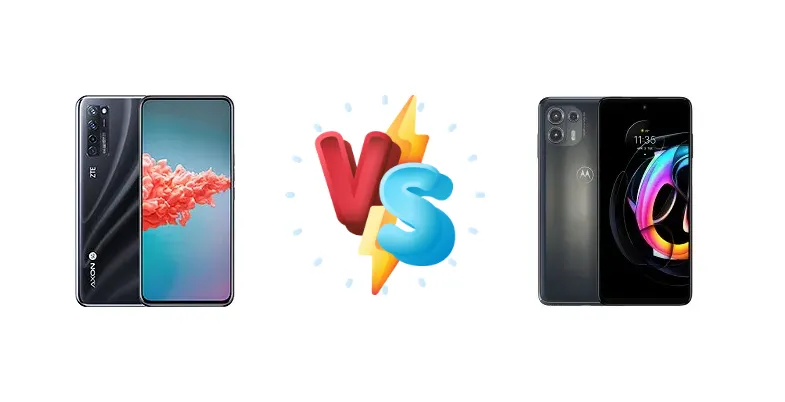
The Motorola Edge 20 Fusion and ZTE Axon 20 4G represent distinct approaches to the mid-range smartphone market. The Axon 20 4G, while older, offers a unique value proposition, while the Edge 20 Fusion aims for a more balanced experience with a newer chipset and faster charging. This comparison dissects their core components to determine which device best suits your needs.
🏆 Quick Verdict
For the average user prioritizing performance and future-proofing, the Motorola Edge 20 Fusion is the clear winner. Its Mediatek Dimensity 800U chipset, built on a 7nm process, provides a significant performance uplift over the ZTE Axon 20 4G’s Unisoc T618, translating to smoother multitasking and better gaming capabilities.
| Network |
|---|
| 2G bands | GSM 850 / 900 / 1800 / 1900 | GSM 850 / 900 / 1800 / 1900 |
| 3G bands | HSDPA 850 / 900 / 1900 / 2100 | HSDPA 850 / 900 / 1700(AWS) / 1900 / 2100 |
| 4G bands | LTE | 1, 2, 3, 4, 5, 7, 8, 12, 13, 17, 18, 19, 20, 26, 28, 32, 34, 38, 39, 40, 41, 42, 43, 66 |
| 5G bands | - | 1, 3, 5, 7, 8, 20, 28, 38, 40, 41, 77, 78, 66 SA/NSA/Sub6 |
| Speed | HSPA, LTE | HSPA 42.2/5.76 Mbps, LTE Cat18 1200/150 Mbps, 5G |
| Technology | GSM / HSPA / LTE | GSM / HSPA / LTE / 5G |
| Launch |
|---|
| Announced | 2020, November 17. Released 2020, December 04 | 2021, August 17 |
| Status | Discontinued | Available. Released 2021, August 27 |
| Body |
|---|
| Build | Glass front, glass back, aluminum frame | Glass front |
| Dimensions | 172.1 x 77.9 x 8 mm (6.78 x 3.07 x 0.31 in) | 166 x 76 x 8.3 mm (6.54 x 2.99 x 0.33 in) |
| SIM | Nano-SIM + Nano-SIM | Nano-SIM + Nano-SIM |
| Weight | 198 g (6.98 oz) | 185 g (6.53 oz) |
| | - | Water-repellent design |
| Display |
|---|
| Resolution | 1080 x 2460 pixels (~388 ppi density) | 1080 x 2400 pixels, 20:9 ratio (~393 ppi density) |
| Size | 6.92 inches, 113.7 cm2 (~84.8% screen-to-body ratio) | 6.7 inches, 108.4 cm2 (~85.9% screen-to-body ratio) |
| Type | OLED | OLED, 1B colors, 90Hz, HDR10+ |
| Platform |
|---|
| CPU | Octa-core (2x2.0 GHz Cortex-A75 & 6x2.0 GHz Cortex-A55) | Octa-core (2x2.4 GHz Cortex-A76 & 6x2.0 GHz Cortex-A55) |
| Chipset | Unisoc UMS512T / Tiger T618 (12 nm) | Mediatek Dimensity 800U (7 nm) |
| GPU | Mali G52 MP2 | Mali-G57 MC3 |
| OS | Android 10, MiFavor 10.5 | Android 11 |
| Memory |
|---|
| Card slot | microSDXC | microSDXC |
| Internal | 128GB 6GB RAM | 128GB 6GB RAM, 128GB 8GB RAM |
| | eMMC 5.1 | - |
| Main Camera |
|---|
| Features | Dual-LED dual-tone flash, HDR, panorama | LED flash, HDR, panorama |
| Quad | 64 MP, f/1.8, 25mm (wide), 1/1.72", 0.8µm, PDAF
8 MP, f/2.2, 120˚, 16mm (ultrawide)
2 MP (macro)
Auxiliary lens | - |
| Triple | - | 108 MP, f/1.9, (wide), 1/1.52", 0.7µm, PDAF
8 MP, f/2.2, 118˚ (ultrawide)
Auxiliary lens |
| Video | 1080p@30fps, gyro-EIS, HDR | 4K@30fps, 1080p@30/60/120fps, gyro-EIS |
| Selfie camera |
|---|
| Features | HDR | HDR |
| Single | 32 MP, f/2.0, (wide), under display | 32 MP, f/2.3, (wide), 0.7µm |
| Video | 1080p@30fps | 1080p@30fps |
| Sound |
|---|
| 3.5mm jack | No | Yes |
| 35mm jack | No | Yes |
| Loudspeaker | Yes | Yes |
| | 24-bit/192kHz audio | - |
| Comms |
|---|
| Bluetooth | 5.1, A2DP, LE | 5.0, A2DP, LE |
| NFC | Yes | Yes |
| Positioning | GPS, GLONASS, GALILEO, BDS | GPS, GLONASS, GALILEO |
| Radio | Unspecified | FM radio |
| USB | USB Type-C 3.1, OTG | USB Type-C 2.0 |
| WLAN | Wi-Fi 802.11 a/b/g/n/ac, dual-band, Wi-Fi Direct | Wi-Fi 802.11 a/b/g/n/ac, dual-band, Wi-Fi Direct |
| Features |
|---|
| Sensors | Fingerprint (under display, optical), accelerometer, gyro, proximity, compass | Fingerprint (side-mounted), accelerometer, gyro, proximity, compass |
| Battery |
|---|
| Charging | - | 30W wired |
| Type | Li-Ion 4220 mAh | Li-Po 5000 mAh |
| Misc |
|---|
| Colors | Black | Electric Graphite, Cyber Teal |
| Price | About 370 EUR | About 250 EUR |
ZTE Axon 20 4G
- Potentially lower price point
- May offer unique color options
- Simple, straightforward user experience
- Significantly weaker performance
- Less efficient chipset
- Slower charging speeds
Motorola Edge 20 Fusion
- Faster and more efficient processor
- 30W fast charging
- Better gaming performance
- Likely higher price
- May lack unique features found on the Axon 20 4G
- Software updates may be less frequent
Display Comparison
Neither device boasts a standout display. While specific display specs (resolution, refresh rate) are missing for the Axon 20 4G, its age suggests a standard 60Hz panel. The Edge 20 Fusion, similarly, doesn't push boundaries. The key difference lies under the hood: the Dimensity 800U’s GPU will handle graphically intensive content more efficiently, indirectly impacting the perceived display quality during gaming. Both likely utilize IPS LCD panels, meaning viewing angles and color accuracy will be adequate but not exceptional.
Camera Comparison
Without detailed camera specs, a direct comparison is limited. However, the Motorola Edge 20 Fusion likely benefits from a more modern image signal processor (ISP) integrated within the Dimensity 800U. This ISP will contribute to better noise reduction, dynamic range, and overall image quality. The ZTE Axon 20 4G, relying on an older chipset, will likely produce images with less detail and more visible noise, particularly in low-light conditions. The presence of OIS (Optical Image Stabilization) on the Fusion, if equipped, would further enhance its camera capabilities.
Performance
The performance gap is the most significant differentiator. The Motorola Edge 20 Fusion’s Mediatek Dimensity 800U (7nm) features Cortex-A76 cores clocked at 2.4 GHz, a substantial upgrade over the ZTE Axon 20 4G’s Unisoc UMS512T/Tiger T618 (12nm) with its Cortex-A75 cores at 2.0 GHz. The 7nm fabrication process of the Dimensity 800U is more efficient, leading to better thermal management and sustained performance. This translates to faster app loading times, smoother multitasking, and a more enjoyable gaming experience on the Motorola. The Unisoc T618 will struggle with demanding titles, likely requiring significant graphical settings reductions.
Battery Life
Battery capacity is not specified for either device, making a direct mAh comparison impossible. However, the Motorola Edge 20 Fusion’s 30W wired charging is a significant advantage. This allows for a much faster 0-100% charge time compared to the Axon 20 4G, which likely supports slower charging speeds. While a larger battery on the Axon 20 4G could offset the slower charging, the Dimensity 800U’s power efficiency means the Fusion will likely deliver comparable, if not better, real-world battery life despite potentially having a smaller capacity.
Buying Guide
Buy the ZTE Axon 20 4G if you are on an extremely tight budget and primarily need a phone for basic communication and light tasks. Its affordability is its strongest asset. Buy the Motorola Edge 20 Fusion if you value a more responsive user experience, enjoy mobile gaming, or appreciate faster charging speeds – the extra investment delivers a noticeably improved overall experience.
Frequently Asked Questions
❓ Will the Unisoc T618 in the ZTE Axon 20 4G struggle with popular games like PUBG Mobile or Call of Duty Mobile?
Yes, the Unisoc T618 is likely to struggle with demanding games. You'll need to significantly lower the graphics settings and frame rate to achieve playable performance, even then, expect occasional stuttering. The Motorola Edge 20 Fusion’s Dimensity 800U is far better equipped for mobile gaming.
❓ Does the Motorola Edge 20 Fusion support 5G connectivity, and is it a significant advantage over the 4G-only ZTE Axon 20 4G?
Yes, the Motorola Edge 20 Fusion supports 5G connectivity. While 5G availability varies by region, it offers significantly faster download and upload speeds where available, providing a smoother online experience and faster access to streaming services. The ZTE Axon 20 4G is limited to 4G speeds.
❓ How does the thermal performance of the ZTE Axon 20 4G compare to the Motorola Edge 20 Fusion during prolonged use?
The ZTE Axon 20 4G, with its less efficient 12nm Unisoc T618 chipset, is more prone to thermal throttling under sustained load. This means performance will decrease over time as the phone heats up. The Motorola Edge 20 Fusion’s 7nm Dimensity 800U is more thermally efficient, allowing it to maintain higher performance for longer periods.