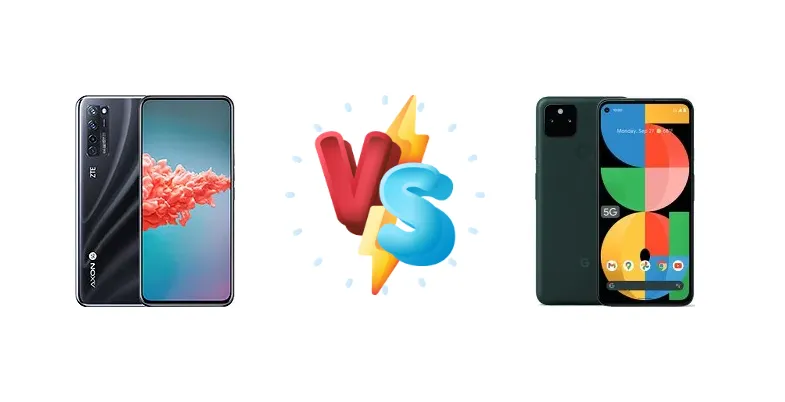
The Google Pixel 5a 5G and ZTE Axon 20 4G represent different approaches to the mid-range smartphone market. The Pixel 5a focuses on a refined software experience and strong camera capabilities, while the Axon 20 4G aims to deliver a larger feature set at a potentially lower price point. This comparison dissects their core components to determine which device offers the best value for your money.
🏆 Quick Verdict
For the average user prioritizing a smooth, reliable experience and excellent camera performance, the Google Pixel 5a 5G is the clear winner. Its Snapdragon 765G chipset and optimized software provide a noticeable performance advantage over the ZTE Axon 20 4G’s Unisoc UMS512T, despite both phones sharing an identical endurance rating.
| Network |
|---|
| 2G bands | GSM 850 / 900 / 1800 / 1900 | GSM 850 / 900 / 1800 / 1900 |
| 3G bands | HSDPA 850 / 900 / 1900 / 2100 | HSDPA 850 / 900 / 1700(AWS) / 1900 / 2100 |
| 4G bands | LTE | 1, 2, 3, 4, 5, 7, 8, 12, 13, 14, 17, 18, 19, 20, 25, 26, 28, 29, 30, 32, 38, 39, 40, 41, 42, 46, 48, 66, 71 |
| 5G bands | - | 1, 2, 5, 12, 25, 28, 41, 66, 71, 77, 78 SA/NSA/Sub6 |
| Speed | HSPA, LTE | HSPA, LTE, 5G |
| Technology | GSM / HSPA / LTE | GSM / HSPA / EVDO / LTE / 5G |
| | - | CDMA2000 1xEV-DO |
| Launch |
|---|
| Announced | 2020, November 17. Released 2020, December 04 | 2021, August 17 |
| Status | Discontinued | Available. Released 2021, August 26 |
| Body |
|---|
| Build | Glass front, glass back, aluminum frame | Glass front (Gorilla Glass 3), aluminum frame, aluminum back |
| Dimensions | 172.1 x 77.9 x 8 mm (6.78 x 3.07 x 0.31 in) | 156.2 x 73.2 x 8.8 mm (6.15 x 2.88 x 0.35 in) |
| SIM | Nano-SIM + Nano-SIM | Nano-SIM + eSIM |
| Weight | 198 g (6.98 oz) | 183 g (6.46 oz) |
| | - | IP67 dust/water resistant (up to 1m for 30 min) |
| Display |
|---|
| Protection | - | Corning Gorilla Glass 3 |
| Resolution | 1080 x 2460 pixels (~388 ppi density) | 1080 x 2400 pixels, 20:9 ratio (~415 ppi density) |
| Size | 6.92 inches, 113.7 cm2 (~84.8% screen-to-body ratio) | 6.34 inches, 97.0 cm2 (~84.9% screen-to-body ratio) |
| Type | OLED | OLED, HDR |
| | - | Always-on display |
| Platform |
|---|
| CPU | Octa-core (2x2.0 GHz Cortex-A75 & 6x2.0 GHz Cortex-A55) | Octa-core (1x2.4 GHz Kryo 475 Prime & 1x2.2 GHz Kryo 475 Gold & 6x1.8 GHz Kryo 475 Silver) |
| Chipset | Unisoc UMS512T / Tiger T618 (12 nm) | Qualcomm SM7250 Snapdragon 765G 5G (7 nm) |
| GPU | Mali G52 MP2 | Adreno 620 |
| OS | Android 10, MiFavor 10.5 | Android 11, upgradable to Android 14 |
| Memory |
|---|
| Card slot | microSDXC | No |
| Internal | 128GB 6GB RAM | 128GB 6GB RAM |
| | eMMC 5.1 | - |
| Main Camera |
|---|
| Dual | - | 12.2 MP, f/1.7, 27mm, (wide), 1/2.55", 1.4µm, dual pixel PDAF, OIS
16 MP, f/2.2, 119˚ (ultrawide), 1.0µm |
| Features | Dual-LED dual-tone flash, HDR, panorama | LED flash, Pixel Shift, Auto-HDR, panorama |
| Quad | 64 MP, f/1.8, 25mm (wide), 1/1.72", 0.8µm, PDAF
8 MP, f/2.2, 120˚, 16mm (ultrawide)
2 MP (macro)
Auxiliary lens | - |
| Single | - | 8 MP, f/2.0, 24mm (wide), 1.12µm |
| Video | 1080p@30fps, gyro-EIS, HDR | 4K@30/60fps, 1080p@30/60/120/240fps; gyro-EIS |
| Selfie camera |
|---|
| Features | HDR | HDR |
| Single | 32 MP, f/2.0, (wide), under display | 8 MP, f/2.0, 24mm (wide), 1.12µm |
| Video | 1080p@30fps | 1080p@30fps |
| Sound |
|---|
| 3.5mm jack | No | Yes |
| 35mm jack | No | Yes |
| Loudspeaker | Yes | Yes, with stereo speakers |
| | 24-bit/192kHz audio | - |
| Comms |
|---|
| Bluetooth | 5.1, A2DP, LE | 5.0, A2DP, LE, aptX HD |
| NFC | Yes | Yes |
| Positioning | GPS, GLONASS, GALILEO, BDS | GPS, GLONASS, GALILEO, QZSS, BDS |
| Radio | Unspecified | No |
| USB | USB Type-C 3.1, OTG | USB Type-C 3.1 |
| WLAN | Wi-Fi 802.11 a/b/g/n/ac, dual-band, Wi-Fi Direct | Wi-Fi 802.11 a/b/g/n/ac, dual-band, Wi-Fi Direct |
| Features |
|---|
| Sensors | Fingerprint (under display, optical), accelerometer, gyro, proximity, compass | Fingerprint (rear-mounted), accelerometer, gyro, proximity, compass, barometer |
| Battery |
|---|
| Charging | - | 18W wired, PD2.0 |
| Type | Li-Ion 4220 mAh | Li-Po 4680 mAh |
| Misc |
|---|
| Colors | Black | Mostly Black |
| Models | - | G1F8F, G4S1M |
| Price | About 370 EUR | $ 189.00 / C$ 249.99 |
| Tests |
|---|
| Battery life | - |
Endurance rating 122h
|
| Display | - |
Contrast ratio: Infinite (nominal) |
| Performance | - |
AnTuTu: 291303 (v8)
GeekBench: 1337 (v5.1)
GFXBench: 19fps (ES 3.1 onscreen) |
ZTE Axon 20 4G
- Potentially lower price point
- Larger feature set (speculation based on brand positioning)
- Similar battery endurance to Pixel 5a
- Less powerful Unisoc chipset
- Less refined software experience
- Limited camera information suggests lower quality
Google Pixel 5a 5G
- Superior Snapdragon 765G performance
- Excellent camera quality with Google’s software
- Faster 18W PD2.0 charging
- Higher price compared to Axon 20 4G
- May lack expandable storage
- Design is less adventurous
Display Comparison
The Google Pixel 5a 5G boasts a significantly brighter display, reaching a measured peak brightness of 861 nits, compared to the Axon 20 4G’s unspecified brightness. This difference translates to better visibility in direct sunlight. While both displays have an infinite (nominal) contrast ratio, the Pixel 5a’s superior brightness makes it the more practical choice for outdoor use. The Axon 20 4G’s display specifications are less detailed, leaving questions about color accuracy and panel technology unanswered.
Camera Comparison
While detailed camera specs are limited for the Axon 20 4G, the Pixel 5a 5G benefits from Google’s renowned computational photography. The Pixel 5a’s image processing excels in dynamic range and low-light performance. The absence of detailed camera information for the Axon 20 4G suggests a less sophisticated camera system, likely relying more on hardware than software optimization. The Pixel 5a’s focus on software processing will deliver more consistent and pleasing results for the average user.
Performance
The core difference lies in the chipsets: the Pixel 5a 5G utilizes the Qualcomm SM7250 Snapdragon 765G (7nm), while the Axon 20 4G relies on the Unisoc UMS512T / Tiger T618 (12nm). The Snapdragon 765G, built on a smaller 7nm process, offers superior power efficiency and performance. Its CPU configuration – a 1x2.4 GHz Kryo 475 Prime core, 1x2.2 GHz Kryo 475 Gold core, and 6x1.8 GHz Kryo 475 Silver cores – is architecturally more advanced than the Axon 20 4G’s 2x2.0 GHz Cortex-A75 and 6x2.0 GHz Cortex-A55 setup. This translates to faster app loading times and smoother multitasking on the Pixel 5a 5G.
Battery Life
Both the ZTE Axon 20 4G and Google Pixel 5a 5G achieve an endurance rating of 122 hours, indicating similar overall battery life. However, the Pixel 5a 5G supports 18W wired charging with PD2.0, offering faster and more efficient charging compared to the Axon 20 4G’s unspecified charging capabilities. While both phones offer comparable longevity, the Pixel 5a’s faster charging provides a more convenient user experience.
Buying Guide
Buy the ZTE Axon 20 4G if you prioritize a potentially lower upfront cost and are comfortable with a less polished software experience. Buy the Google Pixel 5a 5G if you value a consistently smooth user interface, superior camera quality, and guaranteed software updates, even if it means paying a premium.
Frequently Asked Questions
❓ Is the Unisoc UMS512T in the Axon 20 4G capable of handling demanding games like PUBG?
While the Unisoc UMS512T can run PUBG, expect lower frame rates and potentially more stuttering compared to the Snapdragon 765G in the Pixel 5a 5G. The Snapdragon’s superior GPU and thermal management provide a smoother gaming experience, especially during extended sessions.
❓ Does the Pixel 5a 5G receive guaranteed software updates and security patches?
Yes, the Google Pixel 5a 5G is guaranteed to receive at least 3 years of Android OS updates and 5 years of security patches directly from Google. This is a significant advantage over the ZTE Axon 20 4G, which typically receives less frequent and shorter-term software support.
❓ How does the charging speed of the Pixel 5a 5G compare to other phones in its price range?
The Pixel 5a 5G’s 18W charging with PD2.0 is fairly standard for its price range, but not exceptionally fast. It will fully charge the phone in approximately 1.5-2 hours. The Axon 20 4G’s charging speed is unknown, but likely slower given the lack of PD2.0 support.