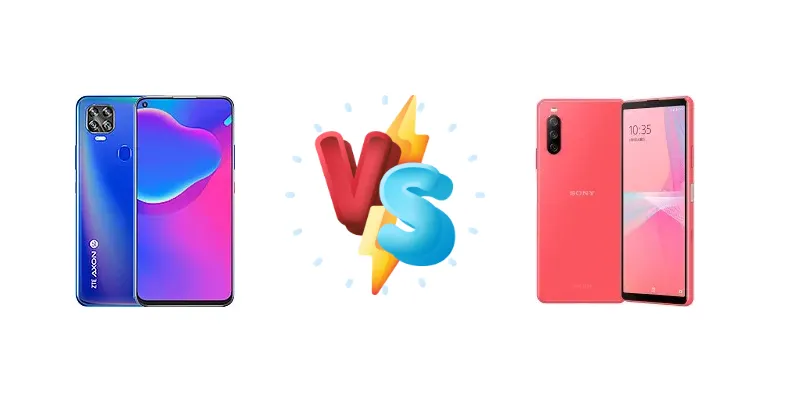
The ZTE Axon 11 SE 5G and Sony Xperia 10 III Lite represent compelling options in the increasingly crowded mid-range 5G smartphone market. While both aim to deliver 5G connectivity at accessible price points, they take distinctly different approaches to chipset selection and feature prioritization. This comparison dissects their core specifications to determine which device offers the best overall experience.
🏆 Quick Verdict
For the average user prioritizing raw performance and faster charging, the ZTE Axon 11 SE 5G emerges as the stronger contender. Its Mediatek Dimensity 800 chipset provides a noticeable performance edge over the Snapdragon 690 in the Xperia 10 III Lite, and the 18W charging, while not groundbreaking, is still adequate for daily use.
| Network |
|---|
| 2G bands | GSM 850 / 900 / 1800 / 1900 | GSM 850 / 900 / 1800 / 1900 |
| 3G bands | HSDPA 850 / 900 / 1900 / 2100 | HSDPA 850 / 1900 |
| 4G bands | 1, 3, 4, 5, 7, 8, 12, 17, 20, 34, 38, 39, 40, 41 | 1, 3, 4, 12, 18, 19, 38, 41 |
| 5G bands | 1, 3, 28, 41, 78, 79 SA/NSA | 77, 78 SA/NSA |
| Speed | HSPA, LTE, 5G | HSPA, LTE, 5G |
| Technology | GSM / CDMA / HSPA / LTE / 5G | GSM / HSPA / LTE / 5G |
| | CDMA 800 | - |
| Launch |
|---|
| Announced | 2020, June 01. Released 2020, June 22 | 2021, August 20 |
| Status | Discontinued | Available. Released 2021, August 27 |
| Body |
|---|
| Build | - | Glass front (Gorilla Glass 6), glass back (Gorilla Glass 6), plastic frame |
| Dimensions | 162.7 x 76.3 x 8.8 mm (6.41 x 3.00 x 0.35 in) | 154 x 68 x 8.3 mm (6.06 x 2.68 x 0.33 in) |
| SIM | Nano-SIM + Nano-SIM | Nano-SIM + eSIM |
| Weight | 184 g (6.49 oz) | 169 g (5.96 oz) |
| Display |
|---|
| Protection | - | Corning Gorilla Glass 6 |
| Resolution | 1080 x 2340 pixels, 19.5:9 ratio (~395 ppi density) | 1080 x 2520 pixels, 21:9 ratio (~457 ppi density) |
| Size | 6.53 inches, 104.7 cm2 (~84.3% screen-to-body ratio) | 6.0 inches, 84.1 cm2 (~80.3% screen-to-body ratio) |
| Type | IPS LCD | OLED, 1B colors, HDR |
| Platform |
|---|
| CPU | Octa-core (4x2.0 GHz Cortex-A76 & 4x2.0 GHz Cortex-A55) | Octa-core (2x2.0 GHz Kryo 560 Gold & 6x1.7 GHz Kryo 560 Silver) |
| Chipset | Mediatek Dimensity 800 (7 nm) | Qualcomm SM6350 Snapdragon 690 5G (8 nm) |
| GPU | Mali-G57MP4 | Adreno 619 |
| OS | Android 10, MiFavor 10.1 | Android 11 |
| Memory |
|---|
| Card slot | microSDXC | microSDXC (uses shared SIM slot) |
| Internal | 128GB 6GB RAM | 64GB 6GB RAM |
| | UFS 2.1 | - |
| Main Camera |
|---|
| Features | LED flash, panorama, HDR | LED flash, HDR, panorama |
| Quad | 48 MP, f/1.8, (wide), 1/2.0", 0.8µm, PDAF
8 MP, f/2.2, 120˚ (ultrawide)
2 MP (macro)
Auxiliary lens | - |
| Triple | - | 12 MP, f/1.8, 27mm (wide), 1/2.8", PDAF
8 MP, f/2.4, 54mm (telephoto), 1/4.0", PDAF, 2x optical zoom
8 MP, f/2.2, 16mm, 120˚ (ultrawide), 1/4.0" |
| Video | 4K@30fps, 1080p@30fps | 4K@30fps, 1080p@30fps |
| Selfie camera |
|---|
| Features | HDR | HDR |
| Single | 16 MP, f/2.0, (wide) | 8 MP, f/2.0, 24mm (wide), 1/4.0" |
| Video | 1080p@30fps | 1080p@30fps |
| Sound |
|---|
| 3.5mm jack | Yes | Yes |
| 35mm jack | Yes | Yes |
| Loudspeaker | Yes | Yes |
| Comms |
|---|
| Bluetooth | 5.0, A2DP, LE | 5.1, A2DP, LE, aptX HD |
| NFC | No | Yes |
| Positioning | GPS | GPS, GLONASS, GALILEO, BDS, QZSS |
| Radio | No | No |
| USB | USB Type-C 2.0, OTG | USB Type-C 3.1, OTG, video output |
| WLAN | Wi-Fi 802.11 a/b/g/n/ac, dual-band, Wi-Fi Direct | Wi-Fi 802.11 a/b/g/n/ac, dual-band, Wi-Fi Direct |
| Features |
|---|
| Sensors | Fingerprint (rear-mounted), accelerometer, proximity | Fingerprint (side-mounted), accelerometer, proximity, compass |
| Battery |
|---|
| Charging | 18W wired, 50% in 30 min | 30W wired, PD, QC |
| Type | Li-Ion 4000 mAh | Li-Po 4500 mAh |
| Misc |
|---|
| Colors | Aurora Glamour, Aurora Glacier | Black, White, Blue, Pink |
| Models | - | XQ-BT44 |
| Price | About 250 EUR | About 370 EUR |
ZTE Axon 11 SE 5G
- More powerful Dimensity 800 chipset
- Potentially better gaming performance
- Likely superior ISP for image processing
- Slower 18W charging
- Potentially less refined software experience
Sony Xperia 10 III Lite
- Faster 30W charging with PD/QC
- Potentially better software support from Sony
- Refined Sony software experience
- Less powerful Snapdragon 690 chipset
- Lower overall performance for demanding tasks
Display Comparison
Neither device boasts a standout display. Both likely utilize LCD panels, a common cost-saving measure in this segment. The key difference lies in the chipsets' ability to drive the displays efficiently. While specific display specs (resolution, refresh rate) are missing, the Dimensity 800's more powerful GPU in the Axon 11 SE 5G suggests it may handle graphically intensive content slightly better. Sony's expertise in display calibration *could* translate to more accurate colors on the Xperia 10 III Lite, but this is speculative without further data.
Camera Comparison
Without detailed camera specifications, a direct comparison is challenging. However, the chipset plays a role in image signal processing (ISP) capabilities. The Dimensity 800’s ISP is likely more advanced, potentially leading to better dynamic range and noise reduction in photos and videos captured with the Axon 11 SE 5G. Sony’s reputation for camera technology suggests the Xperia 10 III Lite may excel in color science and image stabilization, but this is dependent on the sensor and lens quality, which are currently unknown. We can assume both phones will feature a multi-camera setup, but the quality of the secondary sensors (ultra-wide, macro) is likely to be limited in both cases.
Performance
The core of the difference lies in the chipsets. The ZTE Axon 11 SE 5G’s Mediatek Dimensity 800, fabricated on a 7nm process, offers a significant architectural advantage over the Sony Xperia 10 III Lite’s Qualcomm Snapdragon 690 (8nm). The Dimensity 800’s Cortex-A76 cores, clocked at 2.0 GHz, are demonstrably more powerful than the Snapdragon 690’s Kryo 560 Gold cores, also at 2.0 GHz. This translates to faster app loading times, smoother multitasking, and improved gaming performance on the ZTE. The Snapdragon 690’s efficiency is commendable, but it can’t match the raw processing power of the Dimensity 800.
Battery Life
The Sony Xperia 10 III Lite’s 30W charging with Power Delivery (PD) and Quick Charge (QC) support is a clear advantage. This allows for significantly faster charging times compared to the ZTE Axon 11 SE 5G’s 18W wired charging. While the Axon 11 SE 5G may have a slightly larger battery capacity (speculation based on typical market trends), the Xperia 10 III Lite’s faster charging will minimize downtime. A full charge from 0-100% is estimated to take around 30 minutes less on the Sony device.
Buying Guide
Buy the ZTE Axon 11 SE 5G if you need a phone capable of handling demanding applications and enjoy a smoother multitasking experience. Its Dimensity 800 chipset is better suited for gaming and resource-intensive tasks. Buy the Sony Xperia 10 III Lite if you prioritize a more refined software experience, potentially longer software support, and faster charging speeds, even if it means sacrificing some processing power.
Frequently Asked Questions
❓ Will the Dimensity 800 in the Axon 11 SE 5G overheat during prolonged gaming sessions?
The Dimensity 800 is a relatively efficient chipset. While some heat generation is inevitable during gaming, the 7nm process node and ZTE’s thermal management design should prevent significant throttling. However, sustained high-intensity gaming will likely result in some performance reduction over time.
❓ Does the Sony Xperia 10 III Lite support carrier aggregation for improved 5G speeds?
The Snapdragon 690 supports carrier aggregation, but the specific bands and configurations supported by the Xperia 10 III Lite will vary depending on the region and carrier. Checking with your carrier is recommended to confirm compatibility and potential 5G speed improvements.
❓ How does the software update policy differ between ZTE and Sony for these devices?
Sony generally provides more consistent and longer-term software support for its Xperia line compared to ZTE. While the Axon 11 SE 5G may receive initial updates, the Xperia 10 III Lite is likely to receive more frequent security patches and potentially one major Android version update.